Your lungs are not the only reason a hard climb, fast run or busy game of five-a-side leaves you breathless. Your heart, blood vessels, muscles and pacing all play a part. The good news is that you can increase VO2max safely without training for hours every day. The catch is that more effort is not always better. The right dose, repeated consistently, beats the occasional all-out session that leaves you exhausted for a week.
VO₂max is one of the clearest measures of aerobic fitness. It describes the maximum amount of oxygen your body can use during intense exercise. A higher number generally means you can sustain more work before fatigue takes over, whether that means chasing children around the park, running a faster 10K, recovering between golf shots or simply getting through the stairs without stopping.
What improving VO₂max really requires
VO₂max improves when you give the cardiovascular system a reason to adapt. That means regularly spending time at an intensity that challenges your heart and breathing, then allowing enough recovery for your body to respond.
For most busy adults, the best plan has three moving parts: steady aerobic work to build capacity, controlled intervals to raise the ceiling, and strength training to make every stride, pedal stroke or movement more efficient. Skipping one does not make progress impossible, but combining them is often more sustainable.
Your starting point matters. Someone returning after years away from exercise can see meaningful improvements from brisk walking and two coached sessions a week. A regular runner may need more structured threshold and high-intensity work. If you have persistent pain, a long-term health condition, are taking medication that affects heart rate, or experience chest pain, dizziness or unusual breathlessness, speak to your GP or qualified clinician before beginning hard intervals.
Start below your maximum, not at it
The fastest way to stall progress is to make every session a test. If you finish every workout flattened, your next session suffers, your technique slips and small aches become reasons to stop altogether.
Begin with two or three aerobic sessions per week at a pace where you can speak in short sentences but would not want to hold a long conversation. This may be a brisk walk uphill, cycling, rowing, swimming or using a cross trainer. Keep it low impact if your knees, back or ankles are not happy with running. The fitness benefit comes from your effort and consistency, not from forcing one particular exercise.
Aim for 20 to 40 minutes depending on your current fitness. For a busy professional or parent, two focused 25-minute sessions are far more useful than a perfect plan that never makes it into the diary. Add duration gradually, usually by no more than a small amount each week, and keep at least one genuinely easier day between demanding sessions.
Use the talk test and perceived effort
Heart-rate monitors can be useful, but they are not compulsory. A simple effort scale keeps training practical. On a scale of one to ten, easy aerobic work sits around four to six. You are working, but in control. Intervals may reach seven to nine, where breathing is hard and conversation is limited to a few words.
If your normal easy pace suddenly feels difficult, treat that as feedback rather than a challenge to push through. Poor sleep, stress, dehydration, illness and a demanding week at work can all raise the strain of a session. Adjusting the plan is intelligent training, not lost progress.
Increase VO2max safely with intervals
Intervals are short periods of harder work separated by planned recovery. They are effective because they let you accumulate time near a challenging intensity without having to sustain it continuously. They can also be remarkably time-efficient when done properly.
A sensible starting session could be a five to ten-minute warm-up, followed by four rounds of one minute hard and two minutes easy, then a gentle cool-down. The hard minute should feel purposeful, not reckless. You should be able to repeat the quality across all rounds rather than fading dramatically after the first.
After two or three weeks, provided recovery is good, you might progress to five or six rounds, or extend the hard effort to two minutes. More advanced exercisers can use longer intervals, such as four rounds of three to four minutes at a very demanding but controlled pace, with equal or slightly longer recovery. One hard interval session per week is enough for many people at first. Two may work for experienced trainees, but only when the rest of their programme supports it.
Choose a method that allows good technique. A bike, rower or incline walk can be kinder to joints than sprinting. If you are new to exercise, avoid maximal sprints, especially on tired legs. They carry a higher risk of calf, hamstring and Achilles problems and are rarely necessary for early progress.
Strength makes your engine more useful
A stronger body uses movement more efficiently. Building strength in the glutes, legs, trunk and upper body can improve posture, reduce energy leaks and help you tolerate aerobic training with less discomfort. It also matters if your goal is practical stamina rather than a laboratory score: carrying shopping, playing sport, walking farther on holiday or finishing a long day with energy left.
Two full-body strength sessions a week are a strong foundation. Focus on controlled squats or sit-to-stands, hinges, pushes, pulls, loaded carries and trunk stability, adapted to your ability. Quality matters more than chasing fatigue.
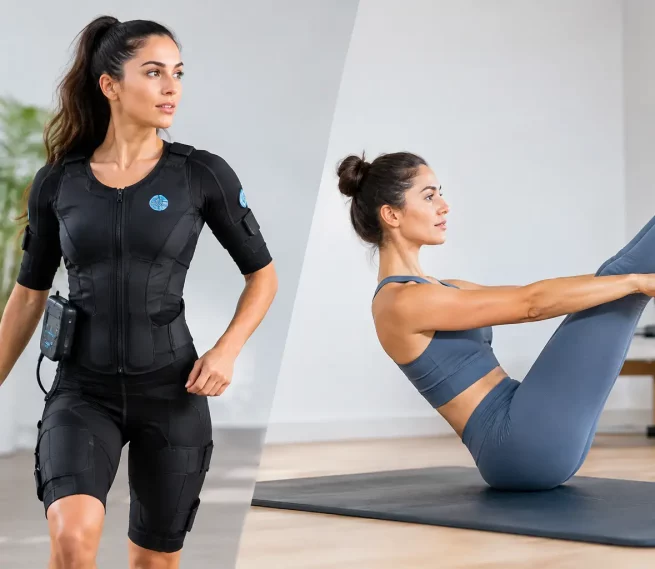
At E-Pulse Studio, EMS training can be a useful part of a time-efficient programme because it supports coached strength work in a focused 30-minute session. It should complement aerobic conditioning, not replace it. To improve VO₂max, you still need work that challenges the heart and lungs, but stronger, more resilient muscles can help you train consistently and move with confidence.
Recovery is where the adaptation happens
Hard work creates the signal. Recovery is when the fitness gain is built. This is particularly relevant for people balancing exercise with deadlines, school runs, travel and broken sleep.
Prioritise seven to nine hours of sleep where possible, eat regular meals with enough protein and carbohydrates to support training, and drink enough fluid that you are not beginning sessions already dehydrated. You do not need a flawless lifestyle. You need enough repeatable basics to make training feel better rather than progressively harder.
Plan at least one lighter week every four to six weeks, especially if you are increasing intensity. Reduce the number of intervals or the length of your aerobic sessions for several days. Many people fear losing momentum during an easier week, but it often brings them back fresher and ready to improve again.
Watch for warning signs: a resting heart rate that stays unusually high, poor sleep, persistent soreness, declining performance, irritability, loss of motivation or niggles that change how you move. Take these seriously. Resting for a day is a small price compared with losing months to injury.
Measure progress beyond one number
VO₂max estimates from watches and fitness tests can be motivating, but treat them as trends rather than verdicts. Heat, hydration, device accuracy and the route you choose can change a reading. Look for improvements across several markers: a faster pace at the same effort, a lower heart rate on a familiar walk, shorter recovery between intervals, better posture and less breathlessness in daily life.
A structured reassessment every six to eight weeks gives you something more useful than guessing. The right next step might be longer easy work, a little more interval volume, better mobility or simply protecting recovery. That is why coached training can move faster than random effort: the programme responds to what your body is actually telling you.
Your goal is not to prove how hard you can suffer in one session. It is to build the kind of fitness that shows up every week, carries into real life and keeps moving forward. Start at a level you can repeat, train with purpose, and let each well-recovered session earn the next one.
 7min
7min