A 30-minute training slot between the school run, meetings and dinner changes the question. EMS versus Pilates is not about which method is ‘better’ in every situation. It is about which one moves you closer to the result you want, with the time, energy and body you have right now.
Both can improve body awareness, posture and confidence in movement. But they get there in very different ways. Pilates is a movement practice built around control, alignment and core strength. EMS training uses electrical impulses alongside coached exercises to recruit muscles intensely in a short session. Knowing that distinction makes choosing far easier.
EMS versus Pilates: the key difference
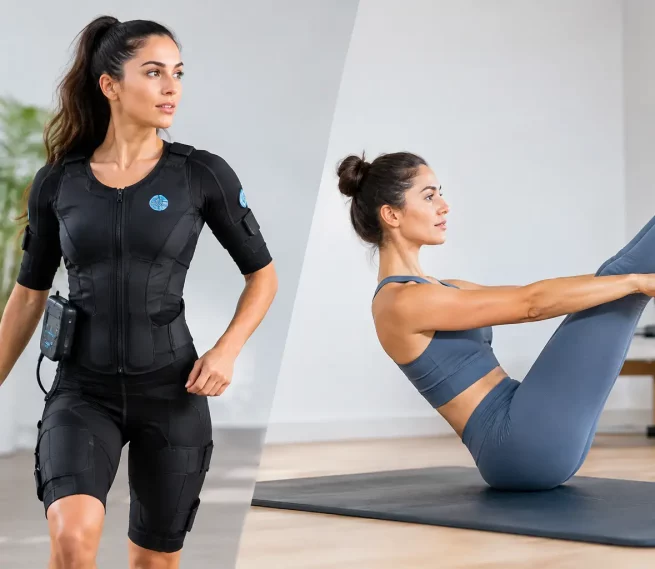
Pilates asks your body to create and control tension through precise, deliberate movement. Whether on a mat or reformer, you might work through bridges, leg circles, planks and mobility drills while focusing on breathing, pelvic position and quality of movement. It can be challenging, but the emphasis is usually on control rather than loading the muscles as heavily as possible.
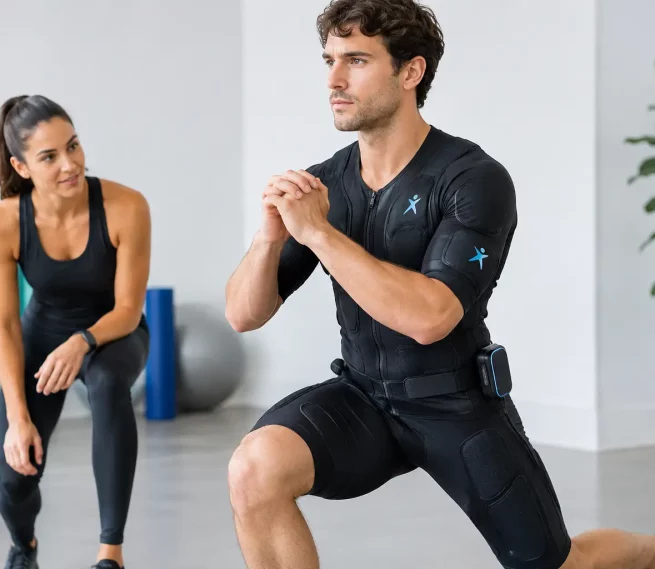
EMS, or Electro Muscle Stimulation, adds an external stimulus to voluntary exercise. You wear a specialist suit with electrodes placed over major muscle groups, while a trainer guides you through functional movements such as squats, lunges, rows and presses. The impulse encourages a stronger muscle contraction while you move, meaning a well-coached 30-minute session can create a demanding whole-body training effect without hours on the gym floor.
Neither approach is passive. Good EMS training is not standing still while a machine does the work, and effective Pilates is not simply stretching on a mat. The difference is where the challenge comes from. Pilates develops your ability to organise, stabilise and control your body. EMS is designed to intensify muscular work efficiently, with the level of stimulation adjusted to you.
Choose Pilates when movement quality is the priority
Pilates can be an excellent fit if you want to reconnect with how your body moves. It is particularly useful for people who feel stiff after desk-based work, struggle to engage their core, or want to improve coordination and posture before progressing to more demanding training.
The slower pace gives you time to notice compensation patterns. Perhaps your shoulders creep up during a plank, one hip drops in a bridge, or your lower back takes over when your glutes should be working. A skilled Pilates instructor can help you correct those habits through repetition and cueing.
It also works well for people who genuinely enjoy a longer, calmer movement practice. If your ideal session is 45 to 60 minutes of controlled exercise, breathing and mobility work, Pilates can become a sustainable weekly anchor. There is real value in training that helps you feel more capable in everyday life, not simply exhausted afterwards.
That said, Pilates is not automatically the fastest route to major changes in strength, body composition or cardiovascular fitness. Progress depends on class level, resistance, frequency and whether you add other forms of training. A gentle beginner mat class may support recovery brilliantly, but it will not necessarily provide enough progressive overload for someone aiming to build significant muscle or improve sporting power.
Choose EMS when time and measurable progress matter
For busy professionals, parents and business owners, the biggest obstacle is often not motivation. It is finding a training routine that still happens during a packed week. This is where EMS has a clear advantage.
At E-Pulse Studio, sessions are built around 30 minutes of trainer-led, full-body work. The stimulation is tailored during the session, so you can work hard without guessing your way through a crowded gym or spending an hour moving from machine to machine. The goal is not to make every session punishing. It is to create enough purposeful, progressive work to drive adaptation while protecting good movement.
EMS is especially compelling if your goals include stronger muscles, improved tone, better posture, body recomposition and a more consistent training habit. Because the body works across several major muscle groups at once, it can be a highly efficient option for people who have repeatedly fallen off conventional gym plans due to lack of time.
It can also support performance goals. Runners may use it to strengthen their posterior chain and improve lower-body resilience. Golfers often value the focus on trunk stability, hip control and rotational strength. For clients returning to exercise after a long break, the coaching environment removes much of the uncertainty that can make a standard gym intimidating.
The trade-off is that EMS is intense. A quality session requires concentration, recovery and appropriate progression, particularly in your first few weeks. More is not always better. One or two well-programmed sessions per week, supported by walking, mobility and sensible nutrition, can be more productive than cramming in random workouts every day.
Strength, posture and fat loss: what each method can deliver
If strength is your main target, EMS generally offers the more direct route because it combines functional resistance exercises with high levels of muscular activation. Pilates can build strength too, particularly at advanced levels or on reformer equipment, but it is more likely to develop muscular endurance and control than maximum strength.
For posture, the answer is more balanced. Pilates has a strong reputation for teaching alignment, breathing and core control. EMS can also help posture by strengthening the back, glutes and trunk, but it needs to be coached well. Stronger muscles do not automatically create better posture if your daily habits still involve eight hours of slumping over a laptop.
For fat loss, neither is a magic switch. Results come from a consistent calorie deficit, adequate protein, sleep, daily activity and training that preserves or builds muscle. EMS can be a powerful part of that plan because it is time-efficient and challenging, while Pilates can make regular movement feel more manageable and enjoyable. The best option is the one you can sustain.
When pain or mobility is part of the picture
If you have back pain, a joint issue or reduced mobility, do not assume you must choose only gentle exercise. Movement and strength training are often valuable, but the right starting point depends on the cause, severity and stage of your symptoms.
Pilates may be appropriate when you need to rebuild confidence in controlled movement. EMS may be useful when a qualified trainer can adapt the range, load and stimulation to your capability, helping you strengthen without high-impact exercise. Neither should replace medical assessment for unexplained, acute or worsening pain.
Tell your coach about previous injuries, surgery, medication and any health condition before you start. EMS is not suitable for everyone, including people with certain implanted electrical devices and some medical conditions. A proper consultation is not a formality. It is how training becomes personal, safe and productive.
The strongest option may be both
The comparison becomes less useful when you stop treating fitness methods like rival teams. Pilates and EMS can complement each other exceptionally well.
A client might use one or two EMS sessions each week to build strength and improve body composition, then add Pilates for mobility, core control and recovery. Another may start with Pilates to gain confidence and movement awareness, then introduce EMS once they are ready for more intensity. Athletes may use EMS in a strength phase and Pilates to maintain control and mobility around their sport.
Your schedule matters here. If you can only reliably train for 30 minutes once or twice a week, EMS may give you more training return for the time invested. If you need a lower-intensity practice that helps you unwind and move better, Pilates may be the better first step. If you want both physical change and a body that feels more connected, combine them deliberately rather than doing either at random.
How to make the right decision
Start with the outcome you want to notice in 12 weeks. If it is stronger legs, firmer muscle tone, improved fitness and a plan that fits into a demanding diary, EMS is likely to suit you. If it is better movement control, flexibility and a more mindful training rhythm, Pilates is likely to feel right.
Then be honest about consistency. The perfect programme on paper is useless if it asks more time than your life can give. Look for qualified coaching, clear progression and a setting where someone pays attention to how you move. Progress is easier to trust when it is tracked through strength, mobility, measurements, how your clothes fit and how you feel in daily life.
The most valuable training method is the one that gives you a clear next step and the confidence to keep showing up. Choose the approach that meets you where you are, then let consistent, well-coached sessions show you what your body can do.
 8min
8min