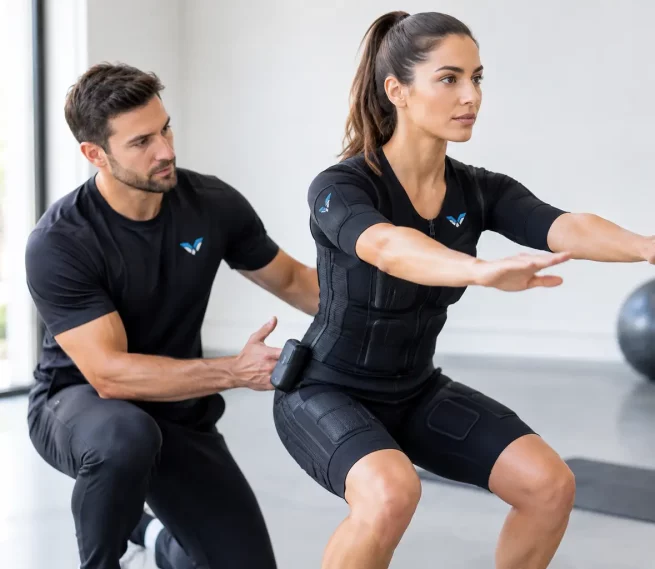
If you get out of breath on stairs, fade halfway through a run, or feel like your fitness has stalled despite training, the question is fair: can EMS improve VO2 max? The short answer is yes – but not by magic, and not in the same way as traditional cardio. EMS can support the systems that help you use oxygen better, especially when it is programmed properly and paired with the right coaching.
That matters because VO2 max is not just a number for endurance athletes. It is one of the clearest markers of cardiovascular fitness, work capacity and long-term physical resilience. For busy adults, it often shows up in more practical ways – better stamina, quicker recovery, stronger sessions and less of that heavy-legged, gasping feeling when life gets hectic.
What VO2 max actually measures
VO2 max is your body’s maximum ability to take in, transport and use oxygen during exercise. The higher it is, the more efficiently your heart, lungs and muscles can keep you moving as effort rises. It is influenced by your cardiovascular system, your muscle condition, your training history and your recovery.
People often treat VO2 max as if it belongs only to runners and cyclists. It does not. If you want to chase your kids, train hard after work, play sport at the weekend or simply feel fitter in everyday life, improving your oxygen-use capacity helps.
Can EMS improve VO2 max directly?
Can EMS improve VO2 max on its own? Sometimes, but usually not to the same extent as a structured endurance programme. Where EMS becomes interesting is in how it can improve several of the limiting factors behind aerobic performance.
EMS training stimulates muscle fibres intensely and efficiently. That can help build strength, improve muscular endurance, and recruit fibres that are often underused in standard training. Stronger, better-conditioned muscles can perform work more efficiently. When your muscles become more capable, your body may handle submaximal exercise with less effort, which can support improvements in aerobic fitness over time.
There is also the training density factor. A properly coached EMS session can create a high physiological demand in a short time. For clients who struggle to fit in long workouts, that matters. If you are only managing one or two rushed sessions a week, a focused EMS programme may give you a stronger fitness stimulus than inconsistent gym visits.
That said, VO2 max is still heavily tied to sustained cardiovascular demand. If your only training is static EMS work with no progressive aerobic challenge, the improvement may be modest. The real gains tend to come when EMS is integrated into a wider plan rather than treated as a stand-alone shortcut.
How EMS supports aerobic performance
The best way to understand the value of EMS is to look at what holds people back.
For some, it is weak glutes, poor posture and inefficient movement. For others, it is low muscular endurance, recurring niggles or a complete lack of training consistency. In those cases, EMS can be a powerful reset. By improving strength, stability and recruitment, it helps the body work better under load.
That has a knock-on effect on aerobic sessions. If your posture improves, your stride becomes cleaner, and your core and lower body stop fatiguing so quickly, you can train harder for longer. If back pain or joint discomfort has been limiting your output, improving support around those areas can make cardio training more productive.
This is where clients often notice a difference before they ever test their VO2 max. They feel less breathless at a given pace. Recovery between efforts improves. Circuits that once felt brutal become manageable. Those are meaningful signs of progress.
When EMS is most likely to help VO2 max
The people who tend to benefit most are not always elite athletes. In fact, beginners, returners and time-poor adults often see the clearest improvement.
If you have been inactive, your fitness ceiling is usually held back by several things at once – muscle weakness, poor movement quality, low confidence and inconsistent training habits. EMS can tackle those quickly. That creates a stronger base for aerobic progress.
It can also be useful for clients coming back from injury or dealing with mobility restrictions. Traditional high-volume cardio is not always realistic in the early stages. EMS offers a way to build capacity and recondition the body without hours of impact-heavy training.
More advanced athletes can benefit too, but expectations need to be sharper. If you already have a solid endurance background, EMS is more likely to act as a performance support tool than a game-changing VO2 max solution. It may help with power, fatigue resistance and muscular efficiency, but it will not replace quality sport-specific conditioning.
Can EMS improve VO2 max better than cardio?
No – not if we are comparing it against a well-designed cardio programme built specifically to raise VO2 max. Intervals, threshold work and progressive endurance training still lead the conversation when the goal is maximal oxygen uptake.
But that is not how most people train in real life. Many people do too little cardio, do it inconsistently, or stop because something starts hurting and motivation drops. In those situations, the better question is not whether EMS beats perfect training. It is whether EMS can help someone make better progress than their current routine.
Very often, yes.
A busy professional with two realistic training slots a week may get more traction from coached EMS and targeted conditioning than from a stop-start gym membership. A parent managing back pain may finally build enough strength and confidence to start pushing their fitness again. A recreational runner may use EMS to strengthen weak links that have been capping performance for months.
The coaching piece matters
This is the part people miss. EMS is not just about wearing a suit and switching on intensity. To improve anything meaningful, including VO2 max, the programme has to match the person.
Session structure, exercise selection, work-rest ratios and progression all matter. So does what happens outside the studio. If your weekly plan includes no walking, no interval work, poor sleep and patchy recovery, your cardiovascular progress will be slower no matter how advanced the technology is.
That is why a coaching-led approach works better than a generic one. Good trainers do not just chase a hard session. They look at what is limiting you, what your body can tolerate, and how to progress without burning you out.
At E-Pulse Studio, that is where the real value sits. The goal is not to throw intensity at people and hope for the best. It is to create measurable progress with a training plan that fits real schedules and real bodies.
What kind of results should you expect?
If your starting point is low to moderate fitness, you may notice changes within a few weeks. Everyday stamina can improve first. Then training tolerance, recovery and work capacity start to shift. Formal VO2 max improvements may follow if your programme includes enough cardiovascular stimulus.
If you are already fit, the gains are likely to be smaller and more specific. You may not suddenly leap to a new performance tier from EMS alone. What you may notice is better efficiency, stronger repeat efforts, fewer weak points and more resilience in training.
That distinction matters. There is a difference between supporting aerobic performance and maximising elite endurance metrics. EMS is excellent at the first and useful for the second when used intelligently.
How to use EMS if your goal is better stamina
The strongest approach is to combine EMS with purposeful conditioning. That might mean one or two EMS sessions each week alongside brisk walking, bike intervals, run sessions or sport-specific conditioning depending on your level.
You also want to track the right signs. Better recovery heart rate, improved pace at the same effort, more reps before fatigue and less breathlessness during everyday activity are all useful markers. VO2 max itself is valuable, but it should not be the only proof that your fitness is moving forward.
Nutrition, sleep and consistency still count. If you want your body to adapt, it needs enough fuel and enough recovery to absorb the work.
So, can EMS improve VO2 max?
Yes, it can – especially if your current fitness is being limited by weak muscles, poor conditioning, pain, lack of time or inconsistent training. It may not replace traditional endurance work, but it can make that work more effective and more sustainable. For many people, that is the difference between another false start and real progress.
If you want better stamina, do not look for a gimmick. Look for a method you can stick with, a coach who can tailor it, and a plan that improves the whole system rather than one isolated metric. That is where lasting fitness change starts.
 8min
8min