If you have ever looked at a 30-minute EMS session and wondered how it can possibly compete with a much longer gym workout, that is the right question to ask. How does EMS training work in practice, and why do so many busy people find it effective enough to build into their weekly routine? The answer comes down to how your muscles contract, how much of the body you can train at once, and how closely the session is coached.
EMS stands for Electro Muscle Stimulation. In an EMS personal training session, low-frequency electrical impulses are delivered through a specialist suit or vest to major muscle groups while you perform guided movements. Those impulses mimic the signals your brain naturally sends to your muscles, causing them to contract more intensely and more frequently than they might during ordinary training alone.
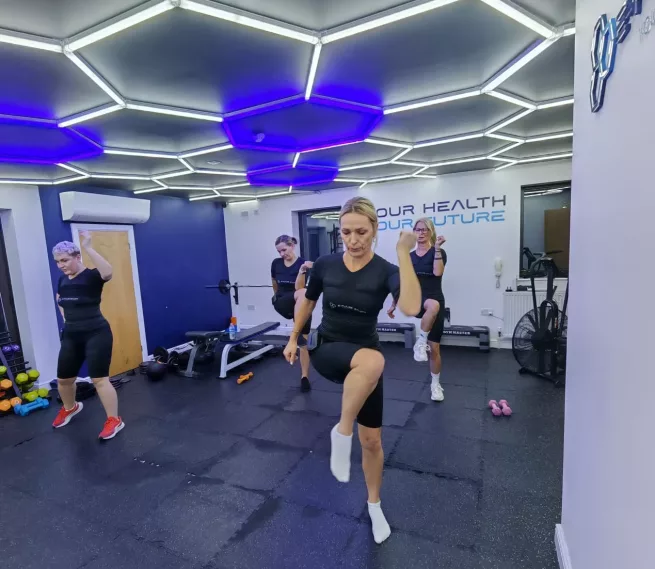
That does not mean the machine does the work for you. Quite the opposite. You are still moving, bracing, squatting, lunging, rotating and holding positions under trainer guidance. The difference is that the muscles are being recruited more deeply during those movements, so the session becomes far more efficient.
How does EMS training work inside the body?
Every voluntary movement starts with an electrical signal from the nervous system. Your brain tells a muscle to contract, and the muscle responds. EMS adds an external electrical stimulus to that process. When the suit sends controlled impulses to the targeted muscles, it encourages extra fibre recruitment during each exercise.
In simple terms, more muscle fibres are being asked to switch on at the same time. That is one reason EMS can feel surprisingly demanding even during movements that look basic from the outside. A bodyweight squat, for example, can become significantly more challenging when your glutes, quads, hamstrings and core are all being stimulated together.
This full-body effect matters. Traditional training often works one area at a time depending on the exercise, machine or weight selection. EMS training can activate several major muscle groups in a single sequence, which is part of why sessions are short and focused.
For clients who are short on time, that efficiency is a major advantage. For clients returning from inactivity, it can also be a helpful way to rebuild strength with close supervision and precise control over intensity.
What happens in an EMS session?
A proper EMS session is not a case of putting on a suit and hoping for the best. It is a coached training session with settings tailored to your body, goals and current fitness level.
You would usually begin by getting fitted with the EMS garment, which is designed to sit closely against the body so the electrodes can reach the key muscle groups effectively. Water is often used to improve conductivity. Your trainer then adjusts the intensity for different areas such as legs, glutes, back, abdominals, chest and arms.
That matters because not every muscle group should be trained at the same level. Stronger areas may tolerate more intensity, while more sensitive or deconditioned areas need a more gradual build. Good coaching makes a huge difference here.
Once the session starts, you move through a series of exercises while the impulses cycle on and off. During the work phase, you perform the movement or hold the position. During the rest phase, the intensity drops briefly before the next effort begins. The structure keeps the session controlled, challenging and surprisingly focused.
Most sessions last around 30 minutes. That sounds short until you try one properly. Because the body is under simultaneous muscle stimulation across multiple areas, the training density is high.
Why does it feel so effective in so little time?
Time efficiency is one of the biggest reasons people turn to EMS. Working professionals, parents and anyone juggling a full diary often struggle to fit in three or four long gym visits each week. EMS changes the equation because it increases muscular workload within a much shorter session.
The key is intensity, not duration alone. If the muscles are being recruited more fully and more consistently, you can create a serious training effect without spending an hour moving between machines.
This does not mean longer traditional training is useless. It means EMS can be a smart alternative or complement depending on your goal. If you want a practical method for improving strength, muscle tone, posture and general fitness in less time, it makes a strong case for itself.
That is especially true when sessions are personalised. One person may want fat loss support and improved confidence. Another may be aiming for stronger running mechanics, less back discomfort or better core control. The same technology can be adapted very differently based on what the client actually needs.
What results can EMS training support?
When used consistently and coached properly, EMS training can support improvements in muscle strength, body composition, endurance, posture and mobility. Many clients also report reduced muscular tension and better support around problem areas such as the lower back.
Part of that comes from stronger muscle activation. Part comes from the fact that EMS sessions are structured and supervised, which improves consistency. People often do better when they know a trainer is guiding every rep and tracking progress rather than leaving them to drift through a gym session alone.
For body transformation goals, EMS is not magic and it is not separate from the basics. Nutrition, sleep, recovery and weekly consistency still matter. But if someone has been struggling to stick to training because life gets in the way, a short, high-quality session can be the difference between doing nothing and finally building momentum.
For performance-focused clients, EMS can also help strengthen areas that support sport. Runners often need better glute and core recruitment. Golfers may benefit from rotational control and posture work. Clients coming back from long desk-based days may simply need their posterior chain switched back on.
Is EMS training safe?
For most healthy adults, EMS training is safe when it is delivered by qualified professionals using proper screening and sensible intensity settings. That last part is important. More is not always better.
A good studio will ask about your medical history, current injuries, training background and goals before you start. Certain people should not use EMS, including those with some implanted medical devices or specific health conditions. This is why personal supervision matters so much.
Done well, EMS should feel intense but controlled. It should challenge you without feeling chaotic. Your trainer should be adjusting the session based on how you respond, not just turning everything up and hoping intensity equals results.
Who is EMS training best for?
EMS works well for a wide range of people, but it is especially appealing for those who want maximum value from limited time. That includes professionals squeezing training into lunch breaks, parents who cannot spare multiple evenings at the gym, and beginners who want expert structure from day one.
It can also be a strong option for people who have fallen out of routine and need accountability. A short appointment with a coach is often easier to commit to than an open-ended gym plan that keeps getting pushed to next week.
There is also a mobility and support angle. Some clients are not looking to become athletes. They simply want to feel stronger, move better, improve posture and stop their back or shoulders complaining every day. With the right programming, EMS can support those goals very effectively.
That said, it depends on expectations. If you love heavy barbell training, long endurance sessions or sport-specific practice, EMS is not a total replacement. It is a powerful tool, not the only tool. For many people, the best approach is to use EMS alongside walking, sport, mobility work or occasional traditional strength sessions.
How does EMS training work compared with a normal gym workout?
The biggest difference is training density. In a normal gym workout, you might spend time setting up equipment, resting between sets, moving from station to station and training one region at a time. In EMS, the body is working more globally and the session is tightly managed from start to finish.
The second difference is coaching contact. In a premium EMS setting, you are not left alone to guess your way through exercises. You are guided closely, corrected when needed and progressed over time. That support is valuable for both safety and results.
The third difference is accessibility. Some people find a large gym intimidating or hard to stay consistent with. A coached EMS session can feel more manageable because it is private, focused and time-bound.
Still, there are trade-offs. Traditional gym training offers more variety in loading, exercise selection and sport-specific progression. EMS offers efficiency, targeted activation and accountability. The better option depends on your lifestyle, preferences and goals.
What should you expect after your first few sessions?
Most people notice two things early on. First, the session feels different from anything they have done before. Second, the muscle fatigue afterwards is very real, even though the workout was short.
In the first few sessions, the focus should be on learning how the stimulation feels, how to brace properly and how to move well under tension. You do not need to prove anything. Gradual progression is the smarter route.
Over the following weeks, clients often start to notice better muscle tone, improved posture awareness, increased strength in everyday movements and more confidence in training. Visible body composition changes take longer and depend on consistency beyond the studio, but measurable progress tends to come faster when training is regular and tailored.
That is where a coaching-led approach stands out. At E-Pulse Studio, the value is not just the technology. It is the combination of EMS, personal guidance and measurable progress that helps clients stay on track when life would otherwise pull them off course.
If you have been putting fitness off because you cannot justify hours in the gym, EMS offers a more realistic way forward. Sometimes the best training plan is not the one that looks hardest on paper. It is the one you can actually stick to, recover from and build into your life week after week.
 9min
9min