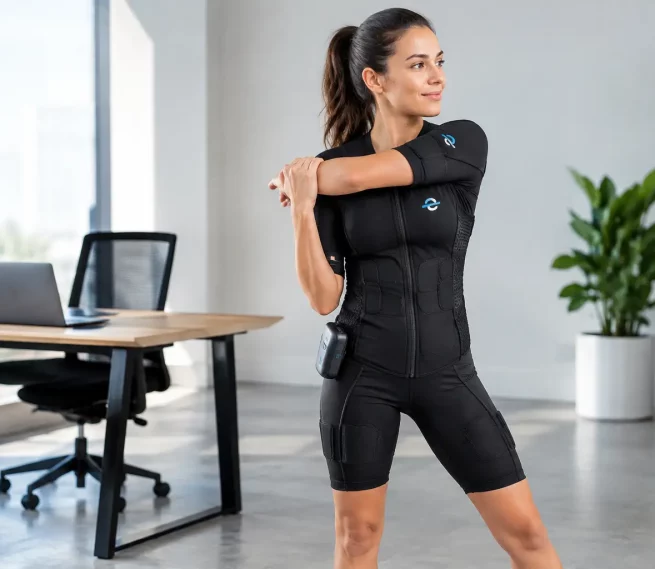
Most people do not notice their posture slipping until their neck feels tight at a desk, their lower back aches after the school run, or their shoulders round forward in every photo. That is exactly why ems training for posture improvement gets so much attention – it gives busy adults a focused way to strengthen the muscles that support better alignment without spending hours in the gym.
Posture is not just about standing up straight for five minutes. It is about how well your body holds itself when you are working, walking, lifting, driving, training, and recovering. If the right muscles are weak or underactive, your body will find shortcuts. Over time, those shortcuts can mean stiffness, discomfort, reduced mobility and a shape that feels harder to correct than it should.
Why posture problems are so common
Modern life is not designed for great posture. Long hours at a laptop, time in the car, stress, poor movement habits and inconsistent training all play a part. Even people who exercise regularly can struggle with posture if they mostly train the muscles they can see and neglect the deeper stabilisers that keep the spine, shoulders and pelvis in a better position.
This is where many people get frustrated. They stretch their shoulders, remind themselves to sit taller, and maybe buy a more supportive chair. Those things can help, but they rarely fix the root issue on their own. If the muscles responsible for supporting posture are not doing their job, the body falls back into the same pattern.
Good posture also is not one fixed position. It is the ability to control your body through different positions with less strain. That means a posture-focused plan should improve strength, awareness, mobility and endurance together.
How EMS training for posture improvement works
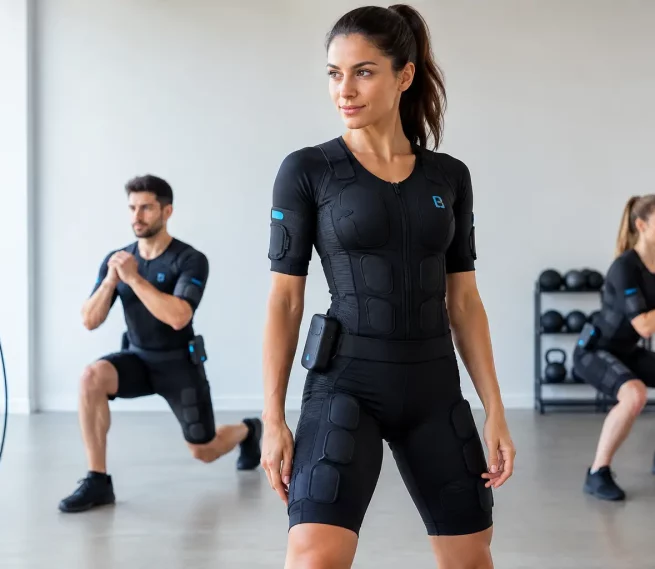
EMS uses electrical muscle stimulation to activate muscles during guided exercise. In a coached session, impulses are delivered through a specialist suit while you perform controlled movements designed around your goals. For posture work, that usually means targeting the core, glutes, upper back, lower back and other stabilising muscles that support alignment.
The key advantage is not that EMS replaces movement. It is that it can increase the quality and intensity of muscle activation while you move. For clients who sit too much, feel disconnected from their core, or struggle to engage the right muscles in conventional training, this can be a real turning point.
When posture is the goal, the coaching matters just as much as the technology. A good trainer will not just switch on the machine and hope for the best. They will assess how you stand, how you move, where you compensate, and which areas need the most attention. That is what turns EMS from a novelty into a results-focused training method.
The muscles that matter most
Posture improvement is rarely about one isolated area. Rounded shoulders may be linked to a weak upper back, but also to a poorly braced core or limited thoracic mobility. An aching lower back may be connected to underactive glutes and a pelvis that is not well controlled.
EMS can help bring more attention to the key muscle groups that often need work, especially the deep core, spinal stabilisers, glutes and postural muscles of the upper back. When those areas become stronger and more responsive, everyday positions can start to feel easier to maintain.
That does not mean every posture issue disappears with a few sessions. If there is a long-standing injury, significant imbalance or a lot of time spent in poor positions each day, progress may take longer. But strengthening the support system around the spine is a smart starting point.
What improvements can you realistically expect?
A realistic posture improvement plan should aim for more than simply looking taller. Most clients care about how they feel. They want less tension in the shoulders, less pulling through the neck, more support through the midsection and less fatigue when standing or sitting for long periods.
With consistent EMS coaching, many people report better body awareness first. They become more conscious of how they stand, where they collapse, and how to switch on the right muscles. After that, physical changes often follow – a stronger core, improved shoulder position, better pelvic control and more confidence in movement.
For some, one of the biggest wins is reduced discomfort. If poor posture is contributing to recurring aches, improving muscular support may reduce the strain placed on overworked areas. That said, pain is complex. Not all pain comes from posture, and not all posture issues cause pain. This is why a personalised approach matters.
It depends on your starting point
Someone with mild desk-related stiffness may notice improvements quite quickly. Someone with years of compensation, very low strength or a history of injury may need a longer runway. The good news is that EMS sessions are typically short and focused, which makes consistency easier for people with demanding schedules.
For busy professionals and parents, that consistency is often the difference between good intentions and actual progress. The best plan is not the one that looks impressive on paper. It is the one you can stick to.
Why EMS can suit people who struggle with conventional training
A common pattern with posture work is knowing what you should do but not doing it often enough, or not doing it well enough. Traditional gym training can be effective, but many people either do not have the time, do not feel confident, or end up repeating the same routines without addressing the underlying issue.
EMS changes that experience because sessions are coached, time-efficient and precise. You are not left guessing whether your core is engaged or whether your glutes are doing the work. The set-up and guidance can make it easier to train with purpose, especially if posture has been drifting for years.
This is also why EMS appeals to people coming back from periods of inactivity. If your body feels deconditioned or your mobility is limited, walking into a crowded gym and trying to piece together a corrective programme is not always realistic. A guided studio environment can feel more manageable and more accountable.
What a good posture-focused EMS programme should include
The best posture results come from a plan, not a one-off session. A strong programme should combine EMS training with movement coaching and regular progression. That might include squat patterns, hinge work, rotational control, upper-back activation and core-focused drills that reinforce better alignment under load.
It should also consider your day outside the studio. If you spend ten hours hunched over a screen, training once a week helps, but daily habits still matter. The goal is not perfection. It is creating enough strength and awareness that your body defaults to better positions more often.
At E-Pulse Studio, that coach-led approach is what makes the difference. Clients are not simply chasing sweat. They are training for measurable change, whether that means standing taller, moving more freely, or easing the physical toll of long working days.
EMS is powerful, but it is not magic
This matters because some people hear about electrical muscle stimulation and expect a shortcut. EMS can speed up muscle engagement and make training more efficient, but it still needs proper coaching, regular attendance and the right exercises. If posture problems are driven by weakness, poor movement habits and lack of consistency, EMS can help address them. If they are linked to a more complex medical issue, it should sit within a broader professional plan.
That is not a drawback. It is simply the honest answer. The people who get the best outcomes are usually the ones who see EMS as part of a smart strategy rather than a quick fix.
Is EMS training for posture improvement worth it?
If you feel stiff, slouched, weak through the core or fed up with recurring tension, it can be a very worthwhile option. It is especially useful for people who need efficiency, structure and expert guidance to stay on track. For the right person, better posture is not just cosmetic. It can mean improved confidence, easier breathing, stronger movement and less daily discomfort.
It is also worth it if you have tried to fix your posture on your own and nothing has really stuck. Often the missing piece is not effort. It is targeted muscle activation, progression and accountability.
The real question is not whether posture can improve. In many cases, it can. The question is whether your current routine is giving your body a reason to change. If it is not, a coached EMS plan could be the step that finally shifts things in the right direction.
Better posture is built, not wished for. When the right muscles start working properly again, your body usually tells you quickly – you stand with more control, move with more confidence and finish the day feeling less beaten up by it.
 7min
7min