A packed calendar is often the real reason training stalls. Not a lack of ambition, not a lack of knowledge – simply the reality of work, school runs, travel and everything else competing for your time. That is why EMS vs weightlifting efficiency is a useful question, but only if we define efficiency properly: results achieved for the time, effort and recovery you can genuinely sustain.
Conventional weightlifting remains one of the best ways to build strength, muscle and confidence. EMS training offers a coached, time-efficient alternative that can make it easier to train consistently, particularly when long gym sessions are not realistic. Neither is magic. Both work best when the programme suits your goal, starting point and weekly routine.
What does efficiency actually mean in training?
Efficiency is not just about the number of minutes spent exercising. A 90-minute gym session is not automatically less efficient than a 30-minute EMS session if you enjoy it, train with good technique and turn up every week. Equally, a short session that you can repeat consistently can outperform an ambitious plan that disappears after three weeks.
For most people, training efficiency has four parts: the quality of muscular stimulus, the time required, the coaching and confidence available, and the recovery cost afterwards. A busy professional looking for improved body composition has different needs from a powerlifter chasing a new squat personal best. Someone rebuilding strength after back discomfort has different priorities again.
The best question is not, “Which is better?” It is, “Which approach moves me towards my result with the least unnecessary friction?”
EMS vs weightlifting efficiency for busy lives
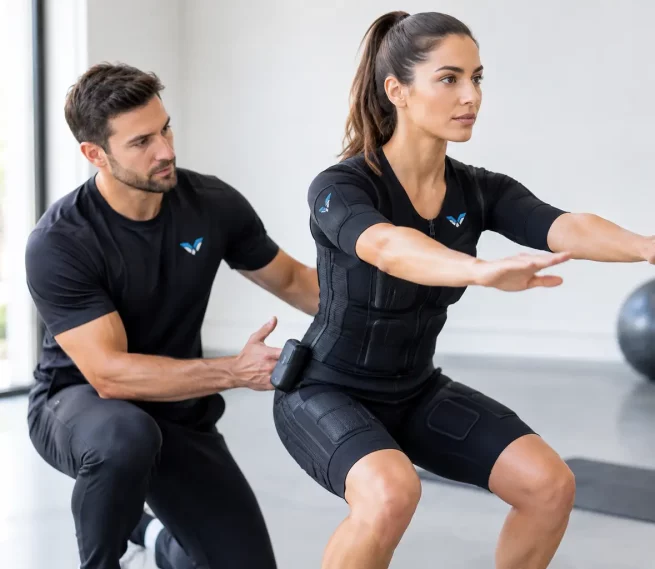
During whole-body EMS training, electrical impulses are delivered through a suit while you perform controlled, functional exercises under a trainer’s guidance. The stimulation is adjusted to your ability and tolerance, with movements selected around your goals, mobility and training experience.
At E-Pulse Studio, sessions are designed to take 30 minutes. That includes focused coaching rather than wandering between machines, waiting for equipment or guessing whether your form is right. For people who repeatedly struggle to fit a conventional gym programme into the week, that structure can be the difference between intending to train and actually training.
Traditional weightlifting usually requires more time around the lifts themselves. You need a warm-up, several working sets, rest periods and often separate exercises for different muscle groups. That is not a criticism – those elements are valuable, especially when progressing heavier loads. But a productive weights session can easily take 60 to 90 minutes once changing, travel and showering are included.
EMS compresses the session by creating a demanding muscular challenge across several major muscle groups at once. It is particularly attractive for clients who want a high-effort, low-time training appointment twice a week, with a coach keeping standards high throughout.
Where EMS can be more efficient
EMS often has the edge when time is your main constraint. It can be a strong fit for busy parents, business owners and shift workers who need a fixed, manageable appointment rather than another open-ended task on their list.
It can also help beginners. A new gym member may spend weeks learning equipment, avoiding certain areas of the gym or training too lightly because they are unsure what to do. Trainer-led EMS removes much of that uncertainty. The focus stays on controlled movement, appropriate intensity and progression from week to week.
For people returning from a lay-off, dealing with reduced mobility or wanting support around posture and muscular balance, the controlled nature of coached sessions can be valuable too. The programme must always be adapted to the individual, and anyone with a medical condition, injury or contraindication should seek appropriate professional advice before starting.
Where weightlifting is more efficient
If your goal is to become highly skilled at lifting a barbell, then lifting a barbell is essential. Strength is specific. A person training for a powerlifting competition needs regular practice with the squat, bench press and deadlift, including the technique, bracing and confidence required under heavier loads.
Weightlifting also gives you enormous exercise choice and a clear way to measure external load. You can progressively add weight, reps or sets over months and years. For experienced lifters who enjoy this process and can commit the time, conventional resistance training is exceptionally effective.
It is often more practical for someone who already has a well-equipped home gym, knows how to programme safely and wants to train four or five times a week. EMS does not need to replace that. It can sit alongside it, particularly during busy periods or as an additional supervised training stimulus.
Results depend on the goal, not the hype
For fat loss and body recomposition, neither EMS nor weights can outrun inconsistent nutrition, poor sleep and a routine that is impossible to maintain. Training supports the process by building or preserving muscle, improving fitness and giving you momentum. Your food choices and overall activity still matter.
The advantage of a short EMS session is that it lowers the time barrier while still asking your muscles to work hard. Clients often value the accountability of a booked appointment, the individual coaching and the visible evidence of progress. Regular 3D body scanning can make changes in body composition, measurements and posture easier to track than relying on the bathroom scales alone.
For muscle strength, conventional weights provide the most direct path to practising and progressively loading specific movements. EMS can support strength development, especially for people who are deconditioned, short on time or not yet comfortable in a gym environment. The strongest choice may be a blend: EMS for efficient whole-body work, plus targeted lifting for the exercises or sporting demands that matter most to you.
For cardiovascular capacity, brisk walking, running, cycling and sport still have a clear role. EMS sessions can be demanding and may support general conditioning, but they are not a shortcut around all forms of aerobic training. A runner preparing for a race still needs to run. A golfer still benefits from practising their swing, mobility and rotational control.
The recovery question many people miss
A session is only efficient if you can recover from it well enough to train again. With EMS, intensity needs to be introduced sensibly. More is not always better, particularly at the start. A qualified trainer should tailor the stimulation and exercises, monitor your response and build capacity gradually.
The same is true with weights. Chasing soreness, lifting too heavy with poor form or cramming too much volume into a week can turn a good programme into a stop-start cycle of fatigue and frustration.
The sweet spot is challenging training that fits your recovery, sleep and stress levels. You should feel worked, not wrecked. Consistency beats occasional heroic sessions every time.
How to choose the right route for you
Choose EMS if you need expert structure, want to train hard in 30 minutes and know that time is the main reason you have been inconsistent. It is a compelling option if you want personal coaching, measurable check-ins and a programme that can accommodate a beginner’s confidence level or individual mobility needs.
Choose weightlifting as your main focus if you love the gym, have time to train, and want to develop maximum strength in particular lifts. It is also the better primary route for competitive lifting goals, because technique under external load cannot be fully replicated.
Choose both if you want the benefits of each. A coached EMS session can keep training momentum strong during a demanding week, while one or two weight sessions allow you to practise the lifts, skills or sports-specific movements you enjoy.
Make your training time count
The most efficient programme is the one you can follow long enough to see change. Track more than your weight. Notice whether stairs feel easier, your posture is stronger, your clothes fit differently, your energy improves and the movements that once felt difficult begin to feel normal.
Start with the time you truly have, not the routine you think you should manage. A focused 30-minute appointment completed week after week can become the foundation for a stronger, more capable body – and that is a result worth making time for.

 8min
8min