The school run is done, your inbox is full, dinner needs sorting, and the idea of spending 90 minutes travelling to and from a gym can feel laughable. The best training options for busy parents are not the ones with the most complicated programme or the longest sessions. They are the options you can repeat consistently, fit around real family life and see genuine progress from.
For most parents, training needs to do more than burn calories. It needs to build strength for carrying children, improve energy through long days, ease the stiffness that comes from desks, driving and poor sleep, and give you a rare half-hour that is entirely yours. The right choice is the one that makes exercise a reliable part of your week rather than another promise pushed to Monday.
What busy parents should look for in a training plan
Time matters, but quality matters more. A 20 or 30-minute session with clear structure, progressive resistance and proper coaching can be far more valuable than an occasional two-hour gym visit where you spend half the time deciding what to do.
Look for training that has a clear purpose. If fat loss is the goal, your plan should protect or build muscle while helping you create sustainable habits. If you want to feel stronger, it should include progressive overload rather than endless random circuits. If back pain, mobility restrictions or postural issues are holding you back, the starting point should be appropriate movement and professional guidance, not being thrown into a punishing class.
Accountability is another major factor. Parents are exceptionally good at keeping commitments to everyone else. A booked session, a coach who knows your goal and progress data you can actually understand make it much harder for your own wellbeing to fall off the calendar.
1. EMS personal training for maximum efficiency
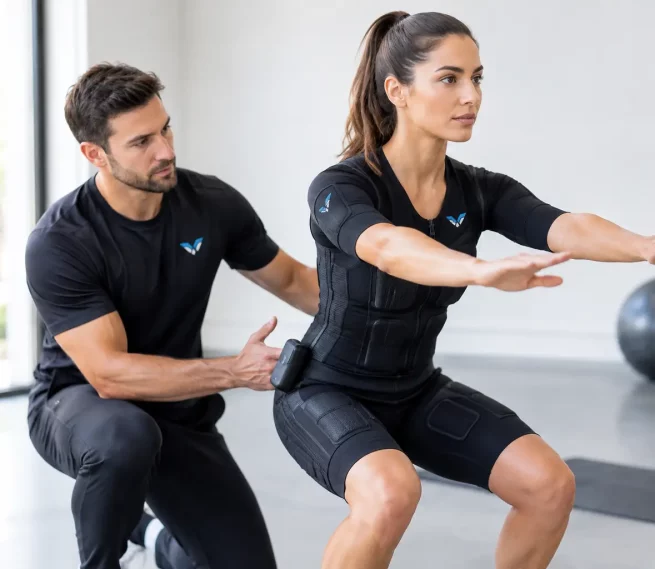
For parents whose biggest barrier is time, EMS personal training is one of the strongest options available. Electro Muscle Stimulation training uses a specialised suit to stimulate major muscle groups while you perform coached movements. Sessions are typically just 30 minutes, yet the training is demanding, focused and tailored to your current ability.
This is not a shortcut that removes effort. You still work, but the format removes wasted time. There is no wandering around a gym floor, waiting for equipment or trying to remember a routine from a video. A trainer guides each movement, adjusts intensity and keeps the session moving.
It can suit beginners returning to exercise, professionals with packed diaries and experienced gym-goers who want an efficient strength stimulus. It can also be adapted for mobility, recovery and performance goals. The trade-off is that EMS is a premium coaching service, and it works best when you attend consistently and support it with sensible food, sleep and daily movement.
At E-Pulse Studio, parents can train in a focused 30-minute session with personal coaching and 3D body scanning to track changes beyond the bathroom scales. Seeing improvements in body composition, posture or measurements can be far more motivating than relying on body weight alone.
2. Strength training with a simple, repeatable programme
Traditional resistance training remains one of the best investments a busy parent can make. Building muscle supports everyday strength, helps maintain healthy bone density and gives your body a stronger foundation for everything from lifting a buggy to playing football in the garden.
The key is simplicity. Two full-body sessions per week can be enough to make meaningful progress when you train consistently. Focus on movement patterns such as squatting, hinging, pushing, pulling, carrying and core control. You do not need a different workout every day, and you certainly do not need to leave the gym exhausted to make progress.
A good programme might use a handful of exercises, gradually increasing resistance or improving control over time. The limitation is that an unstructured gym environment can be intimidating, especially if you are tired, new to training or have not exercised for years. Coaching, even occasionally, can save months of guesswork.
3. Small-group coaching for structure and motivation
Small-group training offers a valuable middle ground between one-to-one personal training and a crowded fitness class. You get a planned session, trainer feedback and a sense of community, but the cost can be lower than fully private coaching.
For busy parents, the social side is more useful than it sounds. Training alongside people who recognise the juggle of family, work and inconsistent sleep creates a different kind of accountability. You are not trying to match the fittest person in the room. You are turning up, putting the work in and building momentum with people who understand why that matters.
Choose a group with limited numbers and qualified coaches. Huge classes can be energetic, but individual technique often gets less attention. A group of up to eight gives the coach room to correct form, adapt exercises and ensure the session works for different fitness levels.
4. Home workouts when travel is the real obstacle
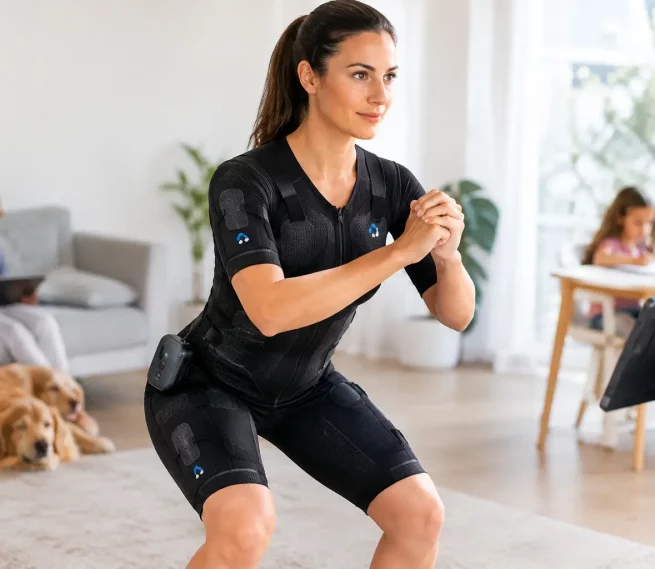
Home training is practical when childcare, commute times or unpredictable work hours make studio sessions difficult. It can be highly effective, especially with resistance bands, adjustable dumbbells, a kettlebell or simply well-designed bodyweight exercises.
The danger is not that home workouts fail. The danger is that they become too easy to postpone. The kitchen needs clearing, a child needs help with homework, and your planned 25 minutes becomes another missed session. Treat home training as an appointment. Put it in the diary, lay out equipment beforehand and choose a programme that tells you exactly what to do.
Keep the target realistic. Three 20-minute sessions are often more sustainable than aiming for an hour every evening. If your child interrupts, finish what you can and move on. Consistency is built through flexibility, not perfection.
5. Walking, cycling and low-impact cardio for energy
Cardio does not need to mean punishing runs at 5 am. Brisk walking, cycling, swimming or incline treadmill work can improve fitness, support heart health and clear your head after a demanding day. For parents who feel worn down, low-impact cardio may be the most sensible place to start.
A walk after dinner can also become family time rather than another task competing for attention. If you have a lunch break, a 20-minute brisk walk is a meaningful win. If you enjoy running or cycling, structured interval sessions can improve fitness in less time, but build gradually to avoid doing too much too soon.
Cardio alone is not always the complete answer for body composition or long-term strength. Pairing it with resistance training is usually the more balanced approach. Think of cardio as a tool for stamina, mood and daily movement, not punishment for what you ate.
6. Mobility and recovery sessions that keep you training
When life is busy, recovery is often the first thing to disappear. Yet tight hips, an aching lower back, sore shoulders and poor sleep can quickly make training feel like another demand on an already stretched body.
A short mobility routine can help you move better and feel more prepared for strength or cardio sessions. Ten minutes of controlled work for your hips, thoracic spine, ankles and shoulders can be enough to make a difference when done regularly. Recovery-focused coaching may be particularly useful if you are returning after pregnancy, managing recurring discomfort or balancing fitness with a physical job.
Mobility work is not a replacement for strength training, but it is a powerful support act. If pain is persistent, worsening or linked to an injury, seek appropriate clinical advice rather than trying to train through it.
How to choose the option you will actually stick with
Start with your most honest constraint. Is it a lack of time, confidence, energy, childcare or knowledge? The answer should shape your plan. If time is the issue, a coached 30-minute EMS session or a short home strength programme may be ideal. If motivation is the issue, small-group coaching and a regular booking can make all the difference. If discomfort is holding you back, prioritise an assessment and a gradual, supported approach.
Do not underestimate the power of a fixed training slot. Two appointments per week that your family knows are protected are more effective than a vague intention to exercise whenever life calms down. Life with children rarely calms down for long.
The best programme is not the one that looks impressive online. It is the one that leaves you feeling stronger, more capable and proud that you kept a promise to yourself. Start with the time you genuinely have, let expert support remove the guesswork, and give your future energy the same priority you give everyone else’s.
 8min