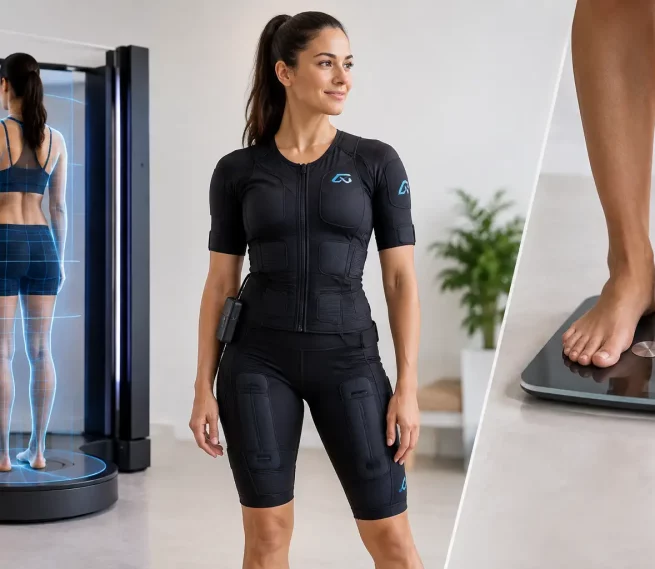
Thirty minutes between meetings, school runs and everything else is not much time to spare. That is why the question of EMS versus Pilates strength matters: both can improve how your body feels and moves, but they create strength in very different ways. The best choice is not the trendiest option. It is the one that matches your goal, your starting point and the consistency you can realistically maintain.
For someone who wants stronger muscles, improved body composition and guided progression without spending hours in a gym, EMS can be a highly efficient route. For someone focused on controlled movement, trunk stability and body awareness, Pilates remains exceptionally valuable. They are not direct substitutes in every situation.
EMS versus Pilates strength: the key difference
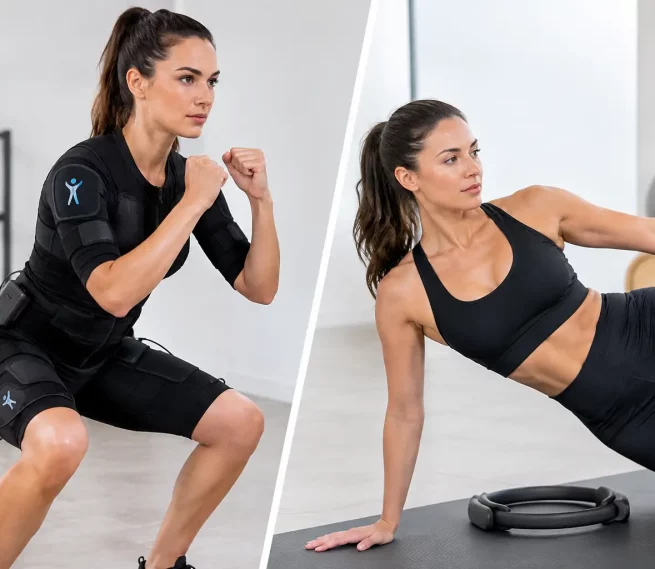
EMS training uses electrical impulses to stimulate muscle contractions while you perform coached exercises such as squats, lunges, presses, rows and core movements. In a studio setting, the trainer controls the intensity and adapts the movements to your ability, injury history and goals. The external stimulation adds a demanding muscular stimulus to movements that may look simple from the outside.
Pilates develops strength through slow, precise movement, controlled resistance and sustained positioning. Mat Pilates uses bodyweight and gravity; reformer Pilates adds springs and a moving carriage. Rather than asking the muscles to produce maximum force, Pilates often challenges them to maintain alignment, resist rotation and control movement through a full range.
Put simply, EMS tends to prioritise high muscular recruitment and time-efficient strength work. Pilates prioritises control, coordination, mobility and muscular endurance. Both can make you feel stronger. The type of strength, and how quickly you notice it, can differ.
Which builds muscle strength faster?
If your main target is measurable muscular strength and a firmer, more athletic shape, coached EMS training will usually offer the more direct stimulus. The electrical impulses are designed to recruit muscles intensely, while exercises provide the functional movement pattern. Sessions are short, but they are not easy. Quality effort and progression still matter.
This makes EMS particularly useful for busy professionals and parents whose previous training routine has been inconsistent. A focused 30-minute session can train the major muscle groups without the long waits, set-up and self-motivation required on a busy gym floor. At E-Pulse Studio, progress can also be tracked through body scanning, so the conversation moves beyond simply hoping your clothes fit differently.
Pilates can absolutely build strength, particularly for beginners or people returning after time away from exercise. You may notice better control in a squat, more stability through your hips and shoulders, and less fatigue when holding good posture. However, once your body adapts, Pilates alone may not provide enough progressive resistance for significant gains in maximal strength or muscle mass, depending on the class format and equipment used.
That is not a criticism of Pilates. It is a question of specificity. If you want to improve the amount of force your muscles can produce, training needs an appropriate resistance challenge. EMS provides that challenge in a compact, closely supervised format.
Strength is more than lifting heavier
There is more than one useful definition of strength. A runner needs stable hips and a resilient core late in a race. A golfer needs rotational control. Someone with recurring back discomfort may need better glute activation, trunk endurance and confidence in moving again. A busy parent may simply want to lift, carry and climb stairs without feeling drained.
Pilates is excellent at teaching the body to organise movement well. EMS can increase the intensity of muscular work while a coach ensures those movement patterns remain safe and purposeful. For many people, better results come from recognising which quality is currently holding them back rather than declaring one method superior in every case.
Posture, core control and mobility
Pilates has earned its reputation for posture and core work for a reason. Its deliberate pace can reveal habits that are easy to hide during faster training: ribs flaring, hips shifting, shoulders creeping upwards or breath holding. Regular practice can improve awareness of these patterns and help you create more controlled movement.
EMS also supports posture and mobility when it is programmed properly. It is not just about standing in a suit and letting the machine do the work. The value comes from coached exercises that strengthen the glutes, back, legs and trunk while working within your available range. As those muscles become stronger, maintaining an upright posture and moving with confidence can become easier.
The trade-off is simple. Pilates usually gives more time to refine subtle movement details in each session. EMS can deliver a higher whole-body muscular challenge in less time. If your posture issue is linked to weakness and too much sitting, EMS may be a powerful part of the answer. If it is linked to poor movement awareness, restricted mobility or anxiety around movement, Pilates may be an ideal starting point or complement.
Can EMS replace Pilates?
For a person whose primary goal is strength, body transformation or efficient fitness progression, EMS may replace Pilates as their main structured training session. You are still moving, squatting, hinging, pressing and bracing, but with a stronger training stimulus and close coaching support.
It does not need to replace Pilates if you genuinely enjoy it or benefit from its movement focus. In fact, the two can work very well together. An EMS session once or twice a week can focus on strength and full-body stimulus, while Pilates can reinforce control, mobility and recovery on another day. Walking, cycling or sport can then cover cardiovascular fitness and enjoyment.
The right split depends on your schedule, recovery and objective. Someone preparing for a physique goal may place EMS at the centre of their programme. Someone rebuilding trust after a period of back pain may begin more gently and introduce EMS progressively. A competitive athlete may use both, with the programme built around their sport rather than around a fashionable method.
What does each session feel like?
A Pilates session often feels concentrated and technical. Muscles may shake during slow holds, and you may be surprised by how difficult apparently small movements become. The post-session feeling is often one of length, control and deep muscular fatigue.
A well-coached EMS session feels more like a full-body personal training appointment. The impulses create a strong contraction, and your trainer will guide you through movements at an intensity suited to you. You should feel challenged, but never abandoned to guess what to do next. Because the training effect is significant, recovery is part of the plan rather than an afterthought.
Neither option should leave you in pain. Normal effort, temporary muscle soreness and a sense of fatigue are different from sharp pain, numbness or worsening symptoms. Tell your coach about injuries, medical conditions, medication and recent changes in health before you start. EMS is not suitable for everyone, including people with certain implanted electronic devices, and a qualified professional should always screen you properly.
Choosing the right option for your goal
Choose EMS when time is your biggest barrier and you want a structured, progressive strength programme with visible metrics. It suits people who want more muscle tone, improved fitness, better support around joints and a coach who will keep standards high when motivation dips.
Choose Pilates when your immediate priority is movement quality, core control, flexibility or a lower-intensity return to regular exercise. It can be especially appealing if you enjoy precision and want to understand how your body moves.
Choose a combination when you want the practical benefits of both: stronger muscles from high-intensity training and greater control from dedicated mobility work. There is no prize for loyalty to one method if your body and goals would benefit from a broader plan.
The result comes from progression, not the label
The EMS versus Pilates strength debate can distract from the question that actually changes bodies: are you following a programme that becomes appropriately more challenging, and are you doing it consistently? One excellent session followed by three weeks away will not beat a realistic routine you can keep.
Start with the outcome you want to feel in daily life. Perhaps it is carrying your child without back ache, feeling confident in fitted clothes, improving your golf swing or finally returning to exercise without wasting evenings in the gym. Choose the training that makes that outcome feel achievable, then give it enough consistency to prove what your body can do.
 8min
8min