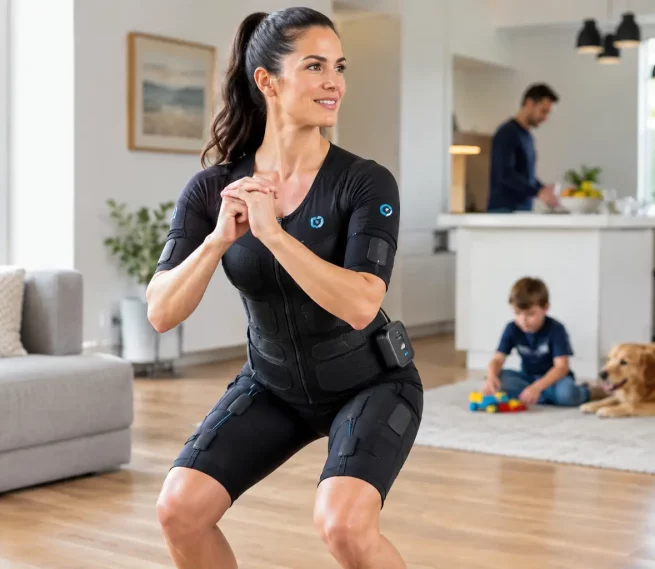
A packed diary is rarely the real reason people stop training. More often, it is the gap between knowing what to do and having the time, energy and accountability to do it consistently. So, can EMS replace gym workouts? For many people, it can replace a large part of their weekly resistance-training routine. For others, it works best as a powerful complement rather than a total substitute.
The honest answer depends on your goal, your training history and what you mean by a “gym workout”. A 30-minute EMS session is not a shortcut that removes the need to move well, recover properly or make sensible food choices. It is a coached, highly efficient way to challenge major muscle groups at the same time – and for the right person, it can make consistent training finally realistic.
What EMS training actually does
Electro Muscle Stimulation uses a wearable suit to deliver controlled electrical impulses to targeted muscles while you perform guided exercises. Those impulses encourage a stronger muscle contraction alongside your voluntary movement. Your coach adjusts the intensity to your ability, movement quality and goals.
At E-Pulse Studio, that means you are not left alone in a suit hoping for a result. You train with a coach who can correct your squat pattern, adapt exercises around a sore knee or stiff back, and gradually progress the session as your capacity improves. This matters because EMS is most effective when the stimulation supports good movement, rather than replacing it.
A typical session can challenge legs, glutes, core, back, chest and arms within 30 minutes. Compared with a conventional gym session, where you may spend an hour moving between equipment, warming up, waiting for machines and deciding what to do next, the training density is very different.
Can EMS replace gym workouts for strength and body shape?
For beginners, busy professionals and anyone returning to exercise after a long break, EMS can absolutely become the main form of strength training. Two coached sessions a week can provide a clear, repeatable stimulus without needing to build an entire gym programme from scratch.
That consistency is a major advantage. A well-designed programme performed twice every week will usually produce more progress than an ambitious five-day gym plan that only happens when life is unusually quiet. Clients often notice better posture, firmer muscle tone, improved confidence with movement and a growing ability to handle everyday tasks without feeling drained.
For body composition goals, EMS can support fat loss and muscle retention because it gives your muscles a meaningful training signal while you improve your overall activity and nutrition. It is not a magic calorie burner. Fat loss still comes from a sustained energy deficit, and the best results tend to come when training is paired with practical eating habits, sleep and regular walking.
For experienced lifters, the answer is more nuanced. EMS can support strength, muscular endurance and training variety, but it may not fully replace heavy barbell work if your specific goal is to maximise a one-repetition squat, deadlift or bench press. Strength is partly muscle capacity, but it is also skill. If you want to become excellent at lifting a heavy barbell, you need some practice lifting heavy barbells.
Where EMS can outperform the traditional gym
The traditional gym is useful, but it asks a lot from a busy person: plan the session, travel there, choose exercises, manage technique, stay motivated and fit the whole process around work and family. EMS reduces that friction.
The biggest benefit is time efficiency. A focused 30-minute session can fit before work, during a lunch break or between school runs. There is no need to spend an evening wandering through a crowded gym floor. You arrive, train with purpose and leave knowing the work is done.
Coaching is another difference. When fatigue sets in, many people compensate with poor form or stop before they have trained effectively. A trainer can spot that immediately, adjust the load and keep you working at the right level. That makes EMS particularly valuable for beginners, people who have lost confidence in gyms, and those who need structure to stay on track.
It can also be a sensible option for people managing mobility restrictions or recurring discomfort. Low-impact movements, careful positioning and individually controlled intensity can make strength training more accessible than high-impact classes or heavy free-weight sessions. That said, pain is not something to train through blindly. If you have an injury, medical condition, recent surgery or persistent symptoms, your programme should be discussed with an appropriate healthcare professional and adapted by an experienced coach.
What EMS cannot fully replace
If fitness means being able to run 10 kilometres faster, play a full match of football or climb hills on holiday without getting breathless, you need to do some of that activity. EMS can help build the strength and muscular endurance behind performance, but it does not replicate the specific demands of running, cycling, swimming or sport.
Cardiovascular fitness also benefits from dedicated aerobic work. Brisk walking, cycling, rowing, jogging or sport all have a place, depending on your starting point and preferences. EMS sessions can be demanding and may contribute to improved overall conditioning, but they should not be presented as the only route to heart and lung fitness for everyone.
Nor can any studio session replace daily movement. The person who trains twice a week but sits still for the rest of the week will not feel as good as the person who trains twice a week, walks regularly, takes breaks from their desk and prioritises recovery. The goal is not to make exercise smaller. It is to make it more achievable and more effective.
The best approach for most busy adults
For many clients, the most effective plan is not EMS versus the gym. It is EMS as the anchor of the week.
Two 30-minute coached EMS sessions can cover structured full-body resistance training. Add regular walks and one or two enjoyable cardio sessions if your goal includes stamina, stress relief or sport performance. This creates a programme that is challenging enough to change your body, but realistic enough to survive a demanding job, family commitments and the occasional chaotic week.
A runner may use EMS to strengthen glutes, hamstrings and core while continuing their runs. A golfer may use it to improve lower-body strength, posture and control while keeping time for the course. Someone rebuilding confidence after back discomfort may begin with coached EMS and walking, then add other training once movement feels stronger and safer.
Progress should be measured, not guessed. Photos, how clothes fit, energy levels, strength improvements and mobility all tell part of the story. A 3D body scan can add useful data by tracking changes in body composition and measurements over time. The point is not to obsess over one number. It is to see evidence that the effort is working and adjust the plan when it is not.
How to know whether EMS is right for you
EMS is worth considering if you want expert guidance, struggle to make long gym sessions happen, value measurable progress or need a lower-impact route back into resistance training. It is also a strong option if you are tired of starting and stopping every January because your plan does not fit your actual life.
You may prefer a traditional gym as your main training base if you love lifting, enjoy the social environment, have time for longer sessions and want highly specific practice in a particular sport or lift. There is no prize for choosing one method over another. The best training method is the one that safely moves you towards your goal and that you can keep doing.
The strongest results come from treating EMS as serious training. Turn up regularly, work with intent, listen to your coach, recover well and support the sessions with everyday movement and nutrition that match your goal. If that sounds more manageable than spending hours in the gym each week, book a session and experience what focused, coached training can do for you.
 7min
7min