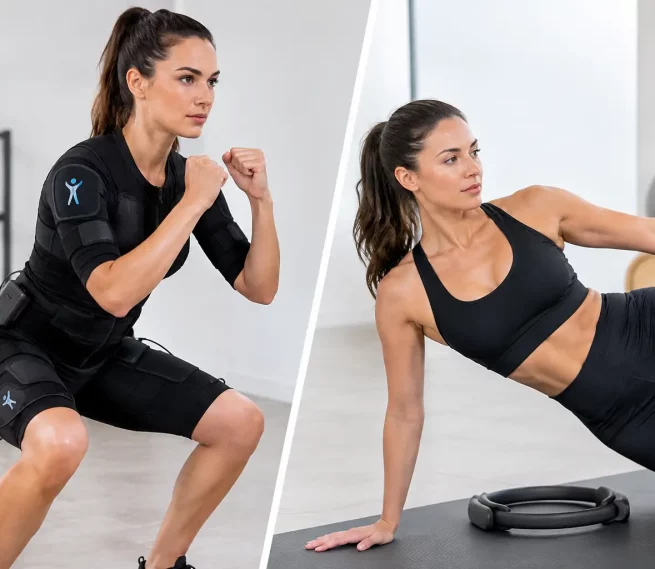
The school run has happened, your diary is already full, and dinner still needs sorting. For many mums and dads, exercise is not a lack of priority – it is a lack of usable time. That is where busy parent EMS results can make a genuine difference: focused, coached training that fits into a demanding week without asking you to live at the gym.
A 30-minute EMS session will not replace good nutrition, sleep or consistency. But it can give time-poor parents a powerful route back to strength, confidence and momentum, with a trainer there to make every minute count.
Why ordinary gym plans often fail busy parents
The usual fitness advice sounds simple: train three to five times a week, add cardio, prepare your meals, stretch, recover and repeat. It may be effective on paper. In real family life, it can be almost impossible to sustain.
A missed workout becomes a missed week. A disrupted night with a child means an early-morning run feels unrealistic. Work overruns, clubs start, childcare changes and the plan that looked perfect on Sunday evening disappears by Wednesday.
The issue is not motivation. Most parents are already highly motivated people. They manage households, careers and other people’s needs every day. What they need is a training structure with a lower time cost and a higher level of accountability.
EMS, or Electro Muscle Stimulation, supports muscular contractions while you perform purposeful, trainer-led movements. At E-Pulse Studio, sessions are built around your current fitness, goals, movement quality and any relevant limitations. Rather than wandering between machines or guessing what to do next, you train with clear direction from start to finish.
What busy parent EMS results can realistically look like
Results are personal. Your starting point, training frequency, food habits, stress levels, recovery and medical history all matter. No responsible coach should promise the same transformation to every person in the same timeframe.
That said, parents who train consistently often notice practical changes before the mirror tells the whole story. Carrying a toddler up the stairs feels less demanding. Getting up from the floor becomes easier. Back and shoulder tension can reduce as strength, posture and movement control improve. Clothes may begin to fit differently as body composition changes.
For one parent, the biggest win may be rebuilding strength after years of putting everyone else first. For another, it is feeling confident in photos again. A runner may want more powerful legs and improved conditioning. Someone returning after back discomfort may simply want to move without fear.
The strongest results are usually measurable as well as visible. Regular 3D body scanning can help track changes in body composition and circumference, rather than relying only on scale weight. That matters because muscle gain, fat loss and water fluctuations do not always show up clearly on a set of bathroom scales.
Strength and tone without long workouts
EMS training is particularly suited to parents who want full-body resistance work but cannot commit to lengthy gym sessions. During a coached session, the aim is not to rush through random exercises. It is to create quality muscular work with safe technique, controlled intensity and progression over time.
As strength improves, everyday life tends to feel lighter. Lifting shopping, carrying bags, getting children into car seats and keeping up on family days out all ask more of your body than you may realise.
Better posture and movement confidence
Hours at a desk, driving between commitments, feeding a baby, carrying children on one hip and poor sleep can all take their toll. Many busy parents arrive feeling rounded through the shoulders, tight through the hips and disconnected from their core.
A well-designed EMS programme can prioritise postural strength, glute activation, core control and mobility alongside body-shaping goals. This is not about chasing a punishing workout for its own sake. It is about helping your body move more capably and comfortably.
Momentum that does not drain your week
The hidden benefit of a short appointment is often consistency. When training takes 30 minutes rather than two hours door to door, it is easier to protect that slot in your calendar. You leave knowing you have completed a meaningful session, not feeling guilty that you have taken an entire evening away from home.
That consistency creates momentum. And momentum is what produces change.
The smart way to fit EMS around family life
Parents do not need a perfect routine. They need a repeatable one. For many people, one or two coached EMS sessions per week are far more sustainable than an ambitious plan that collapses after ten days.
Start by choosing slots you can realistically defend. This could be just after the school drop-off, during a lunch break, before collecting the children, or at a time when your partner can take over. Treat it as a health appointment, not an optional extra you cancel whenever life gets busy.
On non-EMS days, keep movement simple. A brisk walk, a few mobility drills, playing in the park or taking the stairs can all support recovery and general activity. You do not need to turn every spare moment into a workout. The goal is a routine that adds energy to family life rather than competing with it.
Food matters too, particularly for fat loss and body recomposition. Extreme dieting rarely works well when you are tired, busy and responsible for feeding everyone else. A better approach is to build reliable basics: protein with meals, plenty of fibre-rich foods, enough water and meals that reduce the temptation to grab whatever is quickest at 4 pm. Organic supplementation may also support your wider nutrition and recovery plan where appropriate, but it is an addition, not a substitute for the fundamentals.
Why coaching makes the difference
A suit alone does not produce a result. The quality of coaching, exercise selection, intensity, progression and recovery guidance all matter.
For beginners, expert coaching removes the uncertainty that stops many people from starting. You do not need to know your way around a gym or arrive already fit. Your trainer can adapt movements, explain what you should feel and build confidence without making you feel watched or judged.
For experienced exercisers, the value is precision. Training can be progressed according to your goals, whether that means strength, conditioning, mobility, body recomposition or sport-specific performance. Parents who used to train regularly often appreciate that EMS gives them a clear challenge without needing to spend hours rebuilding an old gym routine.
Small-group sessions can work well too, especially if you enjoy encouragement from others. Training alongside a supportive group creates energy and accountability, while keeping the coaching personal enough to maintain good form and suitable intensity.
When EMS needs a more careful approach
EMS is not a shortcut around every health issue, and it is not suitable for everyone. If you are pregnant, recently postnatal, have a pacemaker or other implanted electronic device, have certain neurological or cardiovascular conditions, or are managing an injury, you should discuss suitability with a qualified professional before training.
Postnatal parents deserve particular care. The right time to return to structured exercise depends on your birth, recovery, symptoms and medical guidance. A gradual, individual approach is far more valuable than pressure to “bounce back”.
Likewise, if pain is severe, new, worsening or unexplained, seek appropriate medical advice first. Training should support your health, not mask a problem that needs assessment.
Make the time you have count
The parents who get the best outcomes are not necessarily those with the most free time. They are usually the ones who stop waiting for the perfect week and commit to a realistic plan they can repeat.
Your body does not need endless hours of exercise to begin changing. It needs the right stimulus, expert guidance and enough consistency for that work to compound. If 30 focused minutes helps you feel stronger for the school run, more confident in your clothes and more present at home, that is not a compromise. It is a result worth protecting.
 7min
7min