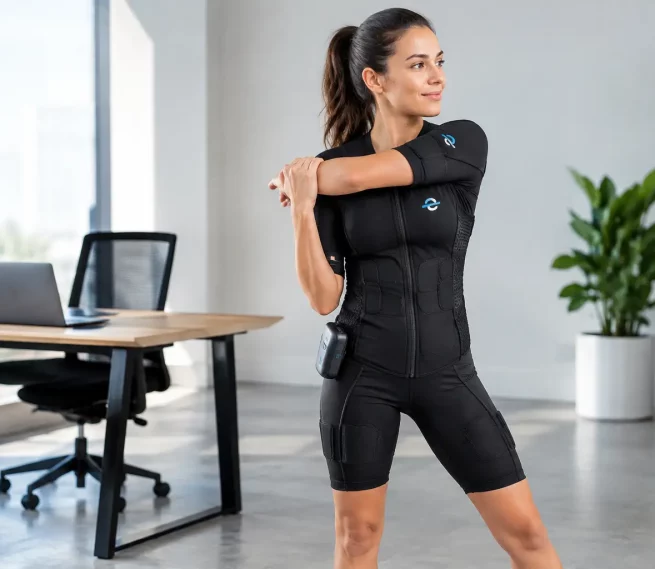
When your week already includes interval sessions, a long run, work, family and the usual life admin, adding more gym time can feel unrealistic. That is exactly why EMS training for runners is getting attention. It offers a way to build strength, improve muscle recruitment and support recovery in short, coached sessions that fit around a demanding schedule.
For runners, the appeal is obvious. You want stronger legs, a more stable trunk, better posture late in a race and fewer niggles, but you do not always want another hour in the gym. The right EMS programme can help fill that gap. The key phrase is the right programme, because this is not a magic shortcut and it is not a replacement for running itself.
Why EMS training for runners makes sense
Running is repetitive by nature. That repetition builds endurance, but it can also expose weak links. A runner might have excellent aerobic fitness while still lacking glute strength, trunk control or the ability to maintain form under fatigue. Those gaps often show up as a drop in pace, heavy legs, sore hips or recurring tightness through the lower back and calves.
EMS works by sending electrical impulses to the muscles during guided exercise, helping them contract more intensely than they might during standard bodyweight movements alone. In practice, that means a short session can place a strong demand on multiple major muscle groups at once. For runners, that can be valuable when the goal is efficient strength work without piling on excessive training volume.
This is especially useful for busy professionals and parents who want measurable progress without spending several evenings each week in a weights area. A focused 20-minute EMS session, delivered with proper coaching, can support strength development in a way that complements running rather than competes with it.
What runners can realistically gain
The strongest case for EMS is not that it turns a 10k runner into a marathon champion overnight. It is that it can improve the physical qualities that support better running.
Stronger posterior chain and better running form
Many runners are quad-dominant. They drive forwards, but they do not always use the glutes and hamstrings efficiently. Over time that can affect stride mechanics and load the knees more than necessary. EMS sessions often target the glutes, hamstrings, core and back very effectively, which can help runners hold posture and produce force more cleanly.
When form starts to fade in the final third of a race, strength matters. Better trunk stiffness and hip stability can mean less wasted movement and a smoother stride when you are under pressure.
Time-efficient strength training
This is where EMS stands out. A runner who skips strength work is rarely lazy. More often, they are short on time or unsure how to fit it around key runs. EMS gives structure to that problem. One or two short sessions per week can provide a serious muscular stimulus without asking for another long gym block.
For people who travel, work long hours or struggle with consistency, that efficiency can be the difference between talking about strength training and actually doing it.
Support for injury resilience
No training method can promise an injury-free season, and anyone who says otherwise is overselling it. But stronger muscles, better control and improved movement quality usually put runners in a better position to cope with training load.
If you have a history of lower back discomfort, hip instability or recurring tightness from poor posture, a coached EMS programme may help address some of the underlying strength deficits. That matters because many running issues are not just about the foot or the knee. They are often linked to how the whole body is managing force.
Recovery and reduced wear from heavy gym lifting
Traditional strength work still has huge value, especially for experienced runners who can lift well and recover properly. But not every runner wants barbell sessions on top of mileage, speed work and life stress. EMS can offer a lower-impact route to meaningful muscular work, particularly during busy periods or when joint irritation makes conventional loading less appealing.
Where EMS fits in a runner’s training plan
The biggest mistake is treating EMS as an add-on with no thought behind it. If your week is already overloaded, any extra stimulus can tip you into fatigue. Runners get the best results when EMS is placed intelligently around key sessions.
For most people, one session per week is a sensible starting point. That gives enough stimulus to build strength without disrupting running quality. More advanced runners or those with specific strength deficits might do two, but that depends on race goals, training age and recovery capacity.
A common approach is to avoid hard EMS work immediately before a speed session or long run. If your legs feel heavy, your running mechanics will suffer. Many runners do better placing EMS after an easier run day or allowing enough time before the next demanding workout.
This is where coached programming matters. A runner building towards a half marathon has different needs from someone returning after a lay-off. At E-Pulse Studio, that individual coaching model is one of the real advantages. It is not just about switching the machine on. It is about matching intensity, movement selection and progression to the person in front of you.
What EMS does not replace
It does not replace miles
If your goal is a faster 5k, 10k or marathon, you still need to run. Aerobic development, pacing skill and race-specific endurance come from structured running. EMS can support those qualities, but it cannot stand in for them.
It does not replace all traditional strength training forever
For some runners, EMS may become their main strength method because it is practical and sustainable. For others, it works best alongside occasional free weights, mobility work or plyometrics. It depends on your experience, injury history and the demands of your event.
If you are an advanced club runner chasing performance margins, you may still benefit from heavy lifting at certain points in the year. If you are a busy recreational runner who simply wants to feel stronger and more durable, EMS may cover much of what you need.
It is not meant to leave you guessing
Good EMS training should feel purposeful, not random. Intensity, exercise choice and recovery all matter. Going too hard too soon is not smart training. Neither is treating every session like a punishment. The best results come from consistency, not theatrics.
Is EMS training for runners good for beginners?
Yes, often more than people expect. Beginners usually need structure, accountability and confidence as much as they need physical training. EMS can provide all three when delivered in a personal coaching environment.
If someone is new to running and also carrying extra body weight, dealing with poor posture or returning from a long inactive period, jumping straight into lots of gym work and lots of miles can be too much. EMS offers a controlled way to start building strength while keeping the overall time commitment manageable.
It can also help people who have always said, “I know I should do strength work, I just never keep it up.” When sessions are short, coached and measurable, adherence tends to improve. And adherence is where results begin.
Who should be cautious
EMS is effective, but it is not a blanket answer for every runner in every situation. If you are deep into race season, already carrying a lot of fatigue and barely recovering between sessions, adding extra work may not be the move right now. Sometimes the better decision is to reduce load, improve sleep and get your running week stable first.
There are also medical considerations with EMS, so proper screening matters. Any reputable studio will cover that before training starts.
The other point is expectation. If you are looking for a passive fix while ignoring your training plan, footwear, recovery and fuelling, you will be disappointed. EMS works best as part of a bigger performance picture, not as a substitute for common sense.
What good results usually look like
For runners, progress often shows up in practical ways before it shows up in race times. You may notice hills feel more controlled, your posture holds together longer, or niggles settle because your body is sharing load better. Some runners report feeling more powerful through the stride. Others simply feel less battered after a demanding training block.
That matters. Performance is not only about one finish time. It is also about staying consistent enough to train well for months, not just a few motivated weeks.
If you are the sort of runner who wants efficient, coach-led support rather than another forgotten gym membership, EMS can be a smart addition. Used properly, it gives you targeted strength work in a format that respects real life and still moves you forward.
The best training plan is the one you can recover from, repeat and trust. For many runners, that is exactly where EMS earns its place.
 7min
7min