You feel it when the stairs stop being a nuisance, when your runs hold together for longer, or when a hard session no longer wipes you out for the rest of the day. That is why VO2 max improvement methods matter. They are not just for endurance athletes. They matter for busy professionals, parents, returners to fitness, and anyone who wants better stamina, stronger recovery, and measurable progress from the time they do have.
VO2 max is a measure of how well your body can use oxygen during exercise. In plain English, it gives you a useful picture of your aerobic fitness. A higher VO2 max often means you can work harder for longer, recover faster between efforts, and cope better with physical stress. It is not the only metric that matters, but it is a strong one, especially if your goals include fat loss, better energy, improved sports performance, or simply not feeling out of breath too easily.
What actually improves VO2 max?
The short answer is this: your body needs a reason to adapt. That means repeated exposure to the right kind of training stress, enough recovery to absorb it, and a plan that fits your current level. People often go wrong by doing all their training at one middling pace. It feels productive, but it is not always the fastest route to better aerobic capacity.
The best VO2 max improvement methods usually combine intensity, consistency, and progression. The trick is choosing the right mix for your body, your schedule, and your injury history.
1. Interval training at the right intensity
If you want one of the most effective tools for improving VO2 max, this is it. Intervals push your cardiovascular system hard enough to trigger adaptation, but with recoveries built in so you can sustain quality effort.
A classic example is 3 to 5 rounds of 3 minutes hard, with 2 minutes easy recovery. Hard should mean controlled but demanding. You should not be sprinting from the first few seconds, but you should be working at an effort where conversation becomes very limited.
This works because time spent near your upper aerobic limit teaches the heart, lungs, and muscles to deliver and use oxygen more efficiently. It is effective on a bike, rower, treadmill, cross trainer, or outdoors. For beginners, shorter intervals often make more sense. For trained individuals, longer intervals can produce excellent results.
The trade-off is recovery cost. Intervals work, but too many can leave you flat, sore, or inconsistent. Two focused sessions a week is enough for many people.
2. Steady aerobic work builds the base
There is a reason endurance coaches still value easier training. Lower-intensity aerobic work improves your base fitness, supports recovery, and helps you tolerate harder sessions better.
This is the kind of session where you can speak in short sentences, not sing, and not gasp. For some people that might be a brisk walk on an incline. For others it is a gentle jog, cycle, or swim. The point is not to impress anyone. The point is to build capacity.
Steady aerobic work helps improve stroke volume of the heart, mitochondrial function in the muscles, and overall efficiency. It may not feel dramatic in the moment, but over weeks it creates the foundation that makes harder training more productive.
For busy people, this matters. If your week is packed, one or two interval sessions paired with one or two lower-intensity sessions is often more sustainable than trying to smash every workout.
3. Progression beats random effort
One of the most overlooked VO2 max improvement methods is simple progression. Your body adapts when training becomes gradually more challenging over time. Without progression, fitness tends to stall.
That progression might mean adding one extra interval, increasing the work period slightly, covering more distance in the same time, or reducing recovery between efforts. It does not need to be dramatic. In fact, aggressive jumps usually backfire.
What works best is measured progress you can repeat. This is where coaching and tracking make a real difference. If your training is guided by data rather than guesswork, you are more likely to improve without burning out.
For many clients, measurable milestones are what keep motivation high. When you can see your pace improve, your recovery heart rate drop, or your body composition move in the right direction, consistency becomes much easier.
4. Strength training supports aerobic performance
People sometimes separate cardio and strength as if they live in different worlds. In reality, stronger muscles can improve movement economy, posture, force production, and fatigue resistance. That all matters when you are trying to move efficiently and sustain effort.
If your legs and trunk are weak, your body has to work harder to produce the same output. If your posture collapses under fatigue, breathing mechanics can suffer too. Well-structured strength work helps fix those leaks.
This does not mean you need to spend hours in a weights area. Short, targeted sessions can improve how your body handles load and movement. For clients with joint pain, previous injury, or poor training tolerance, building strength first can be the difference between steady progress and repeated setbacks.
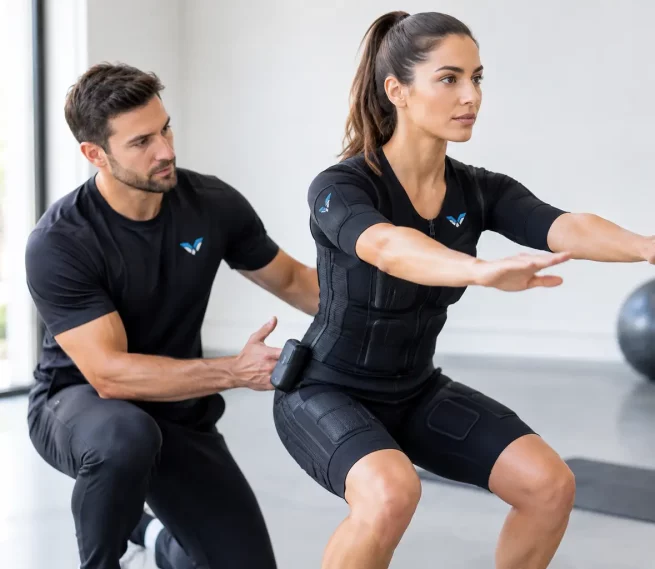
At E-Pulse Studio, this is one reason coaching-led EMS training appeals to time-poor adults. Done properly, it can support muscular strength and conditioning in a highly efficient format, which can complement a broader plan aimed at stamina and performance. It is not a magic shortcut, but it can be a smart tool when used in the right programme.
5. Recovery is part of the plan
You do not improve during the session. You improve after it, when your body has time and resources to adapt. That means poor recovery can quietly cap your VO2 max progress even if your training looks good on paper.
Sleep is a major factor. So is nutrition. So is stress. If you are surviving on broken sleep, working long hours, skipping meals, and trying to train flat out, your body will usually let you know.
That does not mean life has to be perfect. It means training should match reality. In a stressful week, it may be smarter to reduce intensity and keep movement consistent rather than forcing a heroic session that derails the next four days.
Hydration, sufficient protein, enough total energy intake, and recovery days all help. If you are training hard and under-fuelling, especially while trying to lose fat, your performance can plateau quickly.
6. Body composition can affect the number
This point needs a bit of nuance. VO2 max is often expressed relative to body weight, so body composition changes can influence the score. If you reduce excess body fat while keeping or improving muscle and fitness, relative VO2 max often improves.
That is one reason people sometimes notice a sharp change when they combine sensible conditioning with nutrition support. They are not just getting fitter. They are also carrying less non-functional mass.
But chasing lighter at all costs is not the answer. Rapid dieting can reduce energy, compromise recovery, and make quality training harder. Better results usually come from a steady approach that protects muscle and supports performance.
For clients focused on transformation, the best outcome is often a double win: improved stamina and improved body composition. That combination tends to feel better in real life than chasing a single metric.
7. Testing and coaching keep it honest
The most effective plans are rarely the most complicated. They are the ones you can follow, recover from, and adjust when needed. That is why testing matters.
If you are not measuring anything, it is easy to mistake effort for progress. Regular fitness assessments, body scans, heart rate trends, and performance markers help show whether your plan is actually working. They also help you avoid common mistakes, such as training too hard too often or staying too comfortable for too long.
Coaching matters for the same reason. One person may thrive on interval work three times a week. Another may improve more with two short high-quality sessions and extra recovery because of age, stress, or injury history. There is no single formula that suits everyone.
Common mistakes that slow progress
Most plateaus come from a few predictable issues. The first is inconsistency. A perfect week followed by two missed weeks will not move the needle much. The second is overdoing high-intensity work because it feels like the fastest route. The third is ignoring mobility, pain, or movement limitations that reduce training quality.
There is also the problem of choosing the wrong mode. If running flares up your knees, but cycling allows you to push safely, then cycling is the better tool right now. The best training method is the one that gets done well and repeated often enough to create adaptation.
The best approach for busy adults
If your time is limited, the answer is usually not more sessions. It is better sessions. A practical week might include two focused interval-based workouts, one or two easier aerobic sessions, and one or two strength-based sessions depending on your recovery and goals. For some people, those elements can overlap in a well-designed coaching environment.
That structure gives you enough intensity to improve, enough base work to support it, and enough recovery to stay consistent. It is efficient, realistic, and far more effective than relying on random effort whenever you happen to find an hour.
Improving your VO2 max does not require an athlete’s lifestyle. It requires the right stimulus, repeated consistently, with a plan that respects your body and your schedule. Start where you are, train with intent, and let measurable progress build your confidence from there.

 8min
8min