The stiffness that hits when you stand up from your desk is not simply an age thing. It is often your body telling you that certain muscles have been switched off for too long. Muscle activation for sedentary adults is about bringing those muscles back into the conversation, so everyday movement feels stronger, steadier and less restricted.
For busy professionals, parents and business owners, the issue is rarely a lack of intent. It is the reality of long meetings, commuting, school runs and a diary that leaves little room for a 90-minute gym session. The good news is that activation does not require endless workouts. It requires the right movements, performed with control, consistency and enough coaching to make every minute count.
Why sitting changes how your body moves
Your body adapts to what you do most. If most of your day is spent sitting, your hip flexors can become short and overactive, while your glutes may contribute less when you walk, climb stairs or train. Your upper back may stiffen as your chest and shoulders round forwards over a laptop. Your deep core can also become less effective at providing the stability your spine needs.
That does not mean you are permanently damaged, nor does it mean sitting is a personal failure. It means your training should meet your starting point honestly. Throwing yourself into high-impact classes or heavy lifting before you can control a basic squat may leave you feeling more sore, more discouraged and no closer to a lasting routine.
The goal is not to chase exhaustion. It is to restore connection between your brain and the muscles that should be doing the work.
What muscle activation for sedentary adults really means
Muscle activation is the deliberate process of recruiting a muscle before asking it to handle greater load, speed or range of movement. Think of it as preparing the team before the big match. You are teaching your glutes to help extend your hips, your core to resist unwanted movement, and your upper back to support a taller posture.
For someone who has been inactive, this often starts with surprisingly simple exercises. A controlled glute bridge, a supported squat, a banded row or a dead bug can reveal where you compensate. You might feel your lower back taking over in a bridge, your knees collapsing in a squat or your shoulders creeping towards your ears during a row. These are useful signals, not reasons to stop.
Good coaching helps you adjust your position, reduce the range, slow the repetition or choose a more suitable variation. The right exercise is the one you can feel in the intended area while maintaining control, not the one that looks most impressive online.
Start with the muscles desk life often neglects
Glutes and hips
Your glutes support walking, running, getting up from a chair and producing power through your lower body. When they are under-recruited, the lower back or front of the thighs can take on more than their fair share.
Begin with bridges, sit-to-stands and split-stance work, using a light range and slow tempo. Focus on gently squeezing the glutes as you stand rather than arching your back to force the movement. If you spend much of the day at a desk, brief hip mobility work can make this activation feel far more natural.
Core and breathing muscles
Core training is not about holding your breath through endless crunches. A useful core creates a stable base while you breathe, reach, carry and move your limbs. For sedentary adults, controlled exercises such as dead bugs, bird dogs and loaded carries can be more valuable than chasing hundreds of sit-ups.
The key is pressure management. Exhale gently as you exert effort, keep your ribcage from flaring and avoid tensing every muscle in your body. You should feel supported, not rigid.
Upper back, shoulders and posture
Forward-head posture and tight shoulders are common after hours at a screen. Strengthening the upper back helps counterbalance that position, but posture is not solved by forcing your shoulders backwards all day. It improves when you build the strength and mobility to move out of the desk position comfortably.
Rows, wall slides and controlled pulling movements are excellent starting points. Pair them with regular screen breaks and a workstation that supports a neutral, comfortable position. Training helps, but your daily environment still matters.
A realistic routine beats an ambitious restart
The best activation plan is one you can repeat next week. For many sedentary adults, two focused strength sessions each week, combined with more frequent low-level movement, creates a strong foundation. A ten-minute walk after lunch, a few chair squats between calls and a short mobility reset in the evening all count.
A simple session might begin with five minutes of gentle movement to raise your temperature, followed by a few activation drills and then strength exercises suited to your ability. Finish feeling worked, not wrecked. You should be able to move well afterwards and return with confidence, rather than needing several days to recover from one heroic effort.
Progress can come from improving technique, moving through a slightly larger range, adding a little resistance or completing an extra repetition with control. It does not always mean making the session harder. For a client whose back has felt stiff for months, being able to squat to a chair without discomfort is genuine progress.
Where EMS can add value
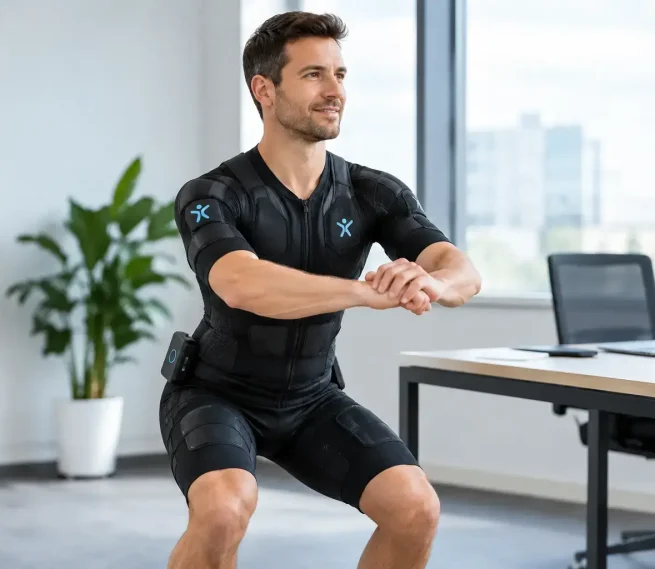
Electro Muscle Stimulation training can be a useful option for people who want a time-efficient, coached route back into regular exercise. During an EMS session, electrical impulses are used alongside purposeful movements to encourage muscle contractions while a trainer guides technique, intensity and progression.
At E-Pulse Studio, this is not treated as a shortcut that replaces movement quality. It is a 30-minute, coach-led training format designed to help clients work their major muscle groups efficiently, with the programme adapted around goals, fitness level and any mobility considerations. For someone balancing work and family commitments, that structure can make consistency far more achievable than an open-ended gym plan.
EMS is not appropriate for everyone, and a proper health screening matters. Pregnancy, certain implanted medical devices, epilepsy and some medical conditions may require medical guidance or mean EMS is unsuitable. A qualified professional should always discuss your history before training begins, especially if you have persistent pain, recent surgery or a diagnosed condition.
Do not ignore pain, numbness or repeated flare-ups
Activation training should create effort, warmth and perhaps mild muscle fatigue. Sharp pain, tingling, numbness, dizziness or pain that worsens afterwards is different. Stop the exercise and seek appropriate clinical advice. If you are returning after an injury, physiotherapy guidance can shape what training is suitable and when.
There is also a difference between feeling stiff because you have been still and experiencing ongoing back, hip or shoulder pain. Strength training can be part of a wider plan, but it should not be used to push through symptoms without understanding them.
Make the first month about evidence, not perfection
Rather than judging success only by the scales, notice the daily changes. Are you standing taller in the kitchen? Do stairs feel less demanding? Can you sit through a meeting without constantly shifting position? Are you more confident carrying shopping, playing with the children or returning to a sport you enjoy?
These wins build the evidence that your body is responding. With consistent activation and progressive strength work, sedentary adults can improve their control, mobility and capacity without living in the gym. You do not need to become a different person overnight. You need a plan that respects where you are now, challenges you safely and gives you a reason to keep turning up.
Your next session does not have to be dramatic. It just has to be the moment you decide that feeling stiff, weak or short on time no longer gets the final say.
 7min