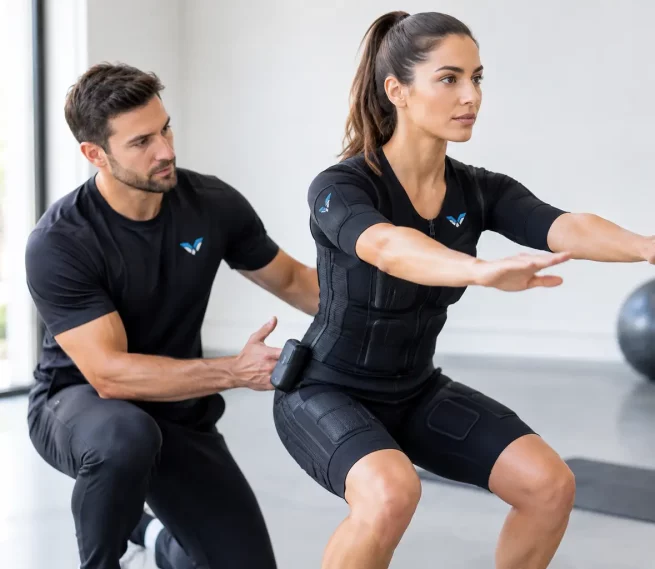
You do not need to be fit, confident in a gym, or willing to spend hours training each week to get started. That is exactly why ems sessions for beginners appeal to so many people – especially busy professionals, parents and anyone who wants expert support without wasting time on workouts that never quite stick.
If you have heard that EMS can help build strength, improve tone, support fat loss and reduce aches, you are not wrong. But your first session should not feel like a mystery. The best results come when you know what is happening, what your body is responding to, and how your coach will tailor the session around you.
What are EMS sessions for beginners?
EMS stands for Electro Muscle Stimulation. In a coached training session, you wear a specialist suit that sends carefully controlled electrical impulses to major muscle groups while you perform guided movements. Those impulses encourage deeper muscle activation than many people achieve in standard training, especially if they are new to exercise, returning after a break, or dealing with poor posture and weak core engagement.
For beginners, the key point is this: the session is not about being thrown in at the deep end. A proper EMS session is adjusted to your current fitness, movement quality, injury history and goals. If you have not trained in years, that matters. If you are already active but want better efficiency, that matters too.
This is one reason people often stick with EMS when they have struggled with traditional gyms. You are not left guessing. You are coached throughout, your intensity is managed properly, and every session has a purpose.
What your first EMS session actually feels like
Most beginners expect one of two extremes. They either think EMS will be uncomfortable and overpowering, or they assume it will be so easy that it cannot possibly work. The reality sits in the middle.
At first, the electrical pulses feel unusual rather than painful. Many clients describe them as a strong buzzing or rhythmic contraction. Your muscles switch on very clearly, and that awareness can be surprisingly helpful if you have spent years sitting at a desk, dealing with lower back tightness, or struggling to feel your core during normal exercise.
Once movement starts, the session becomes more demanding. Simple exercises such as squats, lunges, holds and controlled upper body movements feel harder because more muscle fibres are being recruited at once. That does not mean the session has to be brutal. In fact, a good beginner session is often quite measured. The goal is to introduce the stimulus safely, not to flatten you in 30 minutes.
You should leave feeling worked, supported and clear on what happened. You should not leave feeling confused or pushed beyond what your body can handle.
How beginners are assessed before training
A premium EMS session should start with coaching, not just kit. Before training begins, your coach should ask about your goals, training history, pain points, injuries, mobility limitations and lifestyle. This is where the difference between a specialist studio and a self-service fitness model becomes obvious.
If your main goal is fat loss, your training plan may focus on full-body effort, consistency and progression. If your issue is posture or back discomfort, movement quality and core activation may take priority. If you are returning after pregnancy, injury or a long break from exercise, the coach should scale the session accordingly.
Some studios also use body composition tracking or 3D body scanning to create a measurable starting point. For beginners, this can be a real advantage. It takes the guesswork out of progress. Instead of relying on mood or the mirror alone, you can see changes in body composition, posture and shape over time.
Why EMS works well for time-poor people
Many beginners are not short on motivation. They are short on time, energy and structure. They have tried joining a gym, attending classes, following apps or squeezing in home workouts, only to lose momentum when work gets busy or family life takes over.
EMS solves a different problem from conventional training. It is designed for efficiency. A short, coach-led session can deliver a serious training effect without asking for multiple long gym visits each week. For someone who has spent months saying, “I know I need to do something, I just cannot fit it in,” that matters.
That does not mean EMS is magic. You still need consistency, decent recovery and realistic expectations. But for many beginners, especially those who want visible progress without turning fitness into a second job, it is a practical fit.
Who EMS suits – and when it depends
EMS is a strong option for beginners who want guidance, accountability and a training format that feels purposeful from day one. It can suit people aiming to tone up, improve strength, support weight management, boost stamina, or rebuild confidence after a long break from exercise.
It can also be useful for people dealing with sedentary lifestyles, weak postural muscles, or recurring aches linked to poor movement habits. A coached session can help reconnect those muscles and build better body awareness.
That said, it depends on the individual. If someone has a specific medical condition, recent surgery, a pacemaker, or other contraindications, they need proper screening before starting. EMS should always be delivered responsibly. The quality of coaching is not a minor detail here – it is central to your safety and your results.
What results can beginners realistically expect?
Beginners often notice changes quickly, but the nature of those changes varies. Some feel stronger and more switched on within the first few sessions. Others notice better posture, more core stability, or reduced tightness through the back and shoulders. If body transformation is the goal, visible changes typically build with consistency over several weeks, especially when nutrition and recovery are also managed well.
This is where honest coaching matters. Quick does not mean instant. A good studio will not promise a dramatic transformation after one or two sessions. What it can offer is a highly efficient route to measurable progress when you show up consistently and follow the plan.
For many clients, the biggest win early on is not aesthetic. It is momentum. They finally find a format they can maintain. Once that happens, physical results usually follow.
How to get the most from your first few EMS sessions
Treat your first sessions as the foundation, not the final test. Tell your coach if something feels too intense, too easy or simply unfamiliar. Good feedback helps them fine-tune the settings and movement choices for your body.
Hydration matters more than many beginners realise, and recovery matters too. Because EMS creates a strong muscular stimulus, you need to give your body the support to adapt. That means enough water, sensible nutrition and allowing time between sessions as advised by your trainer.
It also helps to arrive with a clear goal. “I want to feel stronger in my core.” “I want to tone up before summer.” “I want to train without aggravating my back.” Specific goals make coaching sharper and progress easier to track.
If your studio offers body scanning or regular reviews, use them. Seeing your progress in numbers and visuals can be hugely motivating, especially on weeks when the mirror feels less convincing than the data.
Common worries beginners have
One common concern is whether EMS is only for already-fit people. It is not. In many cases, beginners benefit most because they need structure, coaching and efficient muscle activation.
Another worry is soreness. Yes, you may feel your session afterwards, especially at the start, but your coach should manage intensity properly. More is not always better. Smart progression beats trying to prove a point in week one.
People also ask if EMS replaces all other exercise. Usually, no. It can be a powerful primary training method, especially for time-poor clients, but the best overall results often come when it sits alongside daily movement, good sleep and sensible nutrition. If you enjoy walking, running, golf, mobility work or other sport, EMS can support those activities rather than compete with them.
Why coaching makes the difference
The suit and technology matter, but coaching is what turns an EMS session into real progress. A skilled trainer knows when to push, when to hold back, how to adapt around pain or mobility limits, and how to keep sessions aligned with your goal rather than making every workout feel the same.
That personal approach is especially valuable for beginners. You are not paying for confusion. You are paying for clarity, efficiency and results you can measure.
For anyone in Peterborough or Upminster who has put fitness off because life is busy, motivation is inconsistent or aches have made exercise feel daunting, a properly coached EMS session can be a smarter starting point than another abandoned gym membership.
Starting something new always brings a bit of uncertainty, but fitness should not feel like a punishment or a puzzle. The right first session gives you something better – a clear plan, expert support and proof that real progress can fit into real life.
 8min
8min