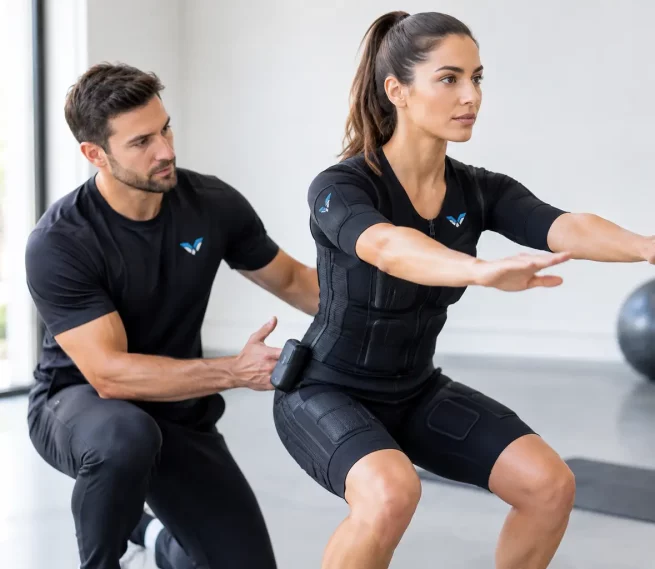
A toned physique is not built by chasing exhaustion or spending every evening in the gym. It comes from building and maintaining muscle, reducing excess body fat where appropriate, and training consistently enough for your body to adapt. Learning how to use EMS for toning gives busy people a focused way to work towards that result in a 30-minute, coach-led session.
EMS, or Electro Muscle Stimulation, uses carefully controlled electrical impulses alongside active exercise. The stimulation encourages your muscles to contract more deeply while you perform purposeful movements such as squats, lunges, presses and core work. It is not a shortcut where you lie down and expect a new body. It is a demanding form of training, made more efficient by technology and expert coaching.
Toning is muscle plus body composition
“Tone” is one of fitness’s most-used words, but it can mean different things to different people. For some, it means firmer arms and a stronger core. For others, it means more definition through the legs, improved posture, or feeling comfortable and capable in their clothes again.
Physiologically, muscles do not switch from untone to toned. They become stronger, more developed and better supported by the rest of your body. Definition then becomes more visible when your body composition, nutrition, movement and recovery support that goal.
That is why EMS works best as part of a complete plan. A high-quality session can create a powerful training stimulus, but your results are also shaped by protein intake, daily activity, sleep, stress and how regularly you show up. The real advantage is that EMS can make strength training realistic when a conventional gym routine keeps slipping down the priority list.
How to use EMS for toning: begin with the right baseline
Before increasing intensity, establish where you are starting from. A qualified trainer should discuss your goals, training history, injuries, pain, mobility and lifestyle. If your focus is a flatter-feeling stomach, firmer legs or improved posture, the programme should still train the whole body. Targeting one area alone will not spot-reduce fat, and it rarely produces the balanced shape or strength people want.
At E-Pulse Studio, 3D body scanning can give clients a clear starting point beyond the scales. Measurements, body shape changes and posture markers can be more motivating than body weight alone, particularly if you are gaining muscle while reducing fat. This matters because progress is often visible in how your clothes fit, how you stand and how confidently you move before it shows up as a dramatic change in kilograms.
For your first sessions, the goal is technique and familiarity. Your trainer will fit the EMS suit, place the electrodes correctly and adjust each muscle group individually. A stronger sensation is not automatically a better session. You should feel clear, firm contractions that allow you to move with control, breathe properly and maintain good form.
Train actively, not passively
The most effective EMS toning sessions pair the impulse with deliberate resistance-style exercise. Think controlled squats for legs and glutes, hip hinges for the posterior chain, rows and presses for the upper body, plus bracing and anti-rotation work for the core.
Your coach may use a range of tempos, holds and movement patterns to make the session challenging without overloading the joints. That makes EMS particularly useful for people returning to exercise, professionals with limited time, or clients whose mobility needs careful attention. It can also challenge experienced gym-goers who want an efficient strength stimulus alongside their current training.
Quality matters more than trying to do hundreds of fast repetitions. A slow squat with strong alignment through the feet, knees, hips and trunk will deliver far more value than a rushed movement performed at a high setting. Your trainer should coach the same fundamentals expected in any excellent strength session: posture, range of motion, breathing, control and progressive overload.
Build intensity gradually
EMS feels unfamiliar at first. The pulses are strong but should remain manageable, and the right level varies from one area of the body to another. Your legs may tolerate a different intensity from your abdominals, back or arms.
Start at an intensity where you can work with good mechanics. Over several sessions, your trainer can raise the stimulation and adjust exercise difficulty as your confidence, coordination and strength improve. This is how you make the training progressive rather than simply repeating the same workout every week.
More is not always better. Excessive intensity can compromise form, leave you overly sore or make the experience unpleasant enough that you stop attending. For toning, consistency beats occasional all-out sessions. One well-coached 30-minute EMS session each week can fit easily around work, family and other activities. Depending on your experience, recovery and wider training load, your coach may advise a suitable schedule rather than pushing frequency for its own sake.
Support your sessions outside the studio
EMS training can strengthen and shape the muscles, but it cannot compensate for a week spent sitting still, sleeping poorly and eating without any awareness of your goal. You do not need a restrictive plan to improve your physique, but you do need habits that give your body the materials and recovery time to adapt.
Prioritise protein across your meals to support muscle repair and fullness. Include fibre-rich vegetables, fruit and minimally processed carbohydrates for energy, particularly on training days. Drink enough water before and after your appointment, as hydrated muscle tissue performs better and recovery is easier to manage.
Outside the studio, walking is one of the simplest ways to reinforce body-composition goals without adding hard training stress. A daily walk, regular movement breaks and a more active commute can make a genuine difference over time. If fat loss is part of your aim, these everyday behaviours often matter as much as the session itself.
Sleep deserves the same attention. Muscle repair, appetite regulation and training motivation all suffer when sleep is consistently poor. You do not need perfection, but treating rest as part of the programme helps you get more from every session.
Use measurements that reflect real progress
The mirror can be useful, but it can also be unreliable from day to day. Track results over several weeks using consistent photos, body measurements, scan data, strength improvements and how you feel in daily life.
You may notice that stairs feel easier, your back feels more supported at your desk, or you can hold a stronger plank before you see major visual changes. These are meaningful signs that your body is adapting. Clients often stay motivated when they recognise these wins rather than judging every session by the scale.
A good coach will review your progress, ask how you are recovering and update the programme when needed. If your goal changes from general toning to a stronger performance focus, fat loss phase or post-injury return to exercise, your EMS plan should change with it.
Who should take extra care with EMS?
EMS is not suitable for everyone. Tell your trainer about any medical condition, implanted electrical device, pregnancy, recent surgery, epilepsy, circulatory concern or unexplained pain before you train. If you are under medical care or returning after injury, seek appropriate clinical advice first and make sure your coach understands your limitations.
For people with back discomfort, reduced mobility or a long break from exercise, a tailored EMS programme may be a useful starting point. However, it should never replace medical assessment where that is needed. The right approach is calm, gradual and personalised, with your trainer adapting movement and intensity to your current capacity.
Make the 30 minutes count
Arrive hydrated, wear suitable training clothing as advised, and let your coach know how you feel that day. If you are unusually sore, sleep-deprived or carrying a niggle, the session can be adapted. That is the benefit of a premium coach-led setting: the programme responds to your body, not just a screen.
Toning is built through repeatable effort. Book the session, train with intent, fuel your recovery and track the changes that matter to you. A stronger, more defined body is not the result of doing everything perfectly. It is the result of giving your body the right stimulus often enough to change.
 8min
8min