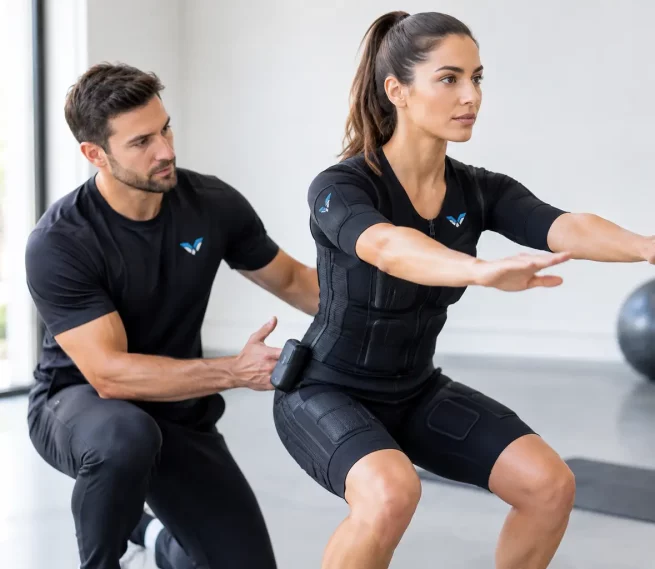
Thirty minutes can feel like a small window in a packed week. Yet, with the right coaching, focused movement and Electro Muscle Stimulation, it can become a serious training session. This guide to EMS group workouts explains how the format works, what it feels like and why it suits people who want more from their training time.
EMS group training is not a crowded class where you disappear at the back and hope you are doing it right. At E-Pulse Studio, groups are kept deliberately small – up to eight people – so every session remains coached, structured and personal. You train alongside others, but your intensity, movement options and targets are still your own.
What is an EMS group workout?
EMS uses low-frequency electrical impulses delivered through a specialist suit to stimulate major muscle groups while you perform controlled exercises. The impulses complement your voluntary muscle contractions, helping create a demanding training effect without relying on heavy barbells, long runs or hours on gym machines.
In a group workout, each participant wears their own EMS suit and works through a trainer-led programme. Think squats, lunges, presses, pulls, core work and mobility drills, adapted to the person in front of the coach. The room has energy and accountability, but the training is not one-size-fits-all.
A typical session lasts around 30 minutes. That includes setup, movement coaching and recovery guidance, rather than 30 minutes of random high-intensity effort. Your trainer adjusts the stimulation across different muscle areas, checks your technique and makes decisions based on how you are moving and how you feel that day.
Why small-group EMS works differently
The biggest advantage is the combination of efficiency and attention. Conventional classes can be motivating, but they often ask every person to follow the same pace, weight and range of motion. That can be frustrating if you are returning from injury, managing back discomfort or simply starting from a low fitness base.
A well-run EMS group gives you the motivation of training with others without sacrificing coaching quality. You may be working next to a runner building stronger legs, a busy parent aiming for body confidence and an office worker tackling stiffness from long days at a desk. Their goals differ, but everyone benefits from a clear session plan and a coach who can correct technique immediately.
The small-group environment also makes consistency easier. When people know their trainer and fellow members expect to see them, it is harder to let another week drift by. For many clients, that regularity is what drives the most visible change: better posture, stronger movement patterns, improved fitness and a body composition goal that finally has a routine behind it.
What happens in your first session?
Your first EMS group workout should never begin with maximum intensity. Good coaching starts with an assessment of your goals, training history, current movement and any injuries or health considerations. If you have not exercised for months, that is useful information, not a reason to feel out of place.
Once fitted with the EMS suit, you will be introduced to the sensation gradually. The stimulation often feels like a strong, rhythmic muscle contraction or pulsing pressure. It should be challenging, but never painful. You remain in control throughout, and your trainer can adjust individual muscle channels as needed.
The workout itself usually centres on simple, purposeful patterns. You might squat to a comfortable depth, hinge at the hips, perform a supported lunge, press against resistance or work through core stability positions. These movements can look straightforward. With EMS added and a coach demanding good form, they become far more focused than they appear.
Expect to work hard, sweat and feel muscles you may not usually notice. Expect too to be coached. The aim is not to leave you exhausted for the sake of it. The aim is to build capacity session by session so your strength, control and confidence keep moving forward.
Who can benefit from EMS group training?
EMS group workouts can suit beginners and experienced exercisers alike, but the programme should match the person. For a beginner, the value often lies in structure. You do not have to plan a workout, guess which machine to use or worry that everyone else knows more than you. You arrive, get coached and complete a session with a clear purpose.
For busy professionals, business owners and parents, the appeal is time. A focused 30-minute session can be far more realistic than attempting to find several hours each week for a traditional gym routine. Results still depend on attendance, nutrition, sleep and overall lifestyle, but a time-efficient plan removes one of the biggest barriers: the belief that fitness requires endless spare hours.
More advanced members can use EMS to complement their existing sport or gym programme. Runners may focus on leg strength, core stability and recovery-friendly conditioning. Golfers can work on posture, rotational control and mobility. Combat athletes may use sessions to support strength endurance and movement quality. It depends on the training load they already carry, which is why communication with the coach matters.
People dealing with stiffness, reduced mobility or recurring aches may also find the controlled format appealing. EMS is not a replacement for medical diagnosis or treatment, and it is not suitable for everyone. But with appropriate screening and sensible exercise selection, coach-led sessions can help people rebuild confidence in movement without being thrown into an intimidating gym environment.
How hard should an EMS group session feel?
Hard enough to create progress. Controlled enough that you can repeat it consistently.
This balance matters. More stimulation is not automatically better, especially when you are new to EMS. The right setting is one that challenges the muscles while allowing you to maintain good alignment, breathe properly and complete the planned repetitions with control. Chasing the highest number on the console can turn a smart session into poor-quality movement.
Your trainer should progress intensity over time, not all at once. As your body adapts, you may handle stronger contractions, deeper ranges of motion, more demanding exercise variations or improved work capacity. That gradual progression is where measurable results come from.
You may feel muscle fatigue after a session, particularly during your first few weeks. Recovery should be treated as part of the programme. Hydration, protein intake, sleep, light movement and appropriate rest all influence how well you respond. If you are unusually sore, run-down or carrying an injury, tell your coach before the session starts.
Getting more from your EMS group workouts
The most successful members approach EMS as a plan rather than a quick fix. They commit to a realistic weekly rhythm, usually with enough recovery between sessions, and use their trainer’s feedback to improve the details that compound over time.
Your body scan and progress checks can be especially valuable here. Scales alone do not tell the whole story. Changes in muscle mass, body fat, measurements, posture, energy and performance can reveal progress even when day-to-day body weight fluctuates. If fat loss is your goal, your nutrition needs to support it. If strength and performance are the priority, recovery and protein become even more relevant.
Bring water, wear suitable clothing as advised by your studio and arrive ready to communicate honestly. Tell your coach if your knee is sore, your sleep has been poor or a movement feels unstable. The best programme is not the toughest one on paper. It is the one that works with your current starting point and keeps you progressing safely.
Safety and suitability come first
EMS training requires professional screening. Certain medical conditions, implanted electronic devices, pregnancy and other health factors may mean EMS is unsuitable or requires medical clearance. A reputable studio will ask questions before training and will not pressure you to push through symptoms that do not feel right.
Technique also remains essential. EMS does not do the movement for you. Your posture, joint control, breathing and effort still determine the quality of every repetition. That is precisely why trainer-led small groups offer more value than being left alone with a suit and a screen.
The strongest results rarely come from dramatic promises. They come from turning up, being coached well and building a programme that fits your real life. If your current routine keeps getting squeezed out by work, family and fatigue, a focused EMS group session may be the practical place to restart – with people around you and an expert guiding every rep.
 8min
8min