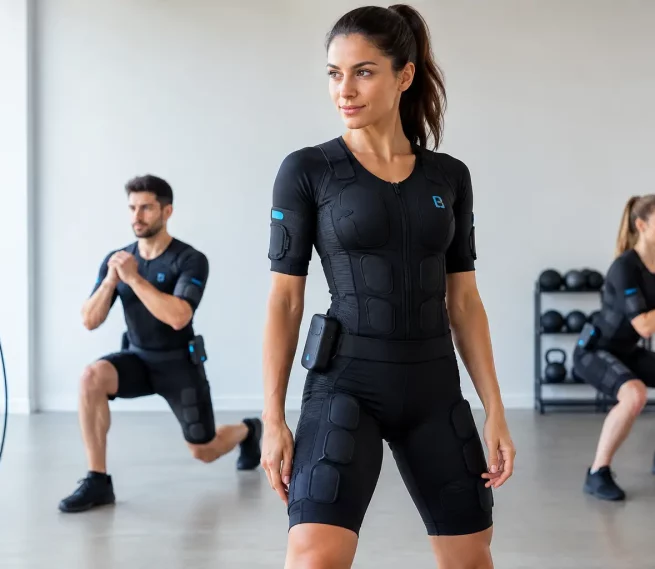
If getting up from a chair feels stiffer than it should, or your back tightens after a day at a desk, the question becomes very practical: can EMS help mobility? For many people, yes – but not in the simplistic way social media sometimes suggests. EMS can support better movement by improving muscle activation, strength, posture and body awareness. It is not magic, and it is not a substitute for smart coaching, but used properly it can be a very effective part of a mobility plan.
That matters if you are busy, inconsistent with training, or frustrated by aches that keep returning. A lot of mobility issues are not just about being “tight”. They are often linked to weakness, poor control, fatigue, old injuries or long hours spent in the same positions. When the body is not supporting itself well, joints stop moving cleanly and everyday movement starts to feel harder than it should.
Can EMS help mobility or just muscle strength?
This is where people often get confused. Mobility is not simply flexibility. It is your ability to move a joint well, with control, through a useful range. That means strength matters. Stability matters. Coordination matters. If your glutes are not switching on properly, your hips may feel restricted. If your core is weak, your lower back may stiffen to compensate. If your upper back lacks strength, your shoulders can lose smooth movement.
EMS – short for Electro Muscle Stimulation – helps by recruiting muscle fibres during guided exercise. In a coached session, that can mean key muscles are working more effectively than they often do in conventional training, especially in people who struggle to “feel” the right areas. Better muscle recruitment can improve support around joints, reduce compensation patterns and make movement feel more stable.
That does not mean one EMS session suddenly gives you deep squat mobility or fixes every painful shoulder. What it can do is create the foundation for better movement. When your body has more strength and control, mobility work tends to work better too.
How EMS supports better movement
The biggest benefit is often not just stronger muscles, but better quality movement. Clients frequently describe standing taller, moving more freely and feeling less heavy or restricted after a consistent block of training. That comes from a few overlapping effects.
First, EMS can strengthen postural muscles efficiently. If you spend most of the week sitting, driving or working at a laptop, you may have areas that are underactive rather than truly short. Training those areas helps the body hold itself better, which can reduce the strain that creates stiffness.
Second, EMS sessions are usually built around controlled movement patterns rather than random exercise. Squats, hinges, rotations, lunges and core work under expert supervision can improve joint control. Mobility is rarely about stretching harder. More often, it improves when the nervous system feels safe and supported during movement.
Third, EMS can help people train consistently because sessions are short and coached. That sounds simple, but consistency changes everything. A person who manages two focused sessions a week for three months will usually move better than someone who keeps planning to do mobility work and never quite gets round to it.
Where EMS can make the biggest difference
For desk-based professionals, EMS can be especially useful where stiffness is linked to deconditioning. Tight hips, a tired lower back, rounded shoulders and poor trunk stability are common patterns. In those cases, mobility improves when the body gets stronger and more balanced.
For people returning from a setback, EMS can also help rebuild confidence. If you have stopped training because of pain, fatigue or lack of time, the idea of long gym sessions can feel unrealistic. A shorter, structured approach often feels more manageable. That is important, because fear of movement can become part of the problem.
It can also work well for those who already train but have obvious weak links. Runners with poor glute activation, golfers lacking rotational control, or combat athletes trying to improve movement efficiency may all benefit when EMS is used to target the muscles that support cleaner mechanics.
The best results usually come when the goal is not “become more flexible”, but “move better under real-life demands”. That includes walking, lifting, climbing stairs, training, working and recovering without the same nagging restrictions.
What EMS cannot do on its own
A strong answer to can EMS help mobility also needs honesty. EMS has limits.
If your mobility issue is caused by a joint restriction, significant injury, unresolved inflammation or a medical condition, EMS is not a standalone fix. It may still play a supportive role, but it needs to sit alongside proper assessment and, in some cases, clinical treatment. The same applies if pain is sharp, worsening or unexplained.
It is also not a replacement for movement skill. If you never work through ranges you want to improve, you should not expect those ranges to appear automatically. Strength helps, but mobility still needs specific movement practice. Good coaching blends both.
And while EMS can create a strong training stimulus quickly, more is not always better. Poorly programmed sessions, intensity that is too high, or a one-size-fits-all approach can leave people feeling overworked rather than improved. This is why supervision matters so much.
Can EMS help mobility when pain is part of the picture?
Often, yes – but the reason matters. Pain changes movement. When something hurts, the body guards, compensates and avoids certain positions. Over time that can create stiffness, weakness and poor mechanics around the original problem area.
In that situation, EMS may help by improving muscle support and reducing some of the workload on irritated structures. For example, stronger glutes and core control may ease pressure that contributes to lower back discomfort. Better postural strength may reduce tension through the neck and shoulders. Some clients also report feeling looser because they are moving more regularly and with better guidance.
Still, pain is not a simple equation. If someone is in acute pain, highly sensitive, or unsure what is driving their symptoms, caution is essential. Good trainers know the difference between productive challenge and pushing through something that needs a different route.
What a realistic timeline looks like
People often want to know how quickly they will feel a difference. That depends on the starting point.
If your issue is mainly stiffness from inactivity and weak muscle support, you may notice changes quite quickly – sometimes within a few sessions. Standing can feel easier. Walking can feel lighter. Certain movements may become less awkward.
If your mobility restrictions are tied to longer-term pain, deeper compensation patterns or years of sedentary habits, progress is usually more gradual. You may first notice improved stability and less post-session soreness before seeing major changes in range of motion. That is still progress. Better movement quality tends to come before dramatic flexibility gains.
The key is not chasing a single “stretchy” feeling. It is building a body that can actually hold and use better positions.
What to look for in an EMS mobility programme
If mobility is your goal, the session design matters as much as the technology. You want more than intensity. You want assessment, coaching and progression.
A good programme should look at posture, movement quality, previous injuries and where your body is compensating. It should include exercises that challenge control through useful ranges, not just static holds or generic repetitions. It should also adapt over time as your movement improves.
That is where a premium coached studio model has a real edge. Instead of guessing your way through exercises, you have someone adjusting position, tempo and exercise selection to suit your body. For clients in Peterborough or Upminster who want expert input without wasting hours in a gym, that kind of structure can make consistency far more realistic.
The real answer to can EMS help mobility
Yes, EMS can help mobility – especially when poor movement is linked to weakness, posture, muscle inactivity or lack of training consistency. It can improve the muscular support and control that mobility depends on, and for many people that leads to less stiffness, better posture and more confident movement.
But the strongest results come when EMS is treated as part of a bigger plan, not a shortcut. Mobility improves fastest when the training is personalised, the coaching is sharp, and the goal is to move better in everyday life, not just tick off another workout.
If your body has been feeling stiff, guarded or unreliable, that is not something you have to accept as normal. Start with the right support, train with intent, and give your body a reason to trust movement again.
 7min
7min