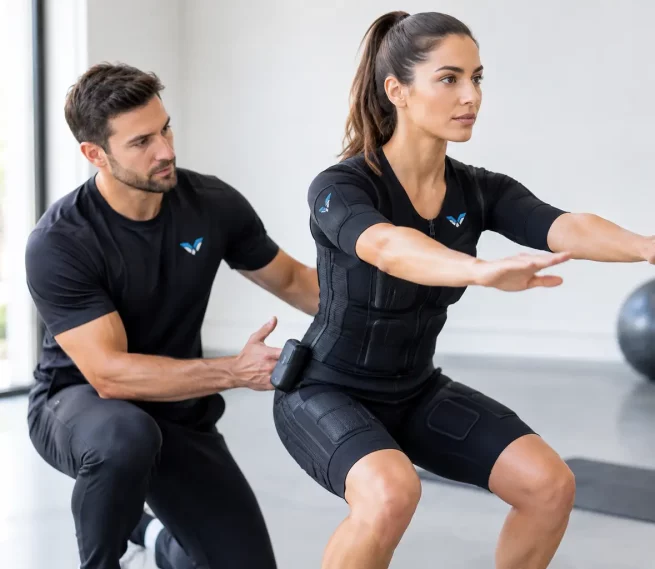
If your shoulders feel tight at your desk, your lower back complains after a long drive, or your squat never quite feels right, guessing is a poor strategy. The right posture and mobility assessment tools take the guesswork out of training and recovery by showing what is actually happening in your body, not what you assume is happening.
That matters more than most people realise. A lot of clients arrive convinced they need to stretch more, train harder, or simply push through. Then an assessment shows a different story. Sometimes the issue is restricted ankle mobility affecting the knees and hips. Sometimes it is poor thoracic movement driving neck tension. Sometimes posture is less about sitting up straight and more about control, strength, breathing, and how well your body handles load.
Why posture and mobility assessment tools matter
Good assessment changes the quality of every decision that follows. If you train without it, you are often choosing exercises based on symptoms rather than causes. That can still produce some progress, but it is slower, less precise, and more frustrating than it needs to be.
For busy professionals and parents, that is a costly mistake. When you only have a limited window to train each week, every session needs a purpose. Assessment helps you target the biggest restrictions first, avoid exercises that reinforce poor mechanics, and track whether your plan is working.
There is also a big difference between posture and mobility, even though people lump them together. Posture is the way you organise your body at rest and during movement. Mobility is your ability to move through a range with control. You can look upright and still move poorly. You can also have flexible joints but poor stability. The best assessments look at both.
The most useful posture and mobility assessment tools
Not every tool is high-tech, and not every high-tech option is automatically better. The strongest approach usually combines visual analysis, movement testing, and objective measurement.
Visual posture analysis
This is often the first step because it quickly highlights obvious imbalances. A coach or therapist looks at alignment from the front, side, and back, checking areas such as head position, shoulder height, spinal curves, pelvic tilt, knee tracking, and foot position.
Done well, visual analysis is helpful. Done badly, it becomes oversimplified. A static posture snapshot can suggest patterns, but it does not tell the whole story. Someone can stand with a forward head posture and still move well under load. Another person may look fairly neutral standing still but lose control the moment they squat, lunge, or rotate.
That is why visual assessment should start the conversation, not end it.
3D body scanning
This is one of the more advanced posture and mobility assessment tools because it gives measurable data rather than relying only on the naked eye. A quality 3D scan can map body symmetry, posture patterns, body composition changes, and structural shifts over time.
For clients who want clear proof of progress, this is powerful. Small improvements in posture are not always obvious day to day, especially when you see yourself in the mirror every morning. A scan can show changes in alignment and body shape that are easy to miss otherwise.
It also helps with accountability. If someone says their training feels better, that is useful. If the scan also shows improved balance through the trunk and better structural positioning, you have stronger evidence that the programme is moving in the right direction.
The trade-off is that scanning is only as useful as the coaching behind it. Data without interpretation is just data. You still need someone who understands what matters, what does not, and how to turn findings into action.
Range of motion testing
Simple range of motion tests are still among the most practical tools available. These can include ankle dorsiflexion checks, shoulder flexion testing, hip internal and external rotation, spinal rotation, and hamstring length assessments.
These tests matter because restrictions rarely stay local. Limited ankle movement can alter walking, running, squatting, and even posture higher up the chain. Reduced thoracic rotation can affect shoulder comfort and golf swing performance. Tight hips can feed into low back discomfort.
The key is not chasing perfect scores everywhere. Bodies vary. What matters is whether a limitation is affecting function, comfort, or performance.
Functional movement screens
Movement screens look at how your body coordinates as a system. This may include squats, lunges, hinges, step-downs, overhead reaches, balance drills, and rotational patterns.
This is where many hidden issues appear. A client may have acceptable mobility in isolated testing but still move poorly in real tasks because they lack stability, timing, or body awareness. A lunge might reveal hip control issues. An overhead squat might expose limited shoulder range or poor trunk stability. A simple single-leg balance test can tell you plenty about ankle control, pelvic stability, and movement confidence.
These screens are especially useful if your goal is not just to feel looser, but to train harder, run better, reduce pain, or move more efficiently in daily life.
Strength and control assessments
Mobility without strength is unreliable. If you can reach a position but cannot own it, your body will often avoid using it when speed or load increases.
That is why good assessments also look at muscular control. Core function, glute activation, scapular stability, and single-leg strength all influence posture and movement quality. In practice, this can explain why someone stretches constantly yet still feels stiff. The body may be creating tension because it does not feel stable enough to move freely.
For many adults with recurring aches, this is the missing piece.
What the best assessments actually reveal
A proper assessment should do more than label you as tight or out of alignment. It should identify the main bottlenecks holding back progress.
Sometimes the issue is mechanical. You may genuinely lack movement at a joint. Sometimes it is behavioural. Long hours at a laptop, repetitive driving, or poor training habits can reinforce the same positions every day. Sometimes it is recovery related. Stress, fatigue, and low activity levels can all change how the body moves and feels.
This is why there is no single perfect tool. If a coach only uses a posture photo, they may miss the movement issue. If they only use movement screens, they may miss useful body composition or alignment trends. If they only use technology, they may ignore what you actually feel during daily life and training.
The best results come from layering methods and then building a plan around the findings.
How posture and mobility assessment tools improve results
Assessment is not about collecting numbers for the sake of it. It is about making training more efficient.
If your screen shows poor ankle mobility and weak glute control, your programme should reflect that. If your posture scan shows a clear asymmetry through the shoulders and trunk, upper body work should be adjusted. If rotation is limited and you play golf or combat sports, mobility and control work need to support that demand specifically.
This is where personalised coaching makes a real difference. A generic class cannot adapt around your movement profile in the same way a tailored programme can. At E-Pulse Studio, that matters because efficiency is the whole point. When people are fitting training around work, school runs, and real life, every session has to count.
Assessment also improves motivation. Clients stay engaged when they can see why they are doing certain exercises and how those exercises connect to better posture, less pain, stronger lifts, or improved sport performance. Measurable progress keeps people committed.
Choosing the right tool for you
The best tool depends on your goal. If you are dealing with recurring pain or stiffness, start with a coach-led movement and posture assessment rather than relying on an app. If you are focused on body transformation and want visible proof of change, 3D scanning adds real value. If performance is the priority, functional movement and strength testing become even more important.
It is also worth being realistic. No assessment tool can diagnose everything, and no single result should create panic. Human movement is variable. Some asymmetry is normal. Some restrictions are more relevant than others. The question is whether a finding explains your symptoms, limits your performance, or increases your risk of compensating elsewhere.
A good coach will not overwhelm you with jargon. They will show you what matters most, explain what can be improved, and build a plan you can actually stick to.
Posture does not improve because someone told you to stand taller. Mobility does not improve because you touched your toes once. Real change happens when assessment leads to the right action, repeated consistently. If you want training to feel better, move better, and produce visible results faster, start by measuring the right things and let your body tell the truth.
 8min
8min