Stiff hips when you stand up from your desk. Tight shoulders halfway through a workday. Ankles that feel blocked when you squat, run or even walk downstairs. For most adults, the best ways to improve mobility are not more random stretching videos or pushing harder through discomfort. They are targeted, consistent habits that help your joints move better, your muscles do their job, and your body feel more capable day to day.
Mobility is often confused with flexibility, but they are not the same. Flexibility is about muscle length. Mobility is your ability to actively control movement through a full range. That distinction matters. You do not just want to touch your toes for the sake of it. You want to bend, reach, rotate, squat and move without feeling stiff, unstable or in pain.
For busy professionals, parents and anyone trying to get results without living in the gym, that means focusing on what gives the biggest return. The goal is not to spend an hour on the floor every evening. The goal is to move better in a way that supports training, posture, recovery and everyday life.
The best ways to improve mobility start with consistency
The biggest mistake people make is treating mobility as an occasional fix. They wait until their back tightens up, their hamstrings feel like cables, or their shoulders start complaining in training. Then they do one long stretch session and expect the problem to disappear.
Mobility responds far better to regular input than heroic effort. Ten focused minutes done four or five times a week beats one long session done every now and then. Your body adapts to what you repeat. If you sit all day, train hard without recovery, and only think about movement when something hurts, stiffness becomes your default.
That is why the best approach is practical. Build mobility into your normal week, not as a side project. A short session before training, a movement break between meetings, and a few drills in the evening can make a noticeable difference within weeks.
1. Train through full ranges, not half ranges
One of the best ways to improve mobility is to stop separating it completely from strength work. Controlled strength through a full range can improve mobility faster than passive stretching alone.
Think about a well-executed split squat, deep goblet squat, Romanian deadlift or overhead press. When done with good form, these movements ask your body to access range and control it. That control is the part many people are missing. You may have enough range available, but not enough strength or coordination to use it.
There is a trade-off here. Chasing depth or range without technique can irritate joints instead of helping them. If your squat turns into a rounded-back collapse, going deeper is not a win. This is where coaching matters. Proper progressions help you build range safely rather than forcing positions your body is not ready for.
2. Focus on the joints that usually cause the biggest problems
Not every area needs equal attention. For most adults, the biggest mobility restrictions show up in the hips, thoracic spine, shoulders and ankles. When those areas are limited, other parts of the body often take the strain.
Tight hips can feed into lower back discomfort. Poor thoracic rotation can make shoulder training feel awkward and restricted. Limited ankle mobility can affect walking, squatting, lunging and running mechanics. If your body feels generally stiff, it is often these key zones driving the issue.
That is good news, because it means you do not need twenty different drills. A few well-chosen exercises can have a big carryover effect. Hip openers, thoracic rotations, shoulder controlled circles and ankle mobilisation drills give most people a strong starting point.
3. Use dynamic mobility before training
Long static stretching before exercise is not always the answer. If your goal is to move well in a session, dynamic mobility usually makes more sense. It prepares your joints, raises tissue temperature and helps your nervous system switch on.
This can be simple. Leg swings, walking lunges with rotation, controlled hip openers, shoulder circles and bodyweight squats all work well before training. The point is not to exhaust yourself. The point is to arrive at your session moving more freely and with better body awareness.
For people short on time, this is one of the easiest wins. Instead of adding a separate mobility block later in the day, you can turn your warm-up into something more effective. You train and improve movement quality at the same time.
4. Strengthen what is weak, not just stretch what feels tight
A muscle that feels tight is not always short. Sometimes it is overworking because another area is not doing enough. That is why endless stretching does not always solve the problem.
Take the classic desk-based pattern – tight hip flexors, glutes not firing well, upper back rounded, neck and shoulders tense. Stretching the front of the hips and chest can help, but if you do not strengthen the glutes, upper back and core, your body often slips back into the same pattern.
This is where mobility and strength should work together. Stability gives your body confidence to access better range. Without it, extra mobility can feel temporary. With it, movement starts to stick.
5. Recover properly if you want better mobility
Hard training with poor recovery often creates the exact stiffness people are trying to get rid of. If you are under-sleeping, carrying stress, dehydrated and constantly sore, your body will not move at its best.
Recovery is not soft. It is performance support. Sleep, hydration, walking, sensible programming and lighter movement days all affect mobility. If your body is always in a state of high tension, range of motion tends to shrink.
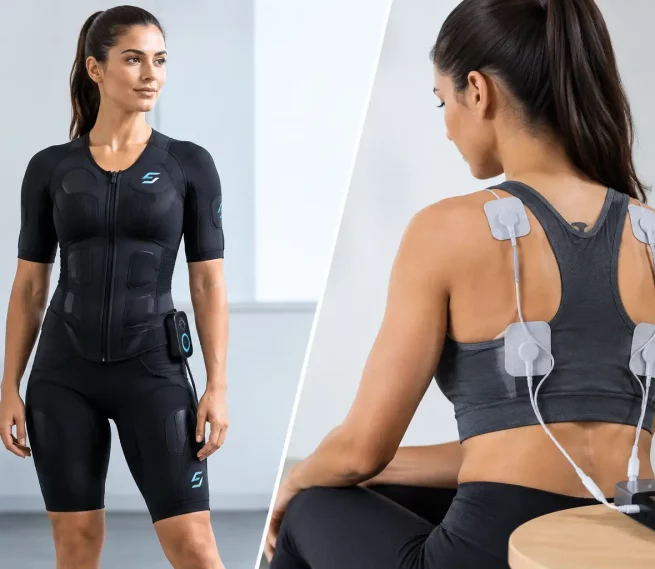
This is also where methods like guided recovery sessions, soft tissue work and targeted EMS support can fit well for the right person. They are not magic shortcuts, but they can help improve muscle activation, circulation and movement quality when used as part of a broader plan. The key phrase is part of a broader plan. No tool replaces regular movement and smart coaching.
6. Improve mobility in the positions you actually use
One reason mobility work gets abandoned is that it feels disconnected from real life. People stretch on the floor for ten minutes, then spend the rest of the day hunched over a laptop, carrying children on one hip, or rushing from car to desk.
A better approach is to improve mobility in relevant positions. If you struggle getting up from a chair, practise sit-to-stand patterns and split squats. If golf feels restricted, train rotation and thoracic movement. If running leaves your calves and hips tight, address ankles, hip extension and single-leg control.
The best ways to improve mobility are the ones that carry over into your actual routine. That is what keeps you motivated, because you can feel the difference where it counts – training better, moving easier, and having less day-to-day discomfort.
7. Do not ignore posture and breathing
Posture is not about standing like a statue. It is about how well your body can organise itself under load and at rest. Poor breathing mechanics and prolonged poor positions can feed into stiffness through the ribs, spine, neck and shoulders.
If you spend hours shallow-breathing into your chest while sitting in the same position, your upper body often pays the price. Gentle thoracic mobility, rib movement work and breathing drills can improve how your body stacks and moves.
This does not need to become overly technical. Sometimes the simple fix is to break up sitting time, reset your posture, breathe more deeply and move every hour. Small inputs done often can be far more effective than waiting for one perfect recovery session at the weekend.
8. Get assessed if pain is part of the picture
There is a difference between normal stiffness and pain that keeps returning. If a joint feels sharp, catches during movement, or consistently limits what you can do, guessing your way through internet exercises is not the smartest route.
Pain changes how people move. It creates compensation, hesitation and guarding. In that situation, the best mobility plan is usually an individual one. You need to know whether the issue is joint restriction, muscular weakness, poor control, previous injury or a combination.
That is why coached training works so well for many people. Instead of collecting random drills, you get a plan based on how your body moves now and what needs to change next. For busy people who want measurable results, that is often the fastest route forward.
How to make mobility progress stick
The people who improve mobility fastest are not usually the ones doing the most. They are the ones doing the right things regularly. They pair mobility with strength, use smart warm-ups, respect recovery and work on the areas that matter most for their goals.
If you want visible change, measure it in real terms. Can you squat deeper with control? Rotate more freely? Walk upstairs without stiffness? Train without your back tightening up afterwards? That is progress you can feel. In a coaching-led environment such as E-Pulse Studio, that progress becomes even clearer when movement work is tied to personalised programming and tracked over time.
Mobility does not need to be complicated, and it certainly does not need to eat up your week. Start with what feels most restricted, train it with purpose, and stay consistent enough for your body to trust the new range. Better movement is not reserved for athletes – it is one of the fastest ways to feel stronger, lighter and more capable in your own body.
 8min
8min