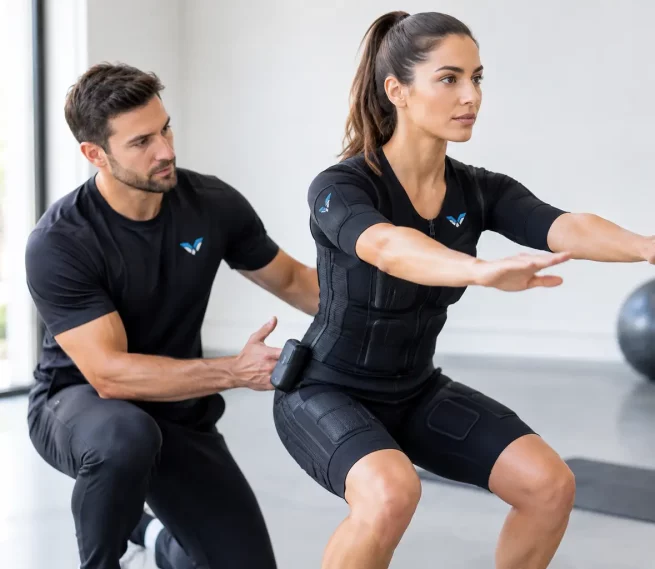
If your diary is packed, your back feels tighter than it should, and you are tired of paying for gym time you do not consistently use, the EMS vs personal training question becomes very real very quickly. Most people are not choosing between two perfect options. They are choosing between what they can actually stick to, what feels safe, and what is most likely to produce visible results.
That is where the comparison gets interesting. Both approaches can work. Both can be coached well or badly. But they are not the same experience, and they do not ask the same things from your body, your schedule, or your motivation.
EMS vs personal training: the real difference
Traditional personal training usually means guided exercise with weights, bodyweight movements, cardio equipment, mobility work, or a mix of all three. It is familiar, flexible, and can be adapted to almost any goal when the coach is experienced.
EMS personal training adds electro muscle stimulation to a coached session. During training, low-frequency electrical impulses activate muscle contractions while you perform controlled movements. The big appeal is efficiency. You are not spending an hour wandering between machines. You are working through a short, focused session with very little wasted time.
For busy professionals, parents and anyone who struggles to train consistently, that difference matters. A plan is only effective if it fits real life.
Time commitment changes everything
This is often the point where people make their decision.
Conventional personal training can be excellent, but it usually needs a bigger time investment. That includes the session itself, getting to the gym, warming up, changing, showering, and often adding extra sessions alone to keep momentum going. If you love that environment, great. If your weeks are already full, it can become another promise to yourself that gets pushed to Monday.
EMS personal training is built for efficiency. Sessions are short, structured and supervised closely. For clients who say, “I know what to do, I just never seem to find the time,” this can be the difference between occasional effort and regular progress.
That does not mean shorter always equals better. If you genuinely enjoy longer training sessions, like lifting, or want the mental switch-off that comes from being in the gym for an hour, traditional PT may suit you more. But if consistency has been your biggest problem, efficiency is not a small advantage. It is often the deciding factor.
What about results?
Here is the honest answer. Results come from the quality of the coaching, the consistency of the client, and whether the method matches the goal.
If your goal is general strength, improved muscle tone, body composition, posture, reduced aches, or getting back into training without spending half your life in the gym, EMS can be extremely effective. Because the sessions are coached closely and the muscular demand is high, many clients feel they have trained properly in a fraction of the usual time. That is one reason EMS has become popular with people who want measurable change without a traditional gym routine swallowing their week.
If your goal is highly specific strength performance, such as pushing up your deadlift numbers, improving Olympic lifts, or building technical skill under heavy external load, traditional personal training often has the edge. You need practice with the movements themselves, not just muscular activation. A runner, golfer or combat athlete may still benefit hugely from EMS, but the best results often come when it supports, rather than replaces, sport-specific training.
So when people ask which works better, the better question is this: better for what?
EMS vs personal training for fat loss and body shape
This is where expectations need to stay grounded. Neither EMS nor personal training is magic. You still need a sensible nutrition plan, regular effort and enough recovery.
That said, coaching-led EMS can be a very strong option for fat loss and body recomposition because it removes friction. Clients who used to miss workouts start showing up because the sessions are manageable. They train hard enough to stimulate change, they stay accountable, and progress is easier to track when the process is simple.
Traditional personal training can produce excellent fat loss results too, especially when sessions include strength work, conditioning and lifestyle support. But again, results depend on whether you maintain the schedule. A perfect 12-week plan on paper means very little if life keeps getting in the way.
For many adults, the best method is the one they can keep doing through busy work periods, school runs, disrupted sleep and low motivation weeks. That is where a shorter, premium coaching format often wins.
Support, accountability and confidence
A lot of people think they need equipment. What they actually need is structure.
Good personal trainers provide that through planning, progression, encouragement and correction. They help you train safely and stop you wasting effort. The downside is that in some gyms, personal training can still feel exposed or intimidating, especially if you are returning after injury, carrying extra weight, or feeling self-conscious.
EMS coaching tends to feel more guided from start to finish. The sessions are personal, focused and closely supervised. That matters for beginners and for people who have lost confidence in their body. It also matters for experienced clients who do not want guesswork. They want to come in, train properly and leave knowing the session counted.
That coaching relationship is often where the strongest transformations happen. Not because someone shouted louder, but because the plan was personalised and the client trusted the process enough to stay with it.
Recovery, aches and getting moving again
If you are dealing with back pain, poor posture, stiffness or reduced mobility, the right training environment matters just as much as the training method.
Traditional PT can be brilliant here when the coach has strong movement knowledge and knows how to regress exercises properly. But poorly programmed gym-based sessions can also aggravate issues, especially when people are pushed into movements they are not ready for.
EMS can be a strong fit for clients who need a low-impact, highly controlled route back into training. Because sessions are supervised closely, posture and movement quality can be monitored while muscles are activated in a targeted way. For people who have spent months saying, “I need to do something, but my body never feels quite right,” this can be a practical starting point.
Of course, context matters. Anyone with an injury, medical condition or rehabilitation need should train under appropriate professional guidance. The point is not that one method replaces clinical care. It is that the right kind of coached exercise can help people rebuild strength and confidence safely.
Who should choose EMS?
EMS usually suits people who value efficiency, want close support, and need sessions that fit around work and family life. It is especially appealing if you have struggled to stay consistent in a traditional gym, want visible progress without long sessions, or need a more supported environment because of pain, mobility issues or low confidence.
It also suits people who are already motivated but time-poor. Business owners, professionals and parents often do not need more fitness information. They need a system they can actually maintain.
In studios such as E-Pulse Studio, that appeal is strengthened by personalised coaching and progress tracking, which turns training into something measurable rather than vague.
Who should choose traditional personal training?
Traditional PT is still a great choice if you enjoy gym training, want longer sessions, or have performance goals that depend on lifting technique, conditioning variety, or sport-specific movement work. If the gym environment energises you rather than drains you, there is no reason to force yourself into a different model.
It can also be the right fit if you simply want more movement options. Some people love barbell work, circuits, boxing drills, sled pushes or outdoor training. That variety can be motivating, and motivation matters.
The key is not to choose the method that sounds hardest-core. Choose the one that you will respect enough to do properly.
The better question than “which is better?”
Instead of asking whether EMS or personal training is better in general, ask which one removes the barriers that have held you back.
If the barrier is time, EMS has a serious advantage. If the barrier is confidence, a private coaching-led EMS setting may feel more approachable. If the barrier is highly specific athletic performance, traditional PT may give you more direct carryover. If the barrier is inconsistency, the simplest option often becomes the smartest one.
The best training plan is not the one that looks impressive on social media. It is the one that fits your life, supports your body, and keeps delivering progress month after month.
If you have been stuck between wanting results and not wanting another fitness routine that eats your week, that is your answer starting to take shape.
 8min
8min