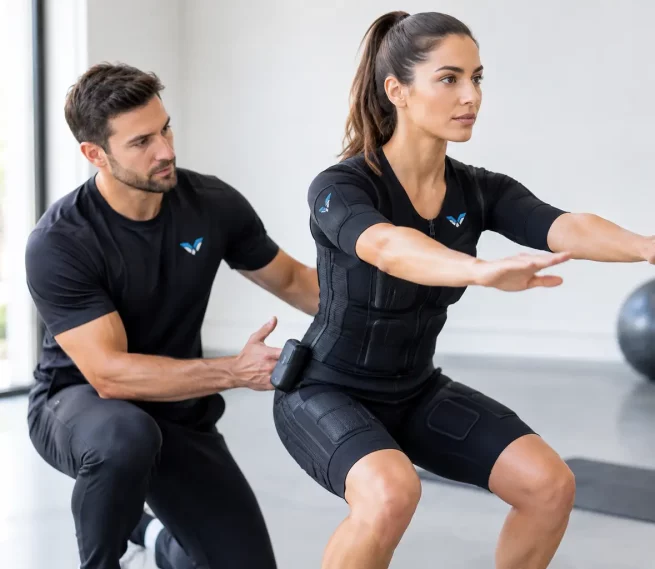
If your schedule barely leaves room for a lunch break, the idea of spending hours each week in the gym can feel unrealistic. That is exactly why an EMS training beginner guide matters. For busy professionals, parents and anyone who wants expert structure without the time drain of traditional training, EMS can be a smart starting point – but only if you understand what to expect.
EMS stands for Electro Muscle Stimulation. In a coached training session, a specialist suit or vest sends controlled electrical impulses to your muscles while you perform guided movements. Those impulses stimulate deeper muscle activation than many people achieve on their own, which is why EMS is often used for strength work, body toning, posture support and recovery-based programmes. It is efficient, but it is not effortless, and beginners do best when they start with the right expectations.
What this EMS training beginner guide wants you to know first
The biggest misunderstanding around EMS is that you stand still while a machine does the work for you. That is not how good coaching-led EMS works. You still move, brace, squat, hinge, press and hold positions under guidance. The difference is that the muscles are being challenged more intensely in a shorter window.
That makes EMS appealing if your main barrier is time. A properly structured session is brief, but it can feel surprisingly demanding. Many first-time clients are shocked by how much work they have done in 30 minutes. Just as important, beginners often like the accountability. You are not left wandering around a gym floor guessing what to do next. A trainer adjusts the intensity, watches your form and tailors the session to your goal.
The other thing to understand is that EMS is not one single experience. A programme for fat loss and muscle tone can feel very different from one built around lower back support, postural work or sports performance. That is why a personal assessment matters. The best results usually come from matching the session to the person, not forcing everyone through the same template.
How EMS training actually feels
Most beginners ask the same question: does it hurt? The honest answer is no, but it does feel unusual. During the impulse phase, you will notice a strong tightening sensation through the muscles being targeted. It can feel like a deep, rhythmic contraction rather than a sharp or painful jolt.
At first, your brain needs a few minutes to get used to it. Once that initial unfamiliarity passes, most people settle quickly and focus on the movement itself. A good trainer increases intensity gradually, so you are challenged without being overwhelmed. You should feel worked, not frightened off.
After the session, the most common response is muscle fatigue similar to strength training, sometimes more noticeable than expected because multiple muscle groups have been activated at once. That is one reason beginners should avoid the trap of thinking more is always better. Higher intensity is only useful if your body is ready for it.
Is EMS right for everyone?
EMS suits a wide range of people, especially those who want structured, coached exercise with measurable progress. It can work well for busy adults trying to regain consistency, people who struggle with motivation in a conventional gym, and clients who want support with posture, muscle tone or general strength.
It can also be useful for people returning to training after a long break, because sessions can be scaled carefully. That said, there are situations where EMS may not be appropriate, or where medical clearance is needed first. If you have certain medical conditions, implanted devices, are pregnant, or are managing a recent injury, you need proper screening before you train.
This is where quality matters. Premium EMS coaching should begin with questions about your health history, lifestyle and goals. If a provider skips that step and rushes you straight into the suit, that is a red flag.
Your first EMS session: what usually happens
A first session should feel more like a coached consultation than a fitness trial by fire. You will usually begin with a discussion about your goals. That could be fat loss, stronger core stability, less back discomfort, better stamina, improved muscle definition or simply getting back into a routine you can stick to.
From there, your coach should explain the equipment, fit the EMS suit correctly and test the sensation level on different muscle groups. Everyone experiences the stimulation slightly differently, so intensity is adjusted area by area. That individual setup matters more than beginners realise.
Once the session starts, movements are usually simple. Think controlled squats, lunges, holds, presses and mobility-based patterns rather than flashy exercises. The aim is not to impress you with complexity. It is to create safe, effective contractions while teaching your body how to move well under stimulation.
Expect the trainer to watch closely. Posture, breathing and core control all matter. If you are dealing with weak glutes, desk-driven posture or recurring tightness, those details become even more important because EMS can amplify both good and bad movement patterns. Coaching is what keeps the work productive.
EMS training beginner guide: how often should you train?
For most beginners, once or twice a week is enough to start. That often surprises people, especially those coming from a mindset that more sessions automatically mean faster results. With EMS, recovery matters. Because the muscular demand is high, your body needs time to adapt.
What works best depends on your baseline. If you have not trained consistently for months, one high-quality session each week can be a strong start. If you already exercise and recover well, adding a second session may make sense. The smart approach is to build momentum without burying yourself in soreness.
You should also think beyond the studio session. Walking more, improving sleep, eating enough protein and staying hydrated can make a visible difference to your results. EMS is powerful, but it still works best as part of a bigger routine.
What kind of results can beginners expect?
This is where honesty matters. You may feel the difference from session one, especially in muscle activation and general energy, but visible transformation takes consistency. Many clients notice early improvements in posture, core awareness and how supported they feel in everyday movement. Clothes fitting better, better muscle tone and improved stamina tend to follow with regular training.
The timeline depends on your starting point, nutrition, sleep and session quality. Someone training once a week while eating poorly and sleeping five hours a night will not progress the same way as someone who supports the process. That is not negative – it is simply real life.
The upside is that EMS can help people who have struggled to stay consistent elsewhere. When sessions are short, coached and measurable, it becomes easier to keep showing up. For many busy adults, that consistency is the game changer.
Common mistakes beginners make
The first mistake is chasing intensity too early. Feeling every channel at maximum does not make you tougher. It usually just makes the session messy and recovery harder. Good progress comes from controlled progression.
The second is treating EMS like a shortcut that replaces all other movement. It can dramatically improve efficiency, but your body still benefits from daily activity, mobility work and sensible nutrition. If your job keeps you seated all day, one weekly session cannot completely cancel that out.
The third is ignoring technique. Because EMS creates strong contractions, proper form matters even more. A coached studio environment helps here. It is one reason many beginners prefer EMS personal training over trying to piece things together alone.
How to choose the right EMS studio
Not all EMS experiences are equal. Look for coaching, screening and individual progression rather than a one-size-fits-all setup. Ask how sessions are tailored, how intensity is managed and what support you get outside the workout itself.
If your goals are specific – body recomposition, postural correction, improved mobility or sports performance – the studio should be able to explain how the programme fits that aim. Progress tracking also helps. When you can see changes in body composition, movement quality or performance markers, motivation becomes much easier to maintain.
For clients in Peterborough or Upminster, working with a specialist studio such as E-Pulse Studio can make the beginner phase far less intimidating because the whole model is built around close trainer support and measurable progress rather than simply giving you access to equipment.
The best mindset to bring into your first session
Come in ready to learn, not to prove something. Beginners often get better results when they focus on consistency, coaching and recovery instead of trying to smash every session. EMS can be a brilliant tool, but the real win is finding a training method that fits your life closely enough that you actually keep doing it.
If you have been waiting for the perfect time to get fitter, stronger or more comfortable in your body, you probably already know that perfect never shows up. A well-coached first session is often enough to replace hesitation with momentum, and momentum is where real change starts.

 8min
8min