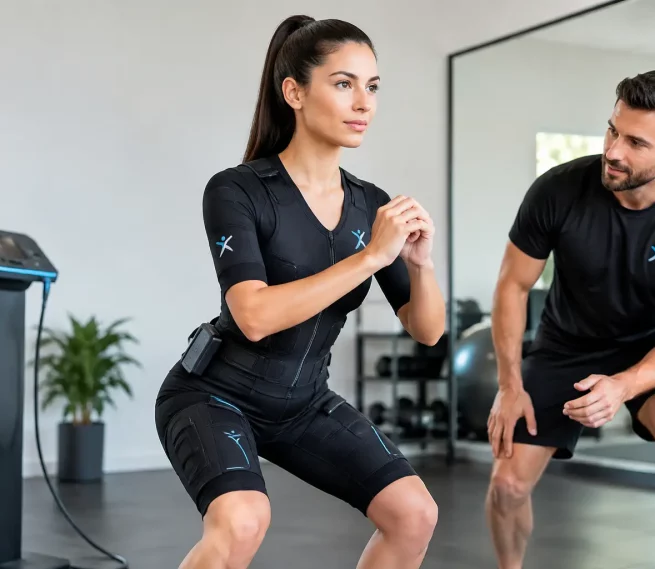
By 3pm, many people are already feeling it: shoulders creeping towards their ears, a stiff upper back, hips locked after hours at a desk, and that familiar ache when standing up. Learning how to improve posture with EMS is not about forcing yourself to sit rigidly upright all day. It is about building the strength, control and movement habits that help your body hold a better position naturally.
For busy professionals, parents and anyone managing persistent tightness, EMS training offers a time-efficient route to stronger postural muscles. When it is coached properly and paired with purposeful movement, it can help you reconnect with the muscles that support your spine, shoulders and hips – without spending hours in the gym.
How to improve posture with EMS safely and effectively
Electro Muscle Stimulation uses controlled electrical impulses to encourage targeted muscle contractions while you perform guided exercises. In an EMS session, the stimulation can recruit a broad range of muscle fibres at once, including muscles that are often underused when we spend much of the day sitting.
Posture is not one muscle or one fixed position. It is a moving system involving your deep core, glutes, upper back, chest, hip flexors and the way your nervous system coordinates them. A coach-led EMS programme can strengthen this system by challenging your body through functional movements such as squats, hinges, rows, presses and controlled rotational work.
The key word is coached. Turning up the intensity is not a shortcut to better posture. The right level of stimulation should allow you to move with control, breathe properly and maintain good technique. Your trainer should adapt the session around your current strength, mobility, training history and any pain or limitations.
Why posture often gets worse when life gets busy
Poor posture is rarely caused by simply being lazy or forgetting to pull your shoulders back. More often, it is the result of repeated positions combined with a lack of capacity. If your upper back tires quickly, your chest feels tight, or your glutes are not contributing well when you walk and stand, your body will find an easier route. That can mean rounded shoulders, a forward head position, an exaggerated arch in the lower back or a tendency to shift weight into one hip.
A long day at a laptop does not permanently ruin your posture. The bigger issue is staying in any one position for too long, especially if you do not have the strength and mobility to move out of it comfortably. This is why the answer is not a posture brace or a constant reminder to ‘sit up straight’. It is building options.
EMS can be particularly useful for people who feel they do not have time for conventional strength training. A short, focused session can train the muscles that support better alignment while improving overall strength and confidence in movement. The benefits are strongest when those sessions are consistent and form part of a wider plan that includes daily movement.
The muscles that matter most
Your core is more than visible abdominal muscles. It includes the deep muscles around the trunk that help manage pressure and keep your torso stable while your arms and legs move. EMS can add intensity to exercises that teach you to brace, breathe and resist unwanted movement rather than simply crunching through repetitions.
Your glutes matter too. They help control the pelvis and support walking, lifting, climbing stairs and standing. When they are weak or poorly coordinated, the lower back and hip flexors often do more than their fair share. Strengthening the glutes through well-executed squats, split squats and hip hinges can make standing feel more balanced.
Then there is the upper back. Strong mid-back and rear shoulder muscles help you control the shoulder blades, which is valuable if your workday involves a keyboard, steering wheel or phone. This does not mean pinning your shoulders back all day. It means having the strength to move your shoulders freely and return to a comfortable, supported position.
What an EMS posture programme should include
A posture-focused EMS programme should never be a one-size-fits-all routine. Someone who sits at a desk all day may need a different approach from a runner with hip stiffness, a golfer looking for better rotation, or a new parent who is regularly lifting and carrying.
Your starting point should be an assessment of how you stand, squat, hinge, reach and rotate. At E-Pulse Studio, progress can also be tracked with 3D body scanning, giving clients measurable feedback alongside how they feel and move. Numbers do not tell the whole story, but they can help make progress visible when paired with regular coaching checks.
In training, expect controlled movements rather than rushed repetitions. Your coach may use a squat pattern to develop leg and glute strength, a row to improve upper-back control, and anti-rotation exercises to challenge the core. Mobility work for the chest, upper back, hips and ankles can be included where it supports better movement quality.
The most effective sessions also teach body awareness. You should leave knowing what a well-braced trunk feels like, how to keep your ribs from flaring when reaching overhead, and how to use your hips rather than loading everything into your lower back. Those are skills you can take into daily life.
Make your results show up between sessions
A powerful EMS session cannot cancel out ten hours without a movement break. It can, however, make it easier to use your body better throughout the day. Think of training as building the capacity, then use small habits to reinforce it.
Set a reminder to stand, walk or change position at least once an hour. When you are at your desk, place your screen at a height that does not encourage you to crane your neck forward, and keep your feet supported rather than perching at the edge of the chair. During calls, take a few standing or walking meetings where possible.
You do not need an elaborate stretching routine. A few slow breaths, a chest-opening reach, gentle upper-back rotation and a short walk can be enough to break up prolonged sitting. If you regularly carry a child, bags or equipment on one side, switch sides when practical and build strength that helps you tolerate those demands.
Sleep, stress and recovery also influence how you hold yourself. When you are exhausted, your body has less capacity to maintain efficient movement. Prioritising recovery is not separate from posture work. It supports it.
When EMS is not the first answer
EMS training is a valuable tool, but it is not a diagnosis or a replacement for medical care. If you have sharp pain, numbness, tingling, unexplained weakness, pain after a fall, or symptoms that are getting worse, speak to a qualified healthcare professional before starting a new programme.
You should also tell your trainer about any surgery, injury, pregnancy, implanted electronic device or medical condition that may affect suitability for EMS. The right programme may involve a lower intensity, more mobility work, a referral to a clinician, or a different starting point altogether. Good coaching means knowing when to progress and when to pause.
How quickly can posture improve?
Some people notice that they feel taller, stronger and less tense after their first few sessions because they are moving more consciously and activating muscles that have been neglected. Meaningful strength and control changes take longer. Consistent training over weeks, supported by better everyday habits, is where lasting improvements are built.
Do not chase a perfectly posed posture. Aim for a body that feels capable: able to sit, stand, lift, walk, train and change position without constant stiffness or fear of pain. With personalised EMS coaching, that goal can fit into even a demanding schedule.
Your next posture win may be simple: standing up from your desk without the usual ache, finishing a long drive feeling looser, or noticing that your shoulders no longer feel heavy by the end of the day. Start with a programme that meets your body where it is, then give it the consistent coaching and movement it needs to become stronger.
 7min
7min