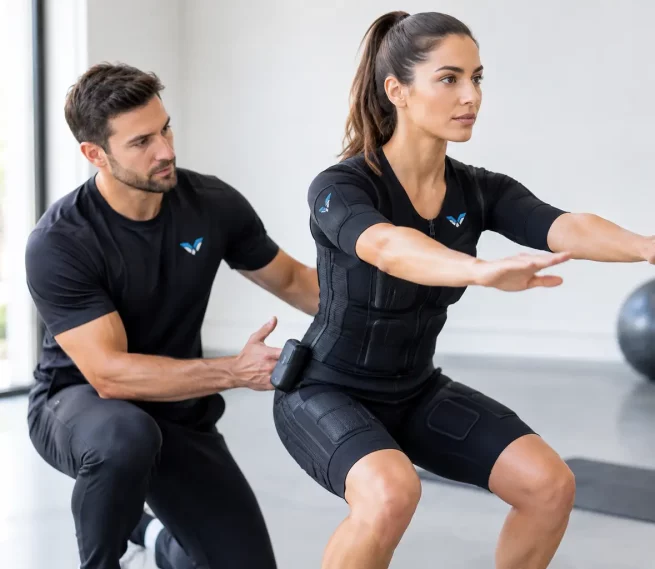
A hard session should not require a packed gym floor, an hour of waiting for equipment or a programme you are never quite sure you are doing correctly. The real small group EMS training benefits come from combining advanced muscle stimulation with close coaching, individual attention and the motivation of training alongside people who are working towards their own goals too.
For busy professionals, parents and anyone who has fallen in and out of exercise routines, that combination can be the difference between good intentions and visible progress. You arrive, train with purpose for 30 minutes, and leave knowing the session was built around your body and your target.
Why small groups make EMS more effective
EMS training uses controlled electrical impulses to stimulate muscle contractions while you perform guided movements. It is not a passive shortcut. You are still squatting, lunging, pressing, pulling and holding positions with focus. The difference is that the muscles are being challenged more intensely and efficiently than in many conventional sessions.
In a group of up to eight people, the coach can keep the session energetic without allowing anybody to disappear into the background. That matters. A large class may feel exciting, but it cannot always accommodate different fitness levels, injuries, movement restrictions or confidence levels. A self-service gym offers freedom, but it also leaves many people guessing about technique, intensity and progression.
Small group EMS sits in the useful middle ground. You get the atmosphere and commitment that comes from training with others, while retaining the coaching standards of a premium personal-training environment.
Your intensity can still be personal
One of the biggest misconceptions about group training is that everyone receives the same workout. With EMS, each participant’s stimulation level can be adjusted individually. A beginner rebuilding strength after a long break does not need the same intensity as an experienced runner looking to support performance.
Your coach can also adapt exercises, range of motion and loading. Someone managing knee discomfort may work through a supported squat variation, while another member of the group performs a more demanding movement pattern. Both can train productively without being pushed into a session that does not suit them.
This is particularly valuable for people who want to improve posture, mobility or confidence after recurring back pain. The goal is not to chase exhaustion for its own sake. It is to train safely, progressively and consistently enough for your body to adapt.
The small group EMS training benefits for busy lives
Time is often the barrier, not motivation. You may genuinely want to get stronger, reduce body fat or feel fitter for the school run, your next race or a long day at work. Yet a conventional gym plan can ask for several lengthy sessions every week, plus travel, changing and time spent deciding what to do.
A focused 30-minute EMS session changes the calculation. It gives your week a protected training appointment that feels achievable, even when work and family commitments are full. Shorter does not mean easier, but it does mean more realistic.
The benefits are strongest when training becomes regular. Two efficient coached sessions completed week after week will usually do more for your progress than an ambitious gym plan abandoned after a fortnight. This is why clients often value the fixed booking and familiar group: it creates a routine that is easier to keep.
There is a trade-off, of course. EMS training asks for concentration and effort. It is not the ideal option for somebody looking for a leisurely hour on the treadmill or a large, anonymous fitness class. But if your priority is measurable work in limited time, the format has a clear advantage.
Accountability without the pressure of a crowd
Training alone can be peaceful, but it can also make it far too easy to skip a session. The weather is poor, work ran late, energy is low – and suddenly another week has passed. In a small group, your attendance has more weight. Your coach expects you, and the people training beside you become familiar faces.
That community does not need to be loud or intimidating. It can be as simple as someone noticing you have increased your squat depth, asking how your back has felt this week, or sharing the satisfaction of finishing a challenging interval. For beginners, this makes stepping into a fitness setting far less daunting. For experienced members, it provides an extra edge when effort starts to dip.
At E-Pulse Studio, groups are deliberately kept small so trainers can correct form, provide encouragement at the right moment and make sure every participant understands the purpose of the exercise. You are never expected to perform for the room. You are coached to improve from your own starting point.
Better feedback leads to better progress
Results are not just about working hard. They depend on whether your training is moving in the right direction. A small-group coach has the space to notice the details: whether your knees are tracking well in a squat, whether you are compensating through your lower back, or whether your EMS intensity should be adjusted as your strength improves.
This feedback is especially useful when body-composition, performance or rehabilitation goals are involved. If fat loss is your goal, your programme should support muscle retention and include sensible advice around activity, recovery and nutrition. If you want to run faster or play stronger golf, the focus may be on lower-body strength, core control and mobility. If you are returning after pain or injury, progression needs to be measured rather than rushed.
Progress tracking adds another layer of clarity. 3D body scanning can help show changes that scales do not always reveal, such as shifts in body shape, measurements and composition. It is encouraging when clothes fit differently or posture improves, even if your body weight has not changed dramatically.
No honest trainer should promise identical results for every person. Sleep, stress, food choices, medical history, baseline fitness and consistency all influence the outcome. What expert support does provide is a clear plan, accurate adjustments and evidence that you are moving forwards.
A stronger option for confidence and capability
Many people begin with an appearance-based goal, and there is nothing wrong with wanting to feel more comfortable in your clothes. Yet the changes clients value most often go beyond the mirror. They feel able to carry shopping without discomfort, climb stairs without losing breath, move with greater confidence or return to an activity they had begun to avoid.
EMS can support gains in muscular strength and conditioning, while guided movement work can improve body awareness, posture and mobility. In a small group, these wins are noticed. Your coach can remind you that the plank you struggled to hold in week one is now controlled, or that the range of movement that once felt restricted has improved.
That visible evidence builds trust in your own capability. For a person who has repeatedly started and stopped gym memberships, this is powerful. Fitness stops being a punishment for not looking a certain way and becomes a practical part of feeling capable in everyday life.
Who will get the most from this format?
Small group EMS training is well suited to people who want a structured, time-efficient plan but do not want the cost or intensity of one-to-one personal training every session. It works for beginners who need guidance, professionals who need efficiency and regular gym-goers who want a new training stimulus.
It can also be a sensible option for those with mobility concerns, provided they are assessed properly and training is adapted to their needs. Anyone with a medical condition, implanted electrical device, pregnancy-related concerns or a recent injury should seek appropriate medical advice and speak openly with the coach before starting. The best programme is always the one that is safe for you.
If your goal is highly specialised athletic preparation, fully individual personal training may sometimes be the better choice. Equally, if you thrive on the buzz of a big dance-style class, a small studio environment may feel quieter than you prefer. The right setting is the one you will attend, enjoy and commit to.
A good first session should leave you feeling challenged, supported and clear about what happens next. Start where you are, let the coaching meet you there, and give consistent effort the chance to show what it can do.
 8min
8min