Your knees should not have to pay the price for getting fitter. If squats leave you sore for days, running jars your hips, or a standard gym session aggravates an old back issue, joint friendly workouts give you another route forward: build strength, improve fitness and move with more confidence without simply avoiding exercise altogether.
The aim is not to make training easy. It is to make every minute count. With the right exercise selection, coaching and progression, you can challenge muscles and your cardiovascular system while managing the impact, range and load your joints have to absorb.
What makes a workout joint friendly?
A joint-friendly session is not one that never feels demanding. It is one that matches the demand to your current capacity. That might mean less impact, a smaller range of motion, more controlled tempo, additional support or a different exercise altogether.
For example, someone with irritated knees may find deep jumping lunges a poor choice right now, but can train their legs effectively with a supported squat, a hinge pattern, glute work and carefully progressed step-ups. Someone managing a sensitive lower back may need to build control through their trunk and hips before loading a heavy barbell from the floor.
This approach matters because muscles grow and get stronger when they are challenged consistently. Joints tend to respond better when that challenge is increased gradually rather than thrown at them in one heroic session. Good training is not about proving how much discomfort you can tolerate. It is about creating progress you can repeat next week.
The joint-friendly workout principles that work
Put control before intensity
Fast, uncontrolled repetitions often turn a useful movement into one your body is not ready for. Slowing down the lowering phase of a squat, press or row can make lighter resistance feel seriously challenging while helping you stay aware of your position.
Control also gives a coach useful information. Does your knee collapse inwards as you stand? Does your shoulder rise towards your ear during a press? Do you lose pelvic position when fatigue arrives? These are not reasons to stop training. They are signs that the exercise, load or setup needs adjusting.
Choose low impact, not low effort
Low impact does not mean lying on a mat for an hour. Cycling, rowing, incline walking, sled work, swimming and resistance training can all raise the heart rate with far less repetitive landing force than running or jumping.
The best option depends on the joint and the person. A stationary bike can be excellent for many people with knee concerns, but a very bent knee position may not feel right for everyone. Rowing is a full-body option, yet technique matters and it may not suit an irritated back in the early stages. There is no universal “safe” exercise. There is a smart choice for your current starting point.
Train the muscles that support the joint
Strong quads, hamstrings, glutes, calves, upper back and trunk muscles help you produce and control force. That can make everyday tasks – carrying shopping, climbing stairs, getting up from the floor or playing with the kids – feel more capable.
For knees, this commonly means building strength through the hips and legs rather than only stretching. For shoulders, it often means improving upper-back strength and controlled pulling alongside pressing. For backs, the focus is usually on confidence with movement, hip strength and trunk control, not endlessly protecting the area from load.
Respect range of motion, then earn more
You do not need to force the deepest squat or the widest press on day one. Train in the range you can control without sharp or escalating pain, then build from there. A box squat, elevated press or supported split squat can be a powerful starting point, not a lesser version of a workout.
As strength, mobility and confidence improve, range can improve too. Progress is often less dramatic than a social media transformation, but it is more valuable when it means you can train consistently for months rather than restarting every few weeks.
A smarter 30-minute session
Busy professionals and parents rarely need more exercises. They need a plan that removes wasted time. A focused 30-minute session can include a brief movement check, full-body strength work, low-impact conditioning and a mobility finish, provided the session is tailored properly.
A typical joint-conscious structure might begin with gentle mobility and activation for the ankles, hips, upper back and shoulders. From there, you could move into supported lower-body work, a controlled pull, a press adjusted to your shoulder comfort, and core exercises that challenge stability without aggravating the back. The final minutes may use low-impact intervals to build fitness without pounding the joints.
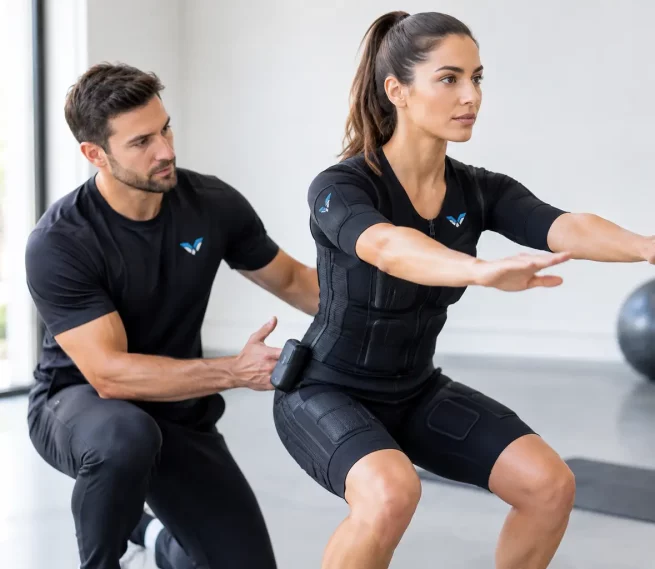
At E-Pulse Studio, EMS training can be a useful option within this structure. The technology adds muscular stimulus while a trainer coaches every movement, allowing clients to work efficiently with light external loads. That can be particularly attractive when time is tight or heavy weights and high-impact exercise are not the right choice. It is not a shortcut around good coaching, however. Position, intensity and progression still matter.
How hard should joint friendly workouts feel?
You should expect working muscles, elevated breathing and a sense of effort. You may also feel normal, temporary muscle soreness after a new programme. What you do not want is sharp pain, a feeling of instability, symptoms that worsen rep by rep, or a flare-up that significantly changes how you move afterwards.
A practical rule is to assess the full picture. Mild discomfort that settles quickly and does not worsen from session to session may be manageable with the right modifications. Pain that is severe, persistent, accompanied by swelling, numbness or weakness, or linked to a recent injury deserves assessment by a qualified healthcare professional before you push on.
Do not use painkillers as permission to train through a problem. They can mask useful feedback. Equally, do not assume every ache means you must stop all activity. The right level of movement is often part of rebuilding confidence and capacity.
Common mistakes that keep people stuck
The first is replacing all strength training with gentle cardio. Walking and cycling are valuable, but muscles need progressive resistance to become more supportive and resilient. The second is copying a workout designed for someone with a completely different history, body size, sport or tolerance for impact.
Another common mistake is changing everything at once. New shoes, a new running plan, extra gym sessions and a weekend of DIY can add up to more load than your body can currently recover from. Start with a sustainable frequency, track how you feel over the following 24 to 48 hours, and make one progression at a time.
Finally, people often wait for the “perfect” pain-free day before beginning. That day may never arrive. A personalised plan gives you a way to train around limitations while steadily working towards fewer of them.
Make progress measurable
Joint-friendly training should still have standards. Track your comfort during key movements, the range you can control, the resistance you use, your recovery and how daily life feels. Can you walk further without stopping? Take the stairs more easily? Complete a golf round or run session with more confidence? Stand taller at the end of a working day?
Those wins matter as much as a number on the scales. For clients focused on body composition, strength training and manageable conditioning also provide a better foundation than repeatedly starting punishing plans that cannot be maintained.
The strongest programme is the one that meets you where you are, challenges you intelligently and keeps you moving towards what you want to do. Start with the movement you can perform well today, and let consistency do the heavy lifting.

 8min
8min