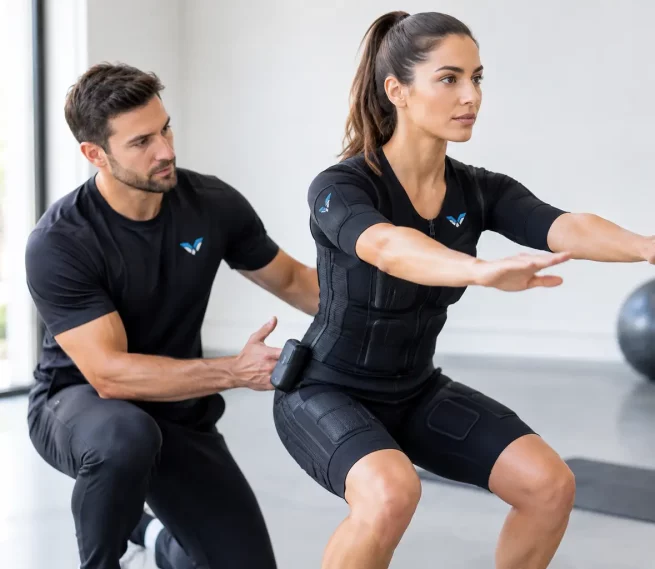
A squat can look simple, yet the quality of the effort behind it varies hugely. One person shifts into their hips, braces their trunk and drives through the whole lower body. Another relies on the strongest muscles available, while weaker or less active areas contribute very little. Understanding how EMS improves muscle recruitment starts with this difference: it helps your body access more of the muscle fibres that should be working during a movement.
For busy professionals, parents and anyone returning from pain or inconsistent training, this matters. Results do not come purely from spending more time exercising. They come from making each repetition purposeful, well coached and appropriately challenging.
What muscle recruitment actually means
Muscles are made up of many fibres, controlled by motor units. When your brain tells a muscle to contract, it does not necessarily recruit every available fibre at once. It calls upon the number and type of motor units needed for the task.
A gentle walk requires relatively little force, so recruitment stays low. A heavy lift, sprint or powerful change of direction demands much more. Your nervous system increases the number of motor units involved and the rate at which they fire to generate greater force.
That is one reason strength training works. Over time, your body becomes better at coordinating effort, producing force and using muscle efficiently. But recruitment can be limited by poor movement habits, lack of confidence under load, fatigue, previous injury, low training experience or simply not having enough resistance to create a meaningful stimulus.
EMS training adds a controlled electrical stimulus to the picture. It does not replace your own effort. It gives that effort an extra layer of targeted activation.
How EMS improves muscle recruitment during exercise
An EMS suit sends low-frequency electrical impulses through electrodes positioned over major muscle groups. The impulses are adjusted by a qualified trainer and delivered while you perform active movements such as squats, lunges, rows, presses, core work or mobility-focused exercises.
The electrical signal stimulates motor nerves, encouraging the underlying muscles to contract. At the same time, you are voluntarily contracting those muscles to complete the movement. This combined demand can create a strong training effect without needing to load your body with a barbell, heavy dumbbells or high-impact exercise.
More active fibres during each repetition
In conventional exercise, recruitment generally increases as a task becomes heavier or more demanding. EMS can raise the local muscular demand even when the external load is modest. That makes bodyweight movements, resistance bands and controlled functional exercises feel far more challenging than they look.
For a beginner, this can make it easier to feel the right muscles working. For a trained client, it can add a new stimulus without endlessly chasing heavier weights. The aim is not to make every session punishing. The aim is to recruit muscles with enough intensity and precision to support progress.
Better awareness of underused muscles
Many people arrive at training with common recruitment patterns: glutes that do not contribute well during lower-body work, a core that switches off when fatigue hits, or upper-back muscles that lag behind the chest and shoulders. These patterns can affect posture, movement quality and how certain exercises feel.
EMS provides immediate sensory feedback. When the pulse is applied to a muscle group during a correctly coached exercise, clients often become much more aware of where they should be generating force. That awareness can carry into everyday movement and conventional training too.
A client working at a desk all day, for example, may struggle to engage their upper back and trunk during a row. With guided positioning and EMS, they can learn to create tension through the right areas rather than pulling only with the arms. The change is not magic. It is repetition, feedback and progressively better coordination.
Strong effort without excessive joint loading
Heavy resistance remains a useful tool for many people. But it is not the only route to increasing muscular challenge, and it is not always the best first option. If you have joint sensitivity, are rebuilding confidence after time away from exercise or need to manage the impact of running, sport or a physically demanding job, loading can be a limiting factor.
Because EMS increases muscular intensity while external resistance can stay low, it may offer a practical way to train hard with less mechanical stress on the joints. This is particularly valuable for people who want to strengthen legs, hips, back and core but cannot comfortably jump straight into high-load gym sessions.
That does not mean EMS is automatically suitable for every injury or health condition. Pain needs a proper assessment, movement needs to be coached, and anyone with a medical concern should seek appropriate clinical advice. A good programme works with your current capacity rather than forcing you into someone else’s training plan.
Why coaching changes the result
The suit is a tool, not a workout in itself. Muscle recruitment improves most when stimulation, movement selection, posture and intensity are managed together.
At E-Pulse Studio, sessions are trainer-led because the details matter. The right pulse level for one person may be too strong or too distracting for another. The best exercise choice for a runner improving leg strength is different from the best choice for a busy parent managing back stiffness or someone focused on body composition.
A coach can adjust the intensity across individual muscle groups, cue better technique and progress the session as your strength and confidence develop. They can also spot when a movement has become compensation rather than quality work. If the lower back is taking over during a hip exercise, for instance, the answer is not always more intensity. It may be a change in stance, range of motion, tempo or exercise selection.
This is where the premium studio approach earns its value. You are not left pressing buttons in a room and hoping for the best. You are coached through 30 focused minutes designed around a clear outcome.
Muscle recruitment is not the same as muscle growth
It is easy to assume that feeling a very strong contraction guarantees rapid muscle gain. Recruitment is a major part of the training stimulus, but it is only one piece of the result.
Building muscle and improving body composition also depend on progressive overload, recovery, protein intake, overall nutrition, sleep, training consistency and your starting point. Someone new to structured training may notice faster improvements in strength, posture and muscle tone than someone who already trains frequently. A seasoned lifter may use EMS as a complementary tool rather than a replacement for sport-specific or heavy strength work.
The same applies to fat loss. EMS sessions can support a higher-effort training routine in a short time, but no technology can outwork an inconsistent nutrition plan or poor recovery habits. The strongest results usually come from combining focused sessions with sensible food choices, daily movement and realistic targets.
Who can benefit most from EMS recruitment training?
EMS can be especially useful for people who need maximum return from limited time. A 30-minute coached session can create a concentrated full-body challenge that would otherwise take much longer to organise in a conventional gym.
It also suits people who find standard gym training difficult to maintain. If you have repeatedly started and stopped because you are unsure what to do, feel self-conscious in a busy gym or cannot fit long workouts around work and family, the structure of a booked, coached session removes friction.
For more experienced clients, the benefits may be different. Runners can use it to strengthen the posterior chain and trunk. Golfers can work on stability and rotational control. Combat athletes may use it alongside their technical training to develop full-body strength and conditioning. In every case, the programme should support the main goal rather than compete with it.
What a productive EMS session should feel like
A well-run session feels intense, but controlled. The pulse should be noticeable and demanding without making good movement impossible. You should still be able to breathe, maintain form and respond to your coach’s cues.
Expect fatigue in the muscles being targeted, particularly during the final seconds of an exercise block. Expect exercises to feel more challenging than their external load suggests. You should not expect sharp pain, numbness, dizziness or a need to prove anything by tolerating an inappropriate setting.
Progress should be measured beyond the sensation of a tough workout. Strength improvements, better movement control, changes in mobility, reduced discomfort where appropriate, fitness markers and 3D body scan data can all help show whether the plan is working. Numbers make the journey clearer, particularly when day-to-day changes are hard to notice.
The real advantage of EMS is not that it makes exercise effortless. It makes focused effort count. When your muscles are recruited well, your movement is coached properly and your programme fits your life, training becomes something you can build on week after week.
 8min
8min