You feel it on the stairs first. Then on a run you used to handle comfortably. Then during a busy week, when energy is already stretched, your fitness starts to feel like one more thing slipping backwards. That is exactly why a guide to VO2 max improvement training matters – because better aerobic capacity does not just help athletes, it makes everyday life feel easier, stronger and more under control.
VO2 max is the maximum amount of oxygen your body can use during intense exercise. In simple terms, it is a strong marker of cardiovascular fitness. The higher it is, the better your body can deliver and use oxygen when effort rises. That can mean improved stamina, better recovery between bursts of effort, and stronger overall performance whether you are running, cycling, playing sport or simply trying to stop feeling wiped out too quickly.
The good news is that VO2 max can improve. The catch is that it usually does not improve from random effort. It improves when training is structured well enough to challenge the heart, lungs and muscles without pushing you into constant fatigue.
What actually improves VO2 max
Most people assume the answer is just harder cardio. Sometimes it is, but not always. VO2 max responds best to the right mix of intensity, consistency and recovery.
Your heart needs a reason to pump more blood per beat. Your muscles need a reason to become better at extracting and using oxygen. Your aerobic system needs repeated exposure to training that is demanding enough to create adaptation. If every session is easy, progress is slow. If every session is brutal, progress stalls for a different reason – you are too tired to perform well often enough.
That is why strong VO2 max training sits in the middle ground between smart pressure and controlled recovery.
A practical guide to VO2 max improvement training
If your goal is better stamina, there are three main levers to pull. The first is interval training. The second is steady aerobic work. The third is strength and movement quality, because poor mechanics and low muscular endurance often cap cardio performance earlier than people realise.
For most busy adults, two cardio-focused sessions and one or two supporting sessions each week is enough to make progress. You do not need to train like a professional cyclist. You do need consistency.
1. Use intervals that are hard enough to matter
VO2 max tends to improve when you spend time working at a high percentage of your maximum effort. Intervals are effective because they let you accumulate more quality work than you could sustain in one nonstop push.
A simple starting point is 4 rounds of 3 minutes hard with 2 minutes easy recovery. Hard means you are breathing heavily, speaking only in short phrases, and working at roughly 8 out of 10 effort. You are not sprinting all-out. You are pressing hard enough that the final minute feels demanding.
Another effective option is shorter repeats such as 8 rounds of 1 minute hard and 1 minute easy. These are useful for beginners or anyone returning after time off, because they still raise oxygen demand without requiring long periods of discomfort.
The key is repeatable quality. If the first interval is huge and the rest fall apart, the session is too aggressive.
2. Keep some training easier than your ego wants
This is where many people get stuck. They make every cardio session moderately hard, thinking more sweat means more progress. In reality, easier aerobic sessions build the engine that supports harder work.
A steady 30 to 45 minute session at a pace where you can still hold a conversation helps improve aerobic efficiency, recovery and endurance. It also places less stress on joints and the nervous system than repeated high-intensity work.
If you are time-poor, this may not sound exciting. It is still valuable. Easy training helps you tolerate hard training better, and that combination is where real gains happen.
3. Build strength if you want better cardio output
This surprises some people, but stronger muscles can improve how efficiently you move. If every stride, pedal stroke or circuit rep feels mechanically wasteful, your cardiovascular system pays for it.
Strength work for the legs, glutes, trunk and postural muscles can support better movement economy and reduce fatigue during conditioning sessions. It can also help if you are carrying old niggles, lower back tightness or mobility restrictions that limit how hard you can train.
This is one reason coaching-led programmes often get faster results than generic plans. They do not treat cardio in isolation. They look at the bottlenecks.
How often should you train for VO2 max?
For most people, 2 focused sessions per week is enough to improve VO2 max when the effort is right. A third session can help, but only if recovery, sleep and general stress are in a good place.
A sensible weekly structure might look like one interval session, one steady aerobic session, and one strength-based session that supports posture, movement and muscular endurance. If you already train regularly, you might add a second interval day, but not back-to-back.
If you are a busy parent, business owner or someone juggling inconsistent weeks, the best plan is the one you can actually repeat. A perfect programme done for ten days is less useful than a realistic one done for twelve weeks.
Signs your training is working
VO2 max does not always announce itself dramatically at first. Often the earliest signs are practical.
You recover faster between efforts. Your usual pace feels easier. Your heart rate settles more quickly after hard bouts. You stop dreading hills. Sessions that used to flatten you become manageable.
If you have access to testing, even better. Wearables can give estimates, though they are not always exact. Lab testing is more precise, but not essential for most people. What matters is seeing a trend in performance, recovery and repeatability.
At E-Pulse Studio, that measurable-progress mindset matters. People stay motivated when they can see their body changing, feel sessions getting easier and know the work is doing what it should.
Common mistakes that slow progress
The first mistake is doing too much high-intensity work. More is not better if every session leaves you cooked. VO2 max improves from repeated quality, not from proving how tough you are once a week.
The second is neglecting recovery. Sleep, hydration, nutrition and stress management all affect adaptation. If your life is flat-out and recovery is poor, training needs to be adjusted, not forced.
The third is choosing the wrong mode of exercise. If running aggravates your knees or back, use a bike, rower, cross trainer or coached low-impact conditioning approach instead. The goal is to challenge the aerobic system, not to stick rigidly to one format.
The fourth is guessing. Plenty of people train hard for months without clear structure, then wonder why results are patchy. A personalised plan removes that guesswork.
Can EMS support VO2 max improvement training?
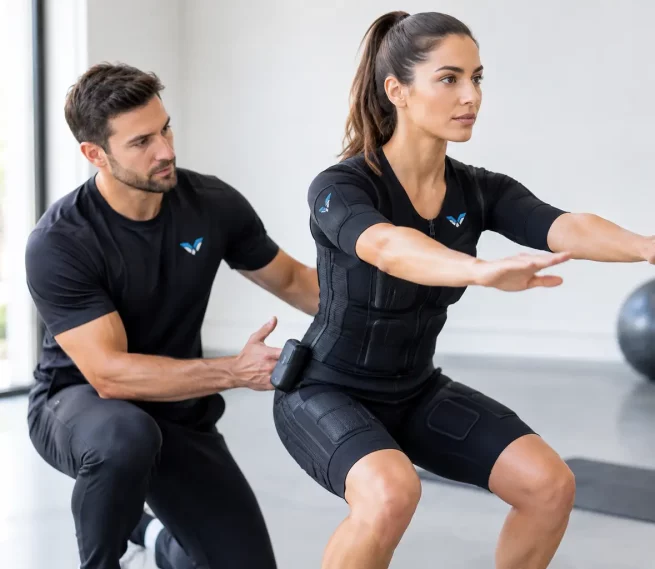
Yes, in the right context. EMS is not a magic shortcut for aerobic fitness on its own, but it can be a highly effective support tool. When used within a coached programme, it can help improve muscular recruitment, strength, posture and movement quality – all of which influence how efficiently you perform during cardio training.
For clients with limited time, recurring back pain, weak core control or inconsistent gym habits, this matters. If your body is more stable and stronger, you can usually train your aerobic system more effectively. You may also recover better between sessions because movement becomes less compensatory and less draining.
That is especially relevant for adults who want results without spending endless hours in a gym. A time-efficient model works when every session has a purpose.
Who benefits most from VO2 max training?
Not just endurance athletes. Busy professionals benefit because better aerobic fitness supports energy, resilience and recovery from daily stress. Parents benefit because being fitter makes active family life easier. Anyone returning from a stop-start exercise history benefits because progress is measurable and motivating.
It can also be a strong fit for people who want fat loss support, as improved work capacity often helps you train more effectively overall. And for those managing mobility issues or old injuries, the right setup can build stamina without grinding the body down.
The important point is this: VO2 max training should match your current level, not your idealised version of yourself. Start where you are. Then build.
The smart way to start
If you are new to structured conditioning, begin with one interval session and one easier aerobic session each week for three to four weeks. Let your body adapt. Once that feels manageable, progress either the duration, the intensity or the number of intervals – not all three at once.
If you already train but feel stuck, look at recovery and session quality before adding volume. Better numbers often come from better planning, not from cramming in more effort.
And if you want faster, more accountable progress, get assessed properly. Good coaching identifies the weak link early, whether that is fitness, mobility, posture, pacing or consistency.
Better VO2 max is not only about pushing harder. It is about making hard work count, so your body becomes more capable week after week and everyday life starts to feel lighter because of it.

 8min
8min