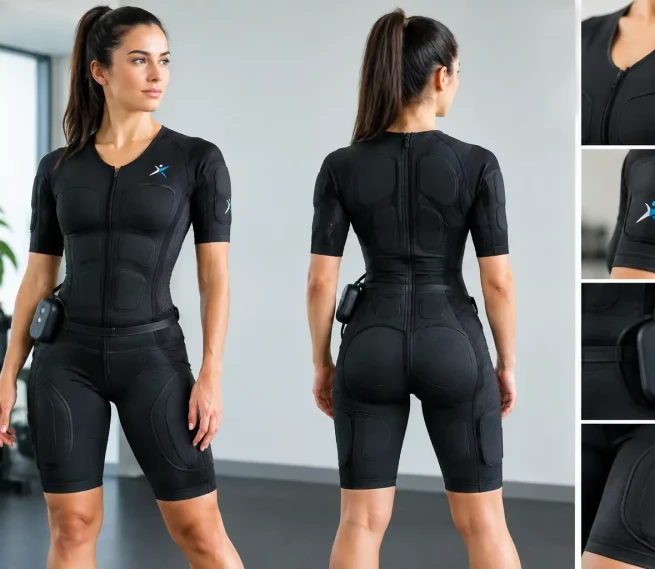
A hard session is only useful if it fits into your real life. If work runs late, school runs take over or a sore back makes traditional workouts feel like a gamble, the question is not simply how hard you can train. It is which method you can follow consistently. EMS versus HIIT is a comparison many time-poor adults make when they want visible progress without giving up several evenings a week.
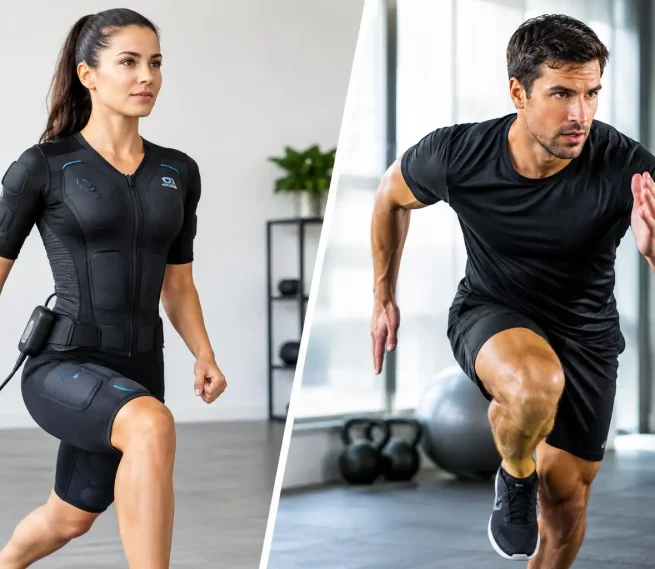
Both can challenge your body, raise your heart rate and support body-composition goals. They are not, however, interchangeable. HIIT asks you to create intensity through fast, demanding exercise. EMS adds controlled electrical stimulation to coached movement, allowing muscles to work hard in a short, carefully managed session. The right choice depends on your goal, training history, recovery capacity and the support you need to stay on track.
EMS versus HIIT: the key difference
HIIT, or high-intensity interval training, alternates short bursts of demanding work with recovery periods. That could mean sprint intervals, bike efforts, kettlebell circuits, rowing, burpees or bodyweight exercises. It is popular for good reason: it is flexible, can be done with little equipment and delivers a serious cardiovascular challenge in a relatively short workout.
EMS training uses a wearable suit to deliver electrical impulses to targeted muscle groups while you perform guided exercises. At E-Pulse Studio, sessions are trainer-led and typically last 30 minutes. The trainer adjusts the intensity to your ability, movement quality and goal, whether that is building strength, improving posture, returning to exercise or supporting sports performance.
The practical distinction is this: HIIT usually places a high demand on your heart, lungs, joints and coordination at speed. EMS places a strong emphasis on muscular activation while keeping movements controlled and low impact. A well-designed EMS session can still feel challenging, but it does not need to involve jumping, sprinting or leaving you sprawled on the gym floor.
What HIIT does well
For people who enjoy moving fast and thrive on variety, HIIT can be a brilliant training tool. It can improve fitness, work capacity and confidence in demanding movements. A runner may use intervals to build speed, while someone who enjoys group exercise may find the pace and shared energy motivating.
HIIT is also highly accessible. You can train outdoors, at home or in a gym, and sessions can be adapted around the equipment available. If your main target is cardiovascular conditioning and you already move well under fatigue, one or two intelligently planned HIIT sessions a week may earn their place in your routine.
The catch is that intensity has a cost. Poor technique becomes more likely when you are exhausted, especially in classes built around high repetitions and short rests. If you are carrying extra weight, managing knee, hip or back discomfort, returning after a long break, or already stressed and under-slept, another all-out circuit may not be the smartest route to progress.
HIIT also has a reputation for being short, but a realistic session includes warm-up, preparation, the workout itself and a cool-down. The total time can easily stretch beyond the advertised 20 minutes. That is not a reason to avoid it. It is simply worth being honest about what you can maintain week after week.
Where EMS can be the stronger fit
EMS is built for people who want high-quality muscular work without spending hours in a conventional gym. Because the stimulation supports muscle recruitment during coached movement, the training can be efficient and highly individualised. Your programme does not have to look like anyone else’s.
This matters when your goals are specific. You may want to feel stronger carrying children, improve glute and core activation after months at a desk, build a more athletic shape, or train around limited mobility. Controlled resistance, posture work and mobility-focused exercises can all be integrated into an EMS session without forcing your body through high-impact drills it is not ready for.
The coaching element is a major advantage. Rather than guessing whether you are working hard enough or compensating through your lower back and shoulders, you have a trainer watching the details. Intensity can be increased gradually as your capacity improves. For beginners, that removes much of the intimidation that comes with a busy gym floor. For experienced exercisers, it creates a focused way to target weak links and support an existing programme.
Progress should not be judged by sweat alone. Better movement, greater strength, improved posture, reduced discomfort and changes in body composition are all meaningful markers. Regular 3D body scanning can make that progress easier to see, particularly when day-to-day mirror checks fail to show the work you have put in.
Is EMS better than HIIT for fat loss?
Neither method makes fat loss happen in isolation. Sustainable results come from an appropriate calorie intake, enough protein, regular activity, sleep and a training plan you can repeat. The strongest programme is rarely the one that leaves you shattered for three days. It is the one that helps you build muscle, use energy consistently and make better choices outside the studio as well.
HIIT can contribute to calorie expenditure and cardiovascular fitness. EMS can help build and maintain muscle while providing a time-efficient training stimulus. More muscle supports a firmer, stronger physique and can make body-recomposition goals more realistic when nutrition is aligned.
For busy professionals and parents, adherence often decides the outcome. If a 30-minute coached appointment is the session you will actually keep, EMS may outperform an ambitious HIIT plan that gets abandoned after two weeks. If you genuinely enjoy intervals and recover well from them, HIIT can be equally valuable. The best answer is not the trendiest one. It is the method you can perform safely, consistently and with purpose.
Recovery, pain and joint impact
This is where the comparison becomes more personal. HIIT is not automatically bad for joints, and EMS is not a substitute for medical care. A knowledgeable coach can adapt either method. But the higher speeds, impact and fatigue often associated with HIIT can be a poor starting point for someone with recurring pain, weak movement control or low confidence.
EMS training can offer a lower-impact route to strengthening the muscles that support better movement. It can be particularly useful for people rebuilding confidence after inactivity, those wanting to improve mobility and posture, or clients who need training to fit alongside demanding work and family commitments. Exercise selection and intensity still matter, which is why an individual assessment is essential.
If you have a medical condition, implanted electronic device, are pregnant, or are recovering from injury or surgery, seek appropriate medical advice before training. A reputable EMS studio will screen you properly and tell you honestly whether EMS is suitable at this stage.
Can you combine EMS and HIIT?
Absolutely, provided recovery is planned rather than hoped for. A footballer, combat athlete or regular runner may use EMS to support strength, core control and muscular conditioning, while keeping HIIT for sport-specific fitness. Someone focused on body transformation may begin with EMS once or twice a week, build a daily walking habit and add low-impact intervals later when their movement and capacity improve.
The mistake is stacking maximum-effort sessions because they sound productive. Training stress comes from more than the workout itself. Poor sleep, long commutes, work pressure and family responsibilities all affect recovery. Your programme should account for the life you are living, not the idealised version of it.
A good coach will also know when to reduce the dial. Better results do not always come from more intensity. Sometimes the smartest session is one that reinforces movement quality, restores confidence and leaves you able to train again as planned.
Choosing your next session
Choose HIIT if you enjoy fast-paced exercise, have a solid movement foundation and want a cardiovascular challenge that can be adapted to many settings. Choose EMS if you want expert-led, low-impact and time-efficient training with muscular strength, posture and measurable progress at the centre of the plan.
For many people, the first session answers more than any article can. You will quickly learn whether the format feels sustainable, whether the coaching gives you confidence and whether the plan fits your week. The most powerful training method is the one that helps you show up, get stronger and leave with more capability for the life waiting outside the studio.
 7min