Thirty minutes can be enough to challenge your whole body when every contraction has purpose. The EMS strength technique combines controlled movement with precisely timed electrical muscle stimulation, helping you work with greater intensity without spending hours moving between machines in a crowded gym.
For busy professionals, parents and anyone whose training has become inconsistent, that efficiency matters. But EMS is not a shortcut that replaces effort. It is coached strength training with technology that raises the quality of each rep, giving you a focused session built around your body, your goals and your current ability.
What is the EMS strength technique?
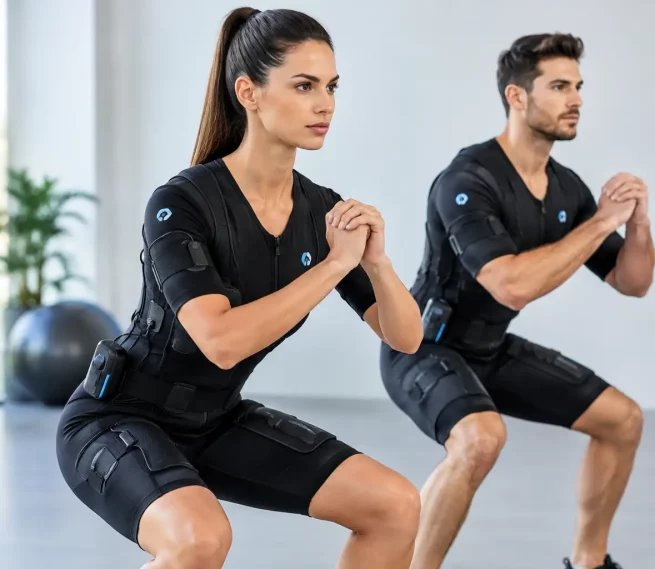
EMS, or Electro Muscle Stimulation, uses a wearable suit with electrodes placed over major muscle groups. During the session, low-frequency impulses are delivered while you perform simple, functional exercises such as squats, lunges, hinges, presses and core movements. Your brain already tells your muscles to contract when you move. EMS adds an external stimulus at the same time, increasing the recruitment demand during the exercise.
The technique is not about turning the setting up and hoping for the best. Effective EMS strength training is about timing, posture, range of movement, breathing and progressive overload. A good coach adjusts the intensity for each area of the body and watches how you move from the first repetition to the last.
This makes it suitable for people at very different starting points. Someone returning after back discomfort may begin with supported squat patterns and mobility-led work. A runner may use EMS to strengthen the posterior chain, trunk and legs alongside their running plan. An experienced gym-goer may use it as a highly efficient full-body strength session when time is tight.
Why technique matters more than intensity alone
The sensation of EMS is distinctive. You will feel a strong, rhythmic contraction while you move, but stronger is not automatically better. If the impulse level compromises your form, forces you to hold your breath or reduces your range of motion, it is no longer doing its job properly.
The right level is one that feels demanding while allowing you to stay in control. You should be able to brace your core, keep your joints aligned and complete the movement with intention. This is where coach-led sessions make a real difference. The aim is not simply to tolerate a hard sensation. The aim is to create safe, repeatable muscular effort that delivers progress.
At E-Pulse Studio, every session is guided rather than left to chance. Your trainer can increase stimulation gradually as your confidence, movement quality and capacity improve. That personal adjustment is particularly valuable if you have an old injury, limited mobility or a history of avoiding exercise because conventional gyms have felt intimidating.
How an EMS strength session is built
A 30-minute session should feel concise, not rushed. The best structure creates enough preparation for quality movement, then uses the main work phase to challenge the muscles efficiently.
Start with your movement, not the machine
Before intensity is increased, your coach needs to understand how you squat, hinge, rotate, press and stabilise. Small adjustments can make a substantial difference. A ribcage held over the pelvis, knees tracking comfortably and a properly braced trunk help transfer effort into the muscles you want to train.
This is also the time to discuss recovery. Poor sleep, a demanding work week, muscle soreness or a recent flare-up of pain can all influence how hard you should train. Progress comes from the right training dose, not from forcing every session to be maximal.
Match the contraction to the exercise
EMS impulses are commonly delivered in work-and-rest cycles. During the contraction phase, you perform the active part of the exercise with control. During the recovery phase, you reset your position, breathe and prepare for the next rep or movement.
For a squat, that might mean staying tall through the chest, sitting into a comfortable depth and driving steadily through the feet as the contraction arrives. For a core exercise, it may mean resisting movement rather than trying to create more of it. The exercises can look straightforward, but they become demanding when the major muscle groups are working together.
Progress with purpose
Progress is not limited to increasing the stimulation setting. It can mean cleaner movement, improved depth, better balance, more control under fatigue or a stronger ability to maintain posture. Over time, resistance bands, dumbbells or more challenging movement patterns may be added where appropriate.
This approach gives your training a direction. Rather than repeating the same session indefinitely, your programme can evolve around body composition, strength, stamina, mobility or performance goals. Regular 3D body scanning can add useful evidence too, helping you see changes that the bathroom scales may miss.
The strength benefits people notice first
Many clients first notice that everyday movement feels easier. Carrying shopping, getting up from the floor, climbing stairs or maintaining a better position at a desk can become less taxing when the legs, glutes, back and core are trained consistently.
Posture often improves because you are not just being told to stand up straight. You are building the muscular awareness and endurance to hold a stronger position. For people who spend long days sitting, this can be a meaningful shift. It depends on the person and the underlying cause of their discomfort, but stronger movement habits can support a more comfortable daily routine.
There is also a powerful consistency benefit. When training takes 30 minutes and is booked with a trainer, it is easier for many people to keep the promise they made to themselves. Two well-coached sessions each week can be more effective than a five-day gym plan that never fits around work, family or travel.
Where EMS fits into a wider fitness plan
EMS works best as part of a realistic plan, not as a reason to ignore everything else. Walking, cardiovascular work, mobility, sleep, hydration and nourishing food still matter. If fat loss is your goal, a sustainable nutrition strategy remains essential. If you are training for a race or sport, sport-specific practice cannot be replaced by an EMS session.
What EMS can offer is an efficient strength foundation. For a busy client, it may be the main resistance training stimulus for the week. For a keen runner, golfer or combat athlete, it can complement existing sessions by targeting full-body strength, stability and recovery support without adding hours of gym time.
The right balance depends on your training age, schedule and recovery capacity. Someone new to exercise may make excellent progress with one or two EMS sessions a week plus regular walking. A more advanced athlete may need a broader programme with conventional lifting, conditioning and technical practice alongside it.
Who should take extra care?
EMS training is not suitable for everyone. People with implanted electronic devices such as pacemakers, certain heart conditions, epilepsy, pregnancy, acute illness or specific medical concerns should seek appropriate medical advice before training. Your coach should ask about your health history before your first session and adapt the programme where needed.
It is also wise to be honest about pain. Training can help build capacity, but sharp, unexplained or worsening pain is not something to push through. A responsible programme respects the difference between productive muscular effort and a signal that needs clinical attention.
Getting more from every 30-minute session
Arrive hydrated, wear the recommended base layer and give your trainer clear feedback on how the stimulation feels. Eat in a way that supports your energy levels, especially if you are training after a long working day. Afterwards, prioritise protein, fluids and sleep so your body has what it needs to adapt.
Most of all, commit to the process. Visible body changes and meaningful strength gains are built through repeated quality sessions, not a single hard workout. Track how you feel, how you move and how your clothes fit, alongside the data from your body scans.
The most valuable session is the one that leaves you feeling challenged, capable and ready to return. Start where you are, train with purpose, and let consistent coaching turn 30 focused minutes into momentum that carries through the rest of your week.
 7min
7min