You do not need another fitness option that sounds good on paper but disappears into real life by week three. When people ask whether to choose EMS or gym membership, the real question is usually simpler: what are you actually going to stick with, and what will get you results fast enough to keep you motivated?
That is where this comparison matters. A traditional gym can work brilliantly for the right person. EMS training can be a game-changer for someone who wants expert guidance, measurable progress and a far more time-efficient route to strength, tone and improved fitness. The best choice depends less on trends and more on how you train, how much time you have and whether you perform better with structure.
EMS or gym membership: what is the real difference?
A gym membership usually gives you access to equipment, classes and a training space you use independently. For some people, that freedom is ideal. If you already know what you are doing, enjoy planning your own sessions and can stay consistent without anyone chasing you, a gym can be a solid investment.
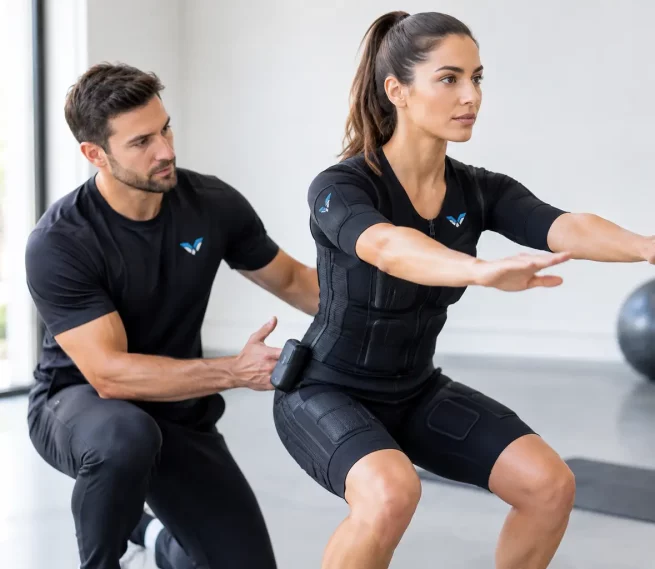
EMS training is different by design. Instead of turning up and deciding what to do, you work one-to-one with a trainer through short, focused sessions using electro muscle stimulation to activate more muscle fibres during controlled movements. The format is coaching-led, precise and built around outcomes.
That difference changes everything. One model gives you access. The other gives you direction.
Who usually gets the best results from a gym?
A standard gym membership suits people who have time, confidence and a degree of self-discipline. If you genuinely enjoy being in the gym three to five times a week, know how to programme your training and are happy to manage your own progress, it can be highly effective.
It also works well for people with very specific preferences. Some enjoy lifting heavy in their own time. Others like variety, from treadmills and rowing machines to spin classes and functional zones. If your routine is already established, the lower monthly cost of a gym compared with coached training may make sense.
But there is a catch. Access is not the same as action. Plenty of people pay for memberships they barely use. Others go regularly but plateau because they repeat the same exercises, train without enough intensity or never quite know whether what they are doing is moving them closer to their goal.
A gym is only valuable when you can turn access into consistent, effective effort.
Who usually gets the best results from EMS?
EMS tends to appeal to people who want more output from less time. Busy professionals, parents, business owners and anyone juggling a packed week often do not struggle with motivation in theory. They struggle with time, energy and consistency.
That is where EMS has real value. A short, coached session can fit into a schedule that would not allow multiple long gym visits. For clients focused on fat loss, muscle tone, posture, core strength or general conditioning, that efficiency can remove one of the biggest barriers to progress.
It is also a strong option for people who need support rather than guesswork. If you have had back pain, mobility limitations, postural issues or long gaps in training, being guided through every session matters. Instead of wandering around a gym floor deciding between machines, you train with a clear plan and close supervision.
For many clients, the biggest win is not simply that EMS is shorter. It is that the session is hard to waste. You arrive, train properly and leave knowing you have done something meaningful.
Time commitment: where most decisions are really made
Let us be honest. Time is often the deciding factor.
A gym session is rarely just 45 minutes of training. It is travel, changing, waiting for equipment, figuring out your workout, and sometimes losing momentum halfway through. Even when intentions are good, the total time cost can be substantial.
EMS changes that equation. Sessions are intentionally brief, but that does not mean easy. They are concentrated, high-efficiency and structured to make every minute count. For someone who has been telling themselves for months that they will get back into training when life calms down, this can be the difference between staying stuck and finally building momentum.
If your week is unpredictable, a model based on shorter coached sessions may be far more realistic than hoping you will suddenly find five spare hours for the gym.
Results: visible progress versus open-ended effort
This is where the conversation around EMS or gym membership gets more personal.
A gym can produce excellent results, but usually only when training quality, frequency and recovery are all handled well. That takes knowledge and consistency. Without those, progress can feel slow, which is one reason many people lose interest.
EMS is built around measurable progression. With trainer oversight, clients are more likely to train at the right intensity, improve movement quality and stay accountable. When body composition, muscle tone, strength, stamina or posture are the target, that support matters.
Many people do not need more fitness information. They need a system that helps them apply it week after week. That is often why coached models outperform self-directed ones in the real world.
Of course, there are limits. If your main goal is to become a specialist powerlifter, bodybuilder or endurance athlete, a full gym environment may still need to play a part in your wider programme. EMS is powerful, but it should be matched to the goal rather than treated as magic.
Cost: cheaper is not always better value
On paper, a gym membership usually looks cheaper. In monthly terms, that is often true.
But value is not about the lowest number on your bank statement. It is about what you actually use and what it helps you achieve. If you spend less on a gym but go twice a month, that is not value. If you invest more in coached training and finally become consistent, improve your strength, reduce pain and feel confident again, the calculation changes.
This is especially true for people who have tried and failed with conventional memberships before. If you know you need accountability, personalisation and a time-efficient format, choosing the cheapest option can end up being the most expensive mistake because it costs you more wasted months.
The better question is not, what costs less? It is, what gives me the highest chance of following through?
EMS or gym membership for fat loss, tone and strength
If your goal is general fat loss, improved muscle definition and better all-round fitness, both options can work. The difference lies in execution.
At the gym, success depends heavily on whether you train consistently and with enough structure. Many members drift between cardio machines and occasional weights without a clear progression plan. That can maintain activity, but it does not always drive body transformation.
With EMS, sessions are more targeted from the start. Combined with proper coaching and progress tracking, that can help clients feel changes sooner – not just on the scales, but in how their clothes fit, how strong they feel and how confidently they move.
For beginners, this can be especially motivating. Early progress builds belief. Belief builds consistency. Consistency changes bodies.
What about pain, mobility and confidence?
This is where a premium coaching-led studio often has an edge over a standard gym floor.
If you are dealing with lower back discomfort, poor posture, reduced mobility or a lack of confidence after time away from exercise, walking into a busy gym can feel overwhelming. Even when the intention is there, uncertainty can stop you training properly.
A more supported environment helps remove that friction. Guided sessions, close attention to technique and programmes tailored to your starting point can make training feel safer, clearer and more productive.
That does not mean gyms are unsuitable for everyone with physical limitations. Some are excellent. But if you know you need hands-on coaching and a more personalised route back into exercise, EMS has a strong case.
So which should you choose?
Choose a gym membership if you are self-motivated, enjoy training independently, have enough time to use it properly and already know how to structure effective workouts.
Choose EMS if you want expert guidance, efficient sessions, stronger accountability and a better chance of fitting training into a demanding week. It is particularly compelling if you have struggled with consistency, want visible results faster or need support with posture, mobility or confidence.
For some people, the answer is even both. A coached EMS session can provide intensity, structure and progression, while occasional gym work adds extra volume or sport-specific practice. It does not have to be tribal. It has to be practical.
At E-Pulse Studio, we see this every week: people who are not lazy, not unmotivated and not beyond help – just busy, frustrated and ready for a smarter way to train. If that sounds familiar, your best option is probably the one that gives you guidance, momentum and proof that your effort is paying off.
The right training choice is the one that fits your life closely enough that results stop being something you plan for and start becoming something you can feel.

 8min
8min