A stiff back when you get out of the car. Hips that complain after a day at the desk. Shoulders that make reaching overhead feel harder than it should. These are not simply signs that you need to stretch more. Mobility coaching looks at why movement feels restricted, then gives you a clear, progressive way to improve it.
For busy adults, the goal is not to spend an hour on a foam roller every evening or force yourself into extreme stretches. It is to move with more confidence in daily life, train with better technique and feel less held back by recurring tightness. Done properly, mobility work is practical, personalised and built around the movements that matter to you.
What mobility coaching actually means
Mobility is your ability to actively control movement through a useful range of motion. Flexibility is part of that picture, but it is not the full story. You might be able to pull your knee towards your chest with your hands, for example, yet struggle to control that same range when you squat, run or climb the stairs.
That is where coaching changes the equation. A good coach assesses how you move, identifies the areas where control, strength or range may be limiting you, then creates drills you can perform well and progress over time. The aim is not to chase impressive-looking positions. It is to build range you can use.
For some people, that means improving ankle movement so a squat feels smoother. For others, it means building thoracic spine control to make golf, swimming or overhead training more comfortable. If you spend long days sitting, hips and upper back may be the priority. The best starting point depends on your body, your training history and your goals.
Why stretching alone often falls short
Stretching can feel great. It can also be useful, especially when it is targeted and performed consistently. But a stretch does not automatically teach your body how to stabilise and produce force in that new range.
Think of it this way: gaining range without control is like buying extra space in a room but never putting a floor underneath it. You may reach the position passively, but your nervous system may not trust you there under load or at speed. That is why someone can feel loose after stretching, then revert to the same compensations during a squat, deadlift or run.
Mobility coaching combines range work with strength, breathing, balance and movement practice. You might use a supported deep squat to explore hip range, then perform controlled split squats to own it. You may work on shoulder rotation before adding light pressing or rowing patterns. The progression is what turns a temporary feeling of looseness into better movement capacity.
There is a trade-off, though. More range is not always better. A hypermobile person may need less stretching and more stability, strength and control. Equally, pain is not a signal to push harder through a mobility drill. Persistent, severe or unexplained pain should be assessed by an appropriate healthcare professional. Good coaching respects those boundaries.
The benefits that matter outside the studio
The most valuable mobility gains tend to show up in ordinary moments. You bend down to tie your shoes without bracing first. You turn to reverse the car with less neck stiffness. You carry shopping, lift a child or walk up the stairs feeling more capable.
For training, improved mobility can help you access stronger positions. Better ankle range may allow a more stable squat. Hip control can support running mechanics and reduce the tendency to overload the lower back. A more mobile upper back can make pressing, pulling and rotational sports feel more efficient.
It can also make consistency easier. If every workout leaves you feeling beaten up, you are less likely to stick with it. When sessions are scaled around your current capacity and technique improves, training becomes something you can build on rather than constantly recover from.
This is especially relevant if time is tight. Working professionals and parents rarely need another complicated routine. They need focused input that fits around work, family and existing exercise. A few well-chosen movements, repeated consistently, will usually outperform an ambitious plan that never survives the first busy week.
What happens in a mobility coaching session?
A useful session begins with a conversation. What feels difficult? When did it start? What activities do you want to return to or improve? A runner may be focused on stride comfort and calf resilience. A desk-based professional may want to ease hip and upper-back stiffness. Someone returning to exercise may simply want to move safely and regain confidence.
The coach then observes key movement patterns. This is not about judging your body or finding a perfect posture. It is about seeing how you currently squat, hinge, lunge, rotate, reach and balance. From there, the programme can focus on the areas that will make the greatest difference.
Expect controlled exercises rather than random stretching. These could include hip rotations, loaded carries, supported squats, ankle control drills, spinal rotations or strength work at the edge of your available range. The right exercise is the one you can perform with good technique and a clear purpose, not the one that looks most advanced on social media.
At E-Pulse Studio, mobility support can sit alongside personalised training, allowing your coach to adapt sessions as your movement improves. That matters because mobility is not a one-off fix. It is a capacity that develops through regular, intelligent practice.
How mobility coaching works alongside strength training
Strength and mobility are not competing goals. In many cases, strength training is one of the most effective ways to keep and improve usable range of motion, provided the exercises are selected and coached well.
If your hips feel restricted, bodyweight mobility may be the right starting point. Once you can access a comfortable range, progressive resistance helps you control it. If your shoulders are sensitive overhead, you may first work through pain-free pulling and rotation before gradually introducing pressing. The process should feel challenging, but not reckless.
This is also why a quick fix can disappoint. A single sports massage, stretch class or mobility video might offer short-term relief, but it cannot replace a plan that responds to your progress. Your needs change as you get stronger, return from injury, increase training volume or prepare for an event.
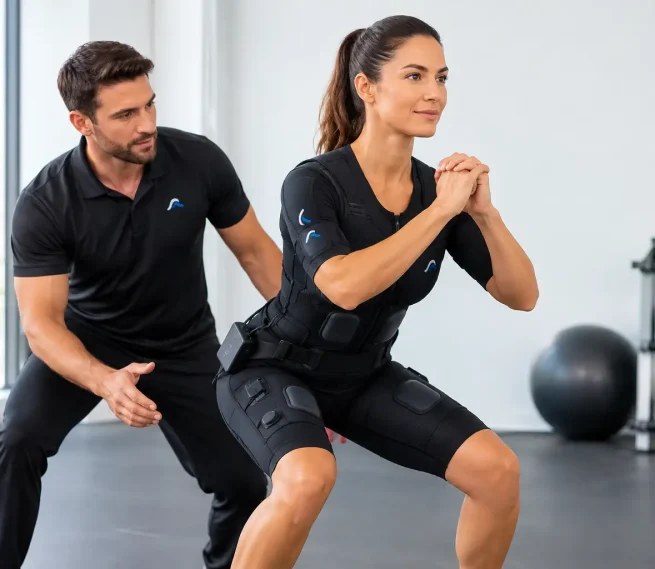
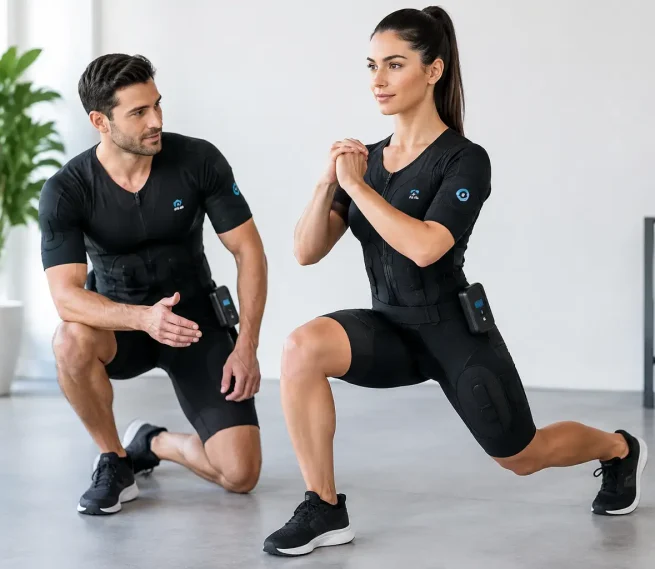
For clients using EMS training, mobility preparation and careful exercise selection can be particularly valuable. EMS sessions are efficient, but efficiency should never mean rushing past movement quality. A coach can use the time well by matching intensity to your ability, reinforcing good positions and adjusting the session when your body needs a different approach.
Building a routine you will actually maintain
The ideal frequency depends on your starting point and goals, but consistency beats intensity. Two or three short mobility blocks each week can create meaningful change when they are specific and progressed. Five to ten minutes before training may be enough on some days. On others, a longer coached session can help you refine technique and address a stubborn limitation.
Keep the routine tied to something you already do. Add ankle work before lower-body training, upper-back rotations after your first coffee, or a short hip-control sequence before bed. The less friction involved, the more likely it is to happen.
Pay attention to quality. Move slowly enough to feel where the restriction is coming from. Breathe normally. Avoid bouncing, forcing a joint into discomfort or treating every sensation as something to overcome. A mild effort or stretch can be appropriate; sharp pain, tingling, numbness or worsening symptoms are not.
Progress is often quieter than people expect. You may first notice that your warm-up takes less time, your squat feels more balanced or you finish a working day with less stiffness. Those small changes matter because they make it easier to keep moving, and that is where bigger improvements begin.
Mobility coaching is not about becoming impressively bendy. It is about giving yourself more options: to train harder when you want to, recover intelligently when you need to, and move through your day with less hesitation. Start with the movement that currently feels limited, then build from there with patience and purpose.
 7min