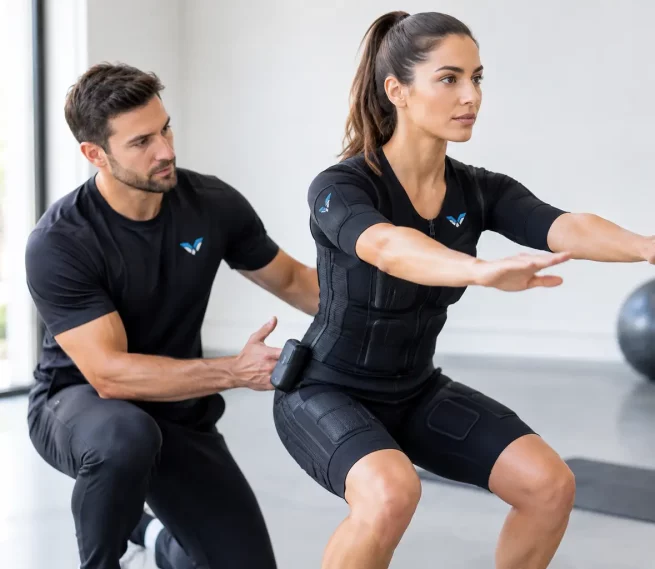
Thirty minutes can change how you train, but the setting changes how that half-hour feels. Individual EMS versus group sessions is not a question of which format works harder. Both can deliver focused, high-efficiency training. The better question is: which one gives you the coaching, structure and motivation you need to stay consistent long enough to see measurable progress?
At E-Pulse Studio, EMS training is never about clipping on a suit and being left to get on with it. Every session is trainer-led, purposeful and adapted to your current ability. Whether you train one-to-one or alongside a small group of up to eight people, you are there to move better, feel stronger and make your limited time count.
Individual EMS versus group sessions: the real difference
EMS uses controlled electrical stimulation alongside voluntary exercise to encourage strong muscle contractions while you perform guided movements. The technology matters, but coaching matters just as much. Your trainer controls the intensity, checks your form and selects exercises that support your goal, whether that is fat loss, muscle tone, improved posture, stronger running legs or a return to training after injury.
The difference between individual and group EMS is mainly the level of personal focus, the energy in the room and the pace of the session.
An individual session is built around you from the first movement. A group session follows a shared structure, while still allowing the trainer to adjust intensity and offer technical support. Neither is automatically superior. The best choice depends on your starting point, your confidence, your training history and what will make you show up week after week.
Choose individual EMS when precision is the priority
One-to-one EMS personal training gives you the greatest degree of individual attention. Your trainer can spend the full session watching how you move, adapting exercises in real time and adjusting the stimulation to match each muscle group and your tolerance.
This is particularly valuable if you have a specific issue to work around. Perhaps lower back discomfort has made conventional gym sessions frustrating. Perhaps you are recovering your confidence after a long break from exercise, managing restricted mobility, or building strength for a sport. In these cases, the ability to slow down, refine technique and progress in a controlled way can make training feel safer and far more productive.
Individual EMS is also an excellent choice for clients with a very clear outcome in mind. If you are preparing for an event, want to improve body composition, or need targeted work to support golf, running or combat sport performance, your programme can be shaped around that outcome rather than a wider class flow.
The experience is focused and efficient. There is no need to keep up with anyone else, and no pressure to compare yourself with the person beside you. For busy professionals and parents, that can be a huge relief. You arrive, train with intent, track progress and leave knowing the session was designed around your body and your target.
What one-to-one coaching can support
Individual sessions are often the strongest fit when you need close form coaching, targeted muscle activation or a carefully managed progression plan. They also suit people who prefer privacy, have not exercised for some time, or want expert accountability without the social aspect of a class.
That does not mean one-to-one training has to feel intense in an intimidating way. A good trainer meets you where you are. Some clients need a push; others need reassurance that they can move well again. Both are part of the job.
Choose group EMS when motivation comes from momentum
A small EMS group session brings a different kind of power: shared effort. You are still coached, your EMS intensity is still personalised, and you are still working within a controlled 30-minute format. But the room has more energy. When everyone is moving through the session together, it becomes easier to commit to that final set or hold a position for a few seconds longer.
For many people, this is exactly what makes exercise stick. You may spend your working day making decisions, looking after others or staring at a screen. A group session gives you a fixed appointment, a friendly atmosphere and a team around you who understand that training can be challenging without becoming a chore.
Groups also make premium coaching more accessible for clients who want expert-led EMS training but do not require every minute to be devoted solely to their programme. You still benefit from trainer guidance and corrections, while gaining the extra spark that comes from training with people who are working towards their own goals.
The small-group format matters. A session capped at up to eight people is not a packed gym class where you disappear in the crowd. Your trainer can still see how you are moving, encourage better technique and help you scale an exercise when necessary.
Who tends to thrive in groups?
Group EMS can be a great match if you enjoy positive pressure, like a timetable in your diary and find accountability easier when other people are expecting you. It suits beginners who want a welcoming entry point to structured training, as well as regular exercisers who want high-quality work without spending hours in the gym.
It can also be ideal for friends, couples or colleagues who want to train together. Sharing the experience often removes the hardest part of any fitness plan: starting. The session becomes a commitment you keep, not another intention pushed to next week.
Results come from the right format and repeatable habits
It is tempting to assume that individual training will always produce faster results because it is more personal. In some circumstances, that is true. If you need rehabilitation support, detailed movement work or a sport-specific plan, one-to-one coaching may help you progress more precisely.
But consistency is the bigger driver. A group client who trains reliably, follows sensible nutrition habits and enjoys the process can make excellent changes to strength, stamina, posture and body composition. Likewise, an individual client who values the personalised plan but rarely attends will struggle to build momentum.
This is why progress tracking matters. Regular 3D body scanning can give you a clearer picture than the scales alone. Weight can fluctuate for countless reasons, while changes in measurements, shape and composition can show the work you are putting in. Combined with trainer feedback, this makes it easier to adjust your plan based on evidence rather than guesswork.
Nutrition, sleep, daily movement and recovery also influence what you see and feel. EMS can be a powerful part of a body transformation or performance plan, but it is not a substitute for the habits that support your health between sessions. The strongest programmes are realistic enough to repeat during busy weeks, not just perfect on paper.
Questions to ask before you book
Start with the training experience you want. Do you need complete personal attention, a targeted plan and detailed support around movement limitations? Individual EMS is likely the better starting point.
Do you already move reasonably well, enjoy training around others and want a time-efficient session that gives you energy and accountability? A group may be your ideal fit.
If you are unsure, do not overthink it. Your first conversation should cover your goals, medical history, previous injuries and confidence level. EMS may not be appropriate for everyone, particularly where certain medical conditions or implanted electrical devices are involved, so honest screening is essential. A qualified trainer can then recommend a suitable route and explain how intensity will be introduced.
You do not have to choose forever
Your ideal format can change as you do. You might begin with one-to-one EMS to learn movement patterns, build confidence and establish a personalised baseline. Later, you may move into group sessions for variety, community and ongoing accountability. Or you may combine both: group training as your regular weekly foundation, with occasional individual sessions when you want a sharper focus on a new goal.
The point is not to find the most impressive option. It is to find the format that makes you feel capable, supported and willing to return. If your training finally fits around your life rather than competing with it, you have already made a meaningful step forward.
 8min
8min