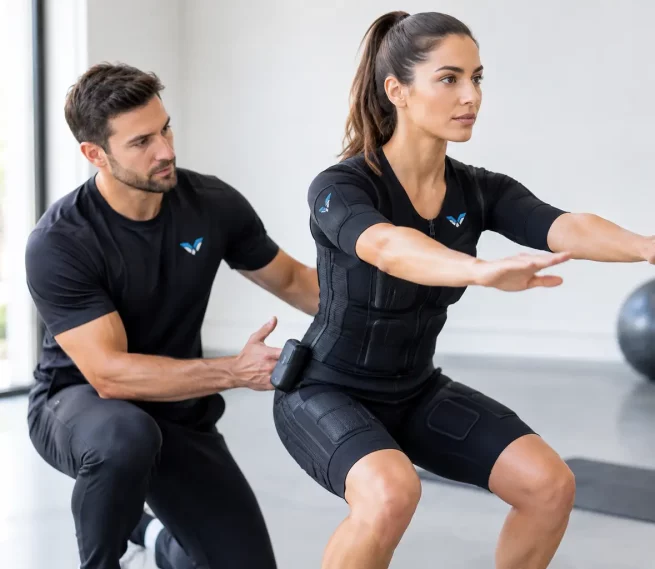
A stiff lower back when you get out of the car. Aching knees after a day at your desk. A shoulder that makes lifting, reaching or playing with the kids feel harder than it should. These are the real-life frustrations that often stop people exercising – even when they know movement could help. So, can EMS help reduce pain? For some people, coached Electro Muscle Stimulation training can be a valuable part of rebuilding strength, improving movement and reducing the day-to-day discomfort linked to deconditioning, poor posture or recurring muscle tightness.
It is not a magic fix, and it is not a replacement for medical assessment where one is needed. But when it is personalised properly, EMS can help you train around limitations, restore confidence in movement and create the stronger foundation your body has been missing.
Can EMS Help Reduce Pain Through Better Strength?
Pain is rarely just about one weak muscle. It can be influenced by inactivity, repetitive positions, old injuries, stress, poor sleep, reduced mobility and how your nervous system responds to load. That is why the best answer is not simply to rest forever. It is often to introduce the right amount of progressive movement, at the right pace.
EMS sends controlled electrical impulses to muscles while you perform guided exercises. The stimulation increases muscular activation, allowing you to work multiple major muscle groups in a short session. With an experienced coach adjusting intensity, exercise selection and range of movement, this can make strength training more accessible for people who do not tolerate heavy weights, high-impact exercise or long gym sessions well.
Stronger glutes, legs, core and upper back can improve how you move through everyday tasks. Think of getting up from a chair without bracing yourself, carrying shopping with less strain, or walking up stairs with more control. For many clients, these functional wins matter long before aesthetics do.
The pain reduction is usually indirect. EMS does not erase the cause of pain. Rather, it may help improve the physical capacities that make certain aches less persistent: muscle strength, posture, joint control, circulation and confidence under load.
Why Low-Impact, Coached Training Matters
When pain has been hanging around for months, people often fall into one of two camps. They either stop moving almost completely because they fear making it worse, or they push through hard sessions that leave them flared up for days. Neither approach is ideal.
A coached EMS session offers a middle ground. Exercises can be adapted to your current ability, whether that means supported squats, controlled pulling movements, gentle core work or mobility-led patterns. The goal is not to prove how tough you are. The goal is to give your body a clear, manageable training signal and build from there.
At E-Pulse Studio, that coaching-led approach is central. A programme should reflect how you feel, what movements aggravate symptoms, your training history and the outcome you want – whether that is returning to golf, running more comfortably, improving your posture at work or simply getting through the week with less stiffness.
The short format also matters for busy people. A demanding work schedule, school run or business to run can make an hour-long gym visit feel impossible. A focused EMS session removes some of that barrier while still giving your muscles a meaningful stimulus. Consistency is where the change happens.
Where EMS May Be Most Useful
EMS training tends to make the most sense when discomfort is linked to reduced strength, sedentary habits, muscle imbalance or a gradual loss of mobility. It may be particularly useful for someone who wants to start exercising but feels intimidated by conventional gym equipment or high-impact classes.
For example, an office-based professional may notice tight hips, a rounded upper back and an increasingly sore lower back after years of sitting. A busy parent may have stopped training after an injury, then found that everyday lifting and carrying feels harder. A runner may be capable of covering the miles but lack the hip and core strength that supports efficient mechanics.
In each case, an EMS programme can complement a wider plan built around progressive strength work, movement quality, walking or sport-specific activity, recovery and sleep. The suit is a tool. The coaching, progression and consistency are what turn that tool into results.
What a Sensible Pain-Support Plan Looks Like
A good starting point is an honest conversation, not a one-size-fits-all workout. Your trainer should ask when the pain occurs, what makes it better or worse, whether there has been a diagnosis or injury, and what normal life activities you want to get back to.
From there, training should begin at a level you can recover from. That may mean lower stimulation settings, a smaller range of movement and slower, more controlled repetitions. As your tolerance improves, the programme can progress through increased strength demands, better movement control and more challenging functional exercises.
Progress is not always linear. You might feel noticeably better for two weeks, then have a busy period, poor sleep or an unusually active weekend that brings symptoms back. That does not mean training has failed. It means the plan needs to respond to your life, not ignore it.
Alongside sessions, small daily changes make a difference. Regular walks, standing up between meetings, gentle mobility work and better desk positioning can reinforce what you are building in training. Your coach can help you focus on the few actions that are realistic, rather than handing you a long list that never gets done.
When EMS Is Not the First Step
There are times when pain needs clinical assessment before any training programme. Do not try to train through severe, unexplained or rapidly worsening symptoms just because you are motivated to improve.
Seek advice from an appropriate healthcare professional if you have:
- sudden severe pain after a fall, collision or other trauma
- numbness, tingling, significant weakness or pain travelling down an arm or leg
- changes in bladder or bowel control, or numbness around the groin area
- unexplained weight loss, fever, night sweats or pain that is constant and worsening
- a known medical condition, recent surgery or a diagnosis where exercise clearance is required
You should also tell your trainer about any implanted electrical device, such as a pacemaker, as EMS may not be suitable. Pregnancy, epilepsy, acute inflammation, active cancer treatment and certain circulatory or neurological conditions may also require medical guidance or mean EMS should be avoided.
The strongest studios do not blur the line between coaching and healthcare. A personal trainer can support safe exercise progression, but they cannot diagnose the source of pain. If you are already working with a physiotherapist or clinician, EMS may sometimes fit into the wider plan, with the right communication and clearance.
Measuring More Than a Pain Score
Pain levels matter, but they are not the only sign that your body is improving. In fact, focusing only on pain can be frustrating because it naturally fluctuates.
Look for practical markers: Can you sit through a meeting without constantly shifting? Can you walk farther, climb stairs more easily or reach overhead with less hesitation? Is your posture improving by the end of the day? Are you sleeping better because your body feels less tense? These are meaningful signs that your capacity is growing.
This is where progress tracking can be useful. Strength, mobility, posture and body-composition measures can show change even when the mirror or a single difficult day tells a less encouraging story. It gives you evidence to keep going and helps your coach adjust your programme with purpose.
Build Capacity, Not Just Temporary Relief
The most encouraging client progress stories are rarely about one dramatic session. They are about the person who starts cautiously, learns that movement is safe again and gradually returns to the activities they had been avoiding. The shift from “my back always plays up” to “I can manage my day” is powerful.
If pain or stiffness has made exercise feel like a gamble, start with guidance, not guesswork. The right EMS programme should meet you where you are, challenge you appropriately and help you build a body that feels more capable in the moments that matter most.
 8min
8min