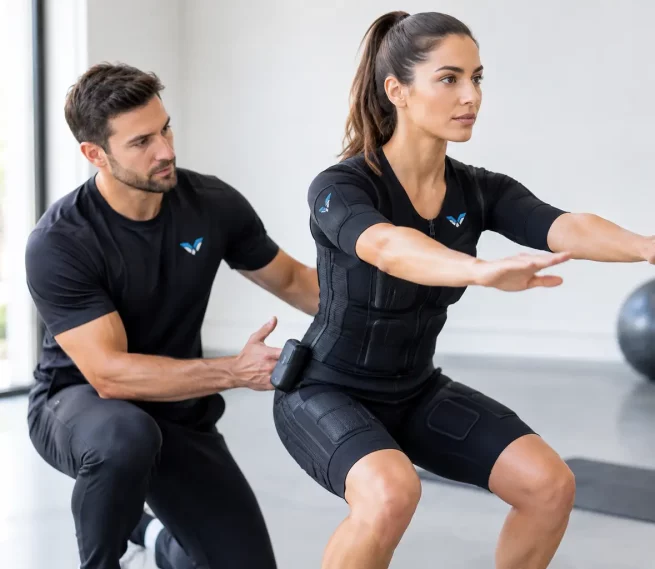
A stronger middle is not built by chasing hundreds of crunches after a long day. The best EMS workouts for abs combine precisely timed muscle stimulation with controlled, coach-led movement, so your core has to work as a unit – not just as a set of muscles you feel burning at the end of a workout.
For busy professionals, parents and anyone returning to exercise after a spell of back pain or inconsistency, that matters. Your abs help you sit taller at your desk, transfer power when you run or play golf, and stay stable when you lift, twist and carry through everyday life. Visible definition can be a welcome result, but real core training starts with strength, control and consistency.
What makes an EMS abs workout effective?
EMS sends electrical impulses through a specialist suit to encourage muscle contractions while you exercise. During a properly coached session, the stimulation adds intensity to movements such as squats, hinges, lunges and holds. It is not a shortcut where you lie down and wait for a six-pack. You still need to brace, breathe, move well and progressively challenge your body.
The strongest EMS core sessions focus on the whole trunk: the deep abdominal wall, obliques, lower back, glutes and hips. This is where many traditional ab routines fall short. Repeated sit-ups can have a place for some people, but they do not automatically teach you to resist twisting, keep your pelvis controlled or protect your posture under load.
At E-Pulse Studio, coaching is central to that difference. The suit delivers the stimulus, while your trainer adjusts the exercise, intensity and technique to your current ability. That makes the session useful whether you are new to training, rebuilding confidence after injury or looking to add a serious edge to an established programme.
The best EMS workouts for abs are built around movement
A high-quality 30-minute EMS session should not be an endless ab circuit. The following movement patterns give your core a reason to work, while training the rest of the body for better strength and body-composition results.
Squats with a strong brace
A bodyweight squat may look like a leg exercise, but it asks your core to keep your ribcage and pelvis organised while your hips and knees move. With EMS intensity applied appropriately, a slow squat becomes a demanding full-body exercise.
Stand with your feet comfortably apart, inhale to prepare, then gently tighten your midsection as if you are about to be nudged in the stomach. Lower with control, keeping your chest proud and your weight balanced through your feet. Exhale as you stand without letting your lower back overarch.
This is particularly valuable for beginners and anyone whose daily routine involves lots of sitting. Better squat control often translates into stronger legs, improved posture and a core that can do its job without constant tension in the lower back.
Split squats and supported lunges
Single-leg work exposes weak links quickly. As one leg works, your trunk has to resist tipping, rotating or collapsing to one side. That is exactly the kind of stability your abs need for walking, running, climbing stairs and sport.
A trainer may begin with a supported split squat, using a wall or stable support to help you find balance. As control improves, the movement can become deeper, slower or more dynamic. The goal is not to wobble dramatically. It is to stay calm and controlled while the core manages the load.
Hip hinges for the glutes and lower back
Many people asking for ab exercises actually need better posterior-chain strength. Your core is stronger when it works with the glutes and back, rather than trying to compensate for them.
In an EMS hip hinge, you push the hips backwards with soft knees, maintain a long spine and then drive through the glutes to stand tall. The abdominal muscles brace to stop your torso from folding or arching excessively. Done well, this movement can support better lifting mechanics and reduce the habit of taking every movement into the lower back.
Plank variations that prioritise quality
Planks are useful, but longer is not always better. A 90-second plank with a sagging back and held breath teaches very little. A shorter, well-coached plank with deliberate tension can be far more effective, especially when EMS is increasing the challenge.
Start with an elevated plank against a bench or wall if needed. Build towards a floor plank, then add shoulder taps, a controlled reach or a side-plank variation once you can maintain a neutral position. Your trainer should cue you to breathe normally, press the floor away and keep the ribs from flaring.
The side plank deserves special attention. It targets the obliques and lateral core, which help resist side bending and rotation. For runners, golfers and combat athletes, that control is essential for producing force without losing position.
Dead bugs and controlled anti-extension work
The dead bug is one of the best ways to teach the abs to control the pelvis while the arms and legs move. Lying on your back, you maintain gentle pressure through the lower back as you slowly lower the opposite arm and leg, then return with control.
It may not look dramatic, but it is a highly effective progression for people with limited mobility, a history of back discomfort or poor awareness of their core. With EMS, the challenge rises quickly, so range of motion and tempo should always be earned rather than forced.
Rotational control, not rushed twisting
Fast twists are often marketed as a route to sculpted obliques. In reality, many people benefit more from learning to resist rotation first. A standing press-out, controlled torso hold or staggered-stance movement can train the obliques while keeping the spine in a safer, more stable position.
Once you have the control, rotational exercises can be layered in for sport-specific performance. A golfer may need to create and control rotation through the swing. A boxer may need to transfer force through the trunk without losing balance. The best exercise depends on what you need your body to do.
How often should you train abs with EMS?
More is not automatically better. EMS training creates a significant muscular demand, which is why sessions should be programmed with recovery in mind. For many people, one or two EMS sessions a week, combined with regular walking, good sleep and sensible nutrition, is a powerful and sustainable starting point.
If fat loss is your goal, remember that spot reduction is not possible. Training your abs strengthens the muscles underneath, but definition depends on overall body fat, nutrition, activity levels, stress and consistency. This is where progress tracking can be motivating: photos, measurements, performance markers and body scans reveal changes that a quick mirror check can miss.
You also do not need to train your core separately every day. A well-designed EMS session already challenges it through full-body movements. If you want extra work between appointments, a few minutes of breathing, mobility, planks or dead bugs can complement the programme without turning recovery into another job.
Technique and safety come first
The right intensity is individual. Higher settings are not a badge of honour if they make you lose posture or rush through the movement. A quality EMS coach will build intensity gradually, check your response throughout the session and adapt exercises around pain, mobility restrictions and confidence levels.
EMS is not suitable for everyone. If you are pregnant, have a pacemaker or other implanted electrical device, certain medical conditions, or are recovering from a recent procedure, seek medical advice and speak openly with the studio before training. Sharp pain, numbness or symptoms that feel wrong are not something to push through.
The best result is not finishing completely flattened. It is leaving with the confidence that you trained hard, moved well and have a plan you can repeat next week. Strong abs are built through that kind of consistency – 30 focused minutes at a time.
 8min
8min