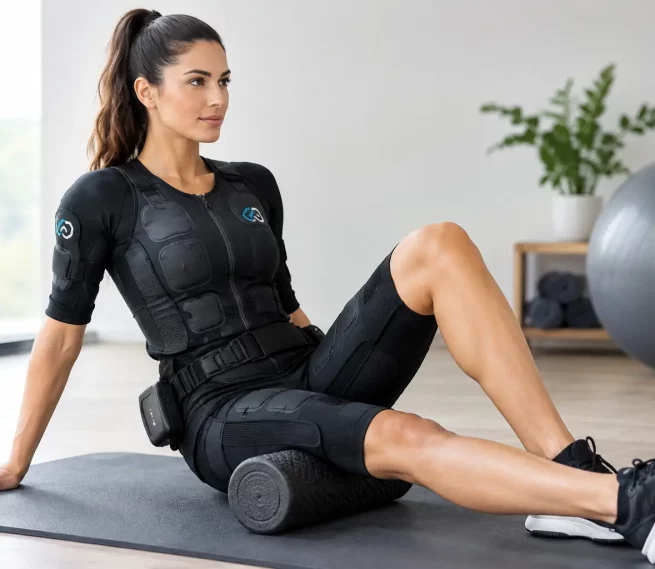
Most people do not notice their posture slipping until their neck feels tight at the desk, their lower back starts complaining on the school run, or they catch their reflection and realise they are standing like they are permanently checking their phone. So, can EMS training help poor posture? In many cases, yes – but not because it magically pulls your shoulders back. It helps by strengthening the muscles that support better alignment, improving body awareness, and making targeted training far more efficient.
That matters if you are short on time, spend long hours sitting, or keep meaning to fix the issue with stretching videos you never quite finish. Poor posture is rarely just about one weak area. It is usually a mix of underactive muscles, overworked muscles, fatigue, habit, and movement patterns that have become automatic.
Can EMS training help poor posture in real life?
It can, provided it is used properly. EMS, or Electro Muscle Stimulation, sends impulses to the muscles during exercise so they contract more intensely than they would with movement alone. In a coached session, that can help activate key postural muscles such as the deep core, glutes, upper back, and spinal stabilisers.
For many adults, these are exactly the areas that tend to switch off during long days at a desk, behind the wheel, or carrying stress through the shoulders. When those muscles are not doing their share, the body compensates. The chest tightens, the shoulders round forward, the lower back arches too much, or the head drifts out in front.
EMS can be especially useful because it does not rely on endless reps or long gym sessions to create a training effect. A well-structured session can challenge muscles that are often difficult to engage properly, particularly for beginners or those returning after injury, pain, or a long break from exercise.
That said, posture is not a one-session fix. If someone has spent years moving in a certain way, it takes consistent work to change it. EMS can speed up that process, but it still needs the right coaching and the right exercise selection.
Why posture gets worse in the first place
Posture has become one of those words people throw around as if there is one perfect way to stand. There is not. Good posture is really about being able to hold efficient positions, move well, and avoid unnecessary strain.
The problem starts when the same poor positions are repeated all day. Sitting for hours, scrolling with the head forward, training only mirror muscles, carrying children on one side, old injuries, and low general strength can all feed into the issue. Stress plays a part too. When people are tense, they often lift their shoulders, brace through the ribs, and breathe shallowly, which changes how the body stacks itself.
Weakness is only part of it. Muscle imbalance matters just as much. You can have tight hip flexors and weak glutes. Tight chest muscles and underactive upper back muscles. A dominant lower back and a core that is not contributing enough. Poor posture is often a coordination problem as much as a strength problem.
This is where coached EMS training stands out. Instead of guessing which muscles need more work, a trainer can target movement patterns and areas that are commonly linked to poor alignment.
How EMS supports better posture
The main benefit is activation. Plenty of people try to strengthen their core or glutes and end up feeling the exercise everywhere except the intended muscle. EMS can help bring those muscles online faster.
If your trunk and pelvis are more stable, your body has a better foundation. If your upper back is stronger, it is easier to resist rounded shoulders. If your glutes are contributing properly, your lower back often stops doing all the work. Better posture usually follows better muscular support.
There is also a body awareness benefit that people do not always expect. During a properly coached EMS session, you become more aware of how you stand, brace, and move. That feedback can make a real difference, especially for clients who have spent years disconnected from their posture.
Another plus is efficiency. Busy professionals and parents do not always have time for multiple strength, mobility, and rehab sessions each week. EMS condenses a lot of muscular work into a shorter training window, which can make consistency more realistic. And consistency is what changes posture.
What EMS can help with – and what it cannot
EMS can help improve the muscular side of posture problems. That includes weak core support, underactive glutes, poor upper-back endurance, and general deconditioning. It can also support mobility work by improving control around joints, which helps people hold better positions more comfortably.
It may also help people who get recurring tension from poor movement habits. When the right muscles start sharing the load, the neck, shoulders, and lower back often feel less overworked.
But EMS cannot solve everything on its own. If your posture issue is driven by a structural condition, significant injury history, severe pain, or a medical diagnosis, training needs to be adapted carefully and may need input from a healthcare professional. It also cannot undo ten hours a day of poor desk setup if nothing else changes.
So yes, it can help – but it works best as part of a wider plan that includes movement coaching, mobility, recovery, and better daily habits.
Can EMS training help poor posture faster than standard workouts?
For some people, yes. The biggest reason is not hype. It is adherence and muscle recruitment.
A lot of standard workouts fail to improve posture because people are inconsistent, rush through exercises, or do not activate the right muscles. A coached EMS session removes some of that guesswork. The intensity is there, the session is structured, and the trainer can correct form in real time.
That often means clients feel key areas working sooner than they do in a conventional gym setting. If someone has struggled to connect with their core, glutes, or upper back, that is a big win. Better muscle engagement can lead to better posture improvements, especially in the early stages.
Still, standard strength training is highly effective too when done well. EMS is not about replacing all other exercise forever. It is about getting strong, moving better, and making progress with far less wasted time.
What a posture-focused EMS plan should include
If the goal is better posture, the session should not just be random squats with wires attached. It needs intention.
A strong programme will usually focus on core stability, glute strength, upper-back engagement, and controlled movement through the hips and thoracic spine. It should also address breathing and alignment, because many posture issues are tied to how people brace and hold tension.
Coaching matters here. The right trainer will watch how you stand, how you hinge, how you squat, and how you control your ribcage and pelvis. They will also adjust intensity, exercise choice, and progression rather than pushing a generic workout.
At E-Pulse Studio, this sort of guided approach is what makes the difference. Technology helps, but results come from pairing that technology with personalised coaching and measurable progress.
Who tends to benefit most?
Busy adults with desk-based jobs often do very well because their posture issues are usually linked to long periods of sitting, weak posterior chain muscles, and lack of time for proper training. Parents juggling work and family also benefit because short, focused sessions are easier to maintain than hour-long gym visits.
People coming back from inconsistent exercise routines can also see strong results, particularly if they feel deconditioned and unsure where to start. Even active people can benefit if their training is one-sided. Runners, cyclists, golfers, and combat athletes often build patterns that need balancing out.
The common thread is not age or fitness level. It is whether the person needs efficient, targeted strength work and hands-on guidance.
The trade-off nobody should ignore
EMS is powerful, but it is not passive. If someone wants better posture, they still need to show up consistently, listen to coaching, and carry some of that work into everyday life.
That means changing workstation habits, standing up more often, learning how to brace properly, and not collapsing onto the sofa every evening in the same twisted position that caused the issue in the first place. Even the best studio session cannot out-train every daily habit.
There is also the reality that some people need a combination of approaches. If mobility is very restricted, if pain is flaring, or if stress and poor sleep are high, posture will improve more slowly. That is normal. Good coaching accounts for that rather than pretending every body responds the same way.
If your posture has been bothering you for a while, the best step is not to wait until it turns into persistent pain. A targeted plan that builds strength, restores balance, and fits into a busy week can make a meaningful difference – and once your body starts feeling stronger in the right places, standing taller tends to happen naturally.
 7min
7min