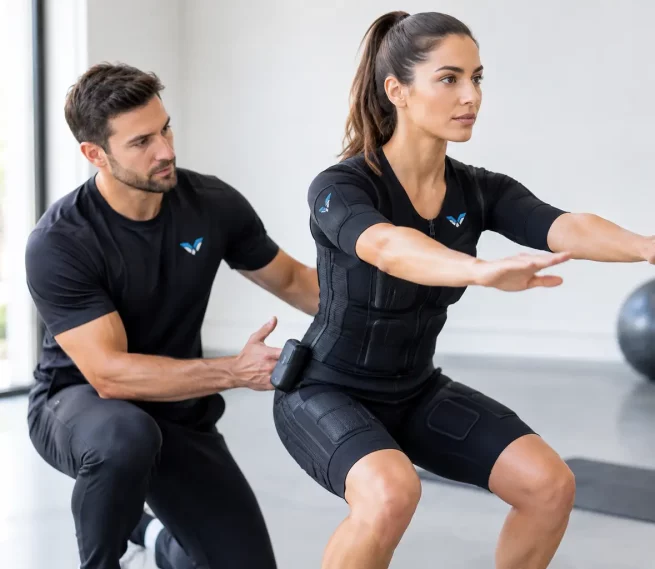
You should finish your first EMS session feeling worked, switched on and confident – not flattened for three days wondering what went wrong. That is the difference between trying a high-tech training method and learning how to start EMS fitness safely. Done properly, EMS can be a powerful, time-efficient way to build strength, improve posture and support fat loss. Done too hard, too soon, it can feel overwhelming and unnecessary.
That is why your starting point matters more than your tolerance for intensity. EMS is not about proving how much discomfort you can handle. It is about creating the right muscle stimulus, at the right level, with the right coaching, so your body adapts well and your results actually last.
Why starting carefully gets better results
A lot of beginners assume safety means holding back. In reality, a smart start is what allows you to progress faster. EMS recruits muscle fibres differently from conventional training, and because the stimulus is external as well as voluntary, your body can fatigue quickly even during a short session.
If your first few workouts are too aggressive, technique usually drops, recovery suffers and consistency becomes harder. That is especially true if you are a busy professional, a parent fitting training around work, or someone returning after a long break. The goal is not to survive session one. The goal is to be ready for session two, three and ten.
A well-managed introduction also helps your coach understand how your body responds. Some people need a gentler ramp-up because of deconditioning, old injuries, low sleep or high life stress. Others can progress faster. Good EMS training is personalised, not copied and pasted.
How to start EMS fitness safely with the right screening
Before you think about intensity, think about suitability. A proper EMS studio should ask detailed health and lifestyle questions before your first session. That is not admin for the sake of it. It is how a trainer decides whether EMS is appropriate for you, how hard to start, and what adjustments are needed.
If you have medical conditions, recent surgery, persistent pain, are pregnant, or use implanted medical devices, you need clear guidance before training. Even if you are generally healthy, factors such as poor sleep, dehydration, heavy drinking the night before, or intense exercise already done that week can all affect how your body handles an EMS session.
This is also the time to be honest about your current baseline. If you have not exercised properly in years, say so. If you get regular back pain, mention it. If your goal is to feel stronger and move better rather than chase exhaustion, that matters too. The safest programme is built around real information, not guesswork.
Your first session should feel controlled, not brutal
One of the biggest mistakes beginners make is treating EMS like a challenge to conquer. They ask for the highest setting, tense up through every exercise and assume more intensity means better results. It rarely works that way.
Your first session should be about familiarisation. You are learning what the pulse feels like, how to breathe through it, how to move well under stimulation and how to distinguish productive muscular effort from plain overload. A strong coach will guide each muscle group carefully, adjusting levels based on your response rather than forcing a generic setting.
Expect the sensation to feel unusual at first. It is often described as a deep muscle contraction rather than a sharp pain. It should feel demanding but manageable. You should still be able to hold good positions, follow instructions and communicate clearly. If your form collapses every time the stimulation increases, the level is too high.
Technique matters more than ego
EMS sessions are short, but that does not make movement quality optional. In fact, when time is condensed and muscle recruitment is high, good technique becomes even more important. Squats, lunges, hinges, presses and core work all need to be coached with precision.
If you are brand new to exercise, this is good news. You do not need to arrive fit. You do need to be teachable. A coach-led environment is valuable because it keeps the focus on alignment, tempo and breathing rather than random effort.
Posture is especially important for people who sit all day, carry stress through the shoulders or live with recurring back tightness. EMS can support better activation through the trunk and glutes, but only if exercises are selected and supervised properly. If a movement does not suit your body yet, it should be adapted. There is no prize for forcing a pattern you cannot control.
Recovery is part of safe progress
When people ask how to start EMS fitness safely, they often focus only on what happens in the studio. Recovery is the other half of the picture. Because EMS can create a significant training effect in a short session, your body needs support afterwards.
Hydration matters. So does protein intake, overall nutrition and sleep. If you leave a session under-fuelled, dehydrated and then sit at a desk all day without moving, you are not giving your body the best chance to adapt well. Gentle walking, light mobility work and sensible daily movement can help reduce stiffness and improve recovery.
It is also wise not to stack everything at once. If you are new to EMS, avoid combining your first week with heavy gym sessions, long runs and poor sleep. Build gradually. Two hard training stresses on top of a stressful workweek can feel very different from one well-managed stimulus with enough recovery around it.
Some soreness can happen, particularly early on, but severe soreness is not a badge of honour. It is often a sign that the loading or progression was not managed well enough.
How often should a beginner train?
For most beginners, one to two EMS sessions per week is a sensible place to start. That gives your muscles and nervous system time to adapt while still creating momentum. More is not automatically better, especially in the early phase.
This is where expert coaching makes a real difference. Frequency should reflect your training history, age, goals, stress levels and recovery capacity. A recreational runner looking to improve power and posture may need a different plan from someone returning after injury or someone focused on fat loss and general fitness.
The strongest results usually come from consistency, not excess. A manageable routine you can keep for months will outperform a too-hard plan you abandon after three weeks.
Red flags to watch for
A safe EMS experience should feel coached, individual and measured. Be cautious if a provider skips screening, pushes maximum intensity straight away, leaves you alone during the session or talks as if more discomfort always means more progress.
Another red flag is vague programming. You should understand what the session is trying to improve, whether that is foundational strength, mobility, posture, conditioning or body composition support. If everything feels random, it usually is.
The right studio will also welcome feedback. If a muscle group feels too strong, if a movement aggravates a niggle, or if your recovery was poor after the last session, your coach should adjust. Good coaching is responsive. That is one reason many clients who train in a dedicated studio environment progress better than those left to figure it out alone.
Who benefits most from a careful EMS start?
Beginners often do brilliantly with EMS because they get structure, supervision and efficient sessions that fit real life. Busy adults who struggle to find time for long gym visits often appreciate the fact that focused training can happen in a much shorter window.
It can also suit people rebuilding confidence after inconsistency, dealing with postural issues from desk-based work, or wanting to support mobility and strength without endless impact. For those with performance goals, a gradual start lays the foundation for stronger outputs later. For those coming in because they feel deconditioned, the benefit is often psychological as much as physical – they finally have a method that feels guided rather than chaotic.
At E-Pulse Studio, that coach-led approach is a big part of why clients stay consistent. They are not just plugged into a machine and left to get on with it. They are assessed, coached and progressed properly.
Your safest first step
If you are curious about EMS, start with a conversation, not a heroic effort. Ask how screening works, how intensity is introduced, what support you get during the session and how recovery is managed afterwards. The answers will tell you a lot.
Safe EMS training should leave you feeling challenged, supported and keen to come back. That is the sweet spot. Start there, build steadily, and let results come from quality rather than rush.
The best training plan is not the one that sounds hardest on paper. It is the one your body can respond to well, week after week, while you get stronger, move better and feel more in control of your progress.

 8min
8min