A packed diary should not force you to choose between feeling strong and getting everything else done. EMS vs strength training is a question we hear from professionals, parents and returning exercisers who want real progress, but cannot commit to multiple long gym sessions every week.
The honest answer is that both can work brilliantly. The better option depends on your starting point, your goal, your movement quality and the time you can give consistently. EMS is not a shortcut that lets you avoid effort. It is a coached training method that makes a short session count. Conventional strength training remains one of the best ways to build long-term capacity, learn movement skills and progressively challenge your body.
EMS vs strength training: the key difference
Traditional strength training uses external resistance such as dumbbells, barbells, cables, machines or your own bodyweight. You create force by voluntarily contracting your muscles against that resistance. Over time, training becomes harder through more load, repetitions, sets, range of motion or better control. It is a proven route to stronger muscles, more resilient joints and improved confidence in everyday movement.
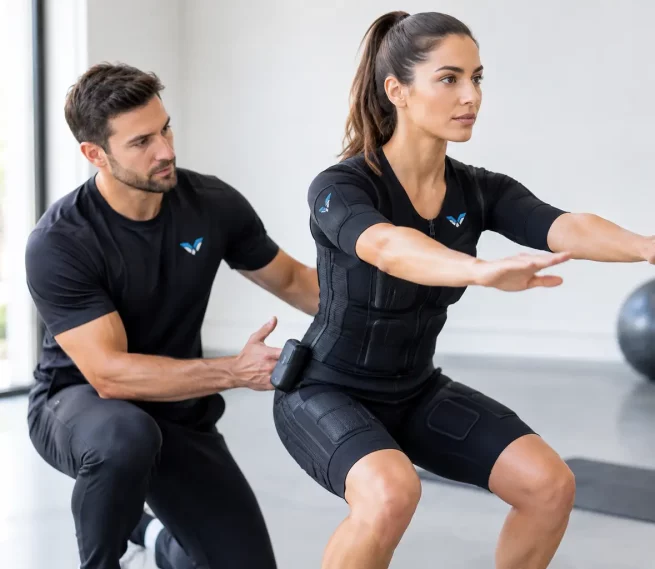
EMS training adds controlled electrical stimulation to voluntary exercise. Wearing an EMS suit, you perform purposeful movements under the guidance of a trainer while impulses stimulate major muscle groups. You are still working. You still need to brace, squat, hinge, push, pull and control your position. The difference is that the stimulation increases the training demand across several areas at once.
That is why a well-coached whole-body EMS session can be completed in around 30 minutes. It is focused, intense and personalised, rather than a leisurely replacement for a gym floor workout.
When EMS has the advantage
For people whose biggest obstacle is time, EMS can be a practical answer. A short appointment is easier to protect in a busy week than a 90-minute gym visit that includes travelling, changing, waiting for equipment and wondering what to do next. Consistency is often the real difference-maker, and a manageable routine beats an ambitious plan that never happens.
EMS can also suit beginners who feel intimidated by conventional gyms. There is no need to arrive with a programme, negotiate a crowded weights area or guess whether your technique is right. Your trainer adjusts the intensity, coaches each movement and keeps the session aligned with your goal, whether that is body composition, posture, strength, mobility or rebuilding confidence after time away from exercise.
The coaching element matters just as much for experienced clients. Runners may want stronger glutes and trunk control. Golfers may need more rotational stability. Combat athletes may be looking to support strength without adding lengthy extra gym sessions. EMS can complement a wider performance plan by delivering a concentrated muscular stimulus without demanding hours of training time.
For some people managing discomfort, stiffness or movement limitations, the ability to train with low external loads can be appealing. That does not mean EMS is a medical cure or the right choice for every injury. It means a qualified coach can adapt exercise selection, range and intensity to help you move with more confidence while working within appropriate professional guidance.
Where conventional strength training wins
Strength training is hard to beat when your goal requires a specific skill. If you want to deadlift a heavier barbell, complete strict pull-ups, lift for a sport or become technically confident with free weights, you need regular practice with those movements. Your nervous system learns the task as well as your muscles adapt to the load.
It also gives you enormous variety. A gym programme can be built around heavy lifting, power, bodybuilding, bodyweight skills, kettlebells or machines. For people who genuinely enjoy training for an hour or more, that variety can make exercise a hobby as well as a health habit.
Traditional lifting may also be the more economical choice if you are self-motivated, already know how to programme safely and have access to suitable equipment. The trade-off is that you are responsible for structure, technique, progression and sticking to the plan when work gets hectic.
Building muscle and losing fat: what actually matters
Neither EMS nor weights creates a changed physique by magic. Building muscle requires a training stimulus that becomes appropriately challenging over time, enough recovery and nutrition that supports your goal. Fat loss requires a sustained energy deficit, alongside habits you can maintain beyond a few motivated weeks.
EMS can contribute strongly to the training side of that equation, particularly when it helps you train consistently and work hard under expert supervision. Strength training can do the same, especially when you follow a progressive programme rather than repeating the same comfortable routine.
At E-Pulse Studio, progress is not judged by one sweaty session or a number on the scales alone. Regular body analysis, performance markers, measurements, movement quality and how your clothes fit can tell a more useful story. A client who has improved posture, gained strength and feels more energetic has made meaningful progress, even if weekly scale weight has fluctuated.
The best body transformation plans are usually less dramatic than social media promises. They are built on repeatable training, protein-rich meals suited to your needs, daily movement, sleep and coaching accountability. EMS can make the training commitment more realistic. It cannot outwork a lifestyle that is pulling in the opposite direction.
Can you combine EMS and strength training?
Yes, and for many people this is the strongest approach. Think of EMS as a high-efficiency coached session within a broader active life, not a rule that you must never touch a dumbbell again.
Someone new to exercise may begin with one or two EMS sessions a week, plus walks and simple mobility work. As confidence improves, they might add a conventional strength session or a favourite sport. An experienced lifter could use EMS strategically alongside their normal programme, with sufficient recovery and a plan that avoids simply piling fatigue on top of fatigue.
Your weekly balance should reflect the goal. A busy parent wanting strength, tone and consistency may get excellent value from EMS-led training. A competitive powerlifter needs barbell practice as the priority. A runner with recurring weak links may benefit from a blend of running-specific work, strength exercises and carefully managed EMS support.
Safety and recovery are part of the programme
Because EMS is intense, more is not always better. Sessions should be properly spaced, and the stimulation level should be tailored to your fitness, recovery and experience. Trying to prove something by turning every setting to maximum is not smart training.
A reputable studio will complete a health screening and discuss relevant medical history before you train. EMS may not be suitable for everyone, including people with certain implanted electrical devices, specific medical conditions or during pregnancy. If you are recovering from injury, have persistent pain or are under medical care, get the right clearance and ensure your coach understands the situation.
Hydration, sleep and protein matter after EMS just as they do after lifting. You may feel muscular fatigue or delayed onset soreness, especially in your first sessions. That is feedback, not a badge of honour to chase. Good coaching progresses your workload so that you can recover, return and improve.
Choose the method you will keep doing
Choose conventional strength training if you enjoy the gym, want to master loaded movements or have a performance target that depends on lifting skill. Choose EMS if time is tight, you want close coaching and accountability, or you need a powerful, structured session without spending your evenings in the gym.
Most importantly, choose a plan that meets you where you are now. The strongest result is not the workout that looks most impressive online. It is the one that helps you show up next week feeling capable, supported and ready to progress.

 8min
8min