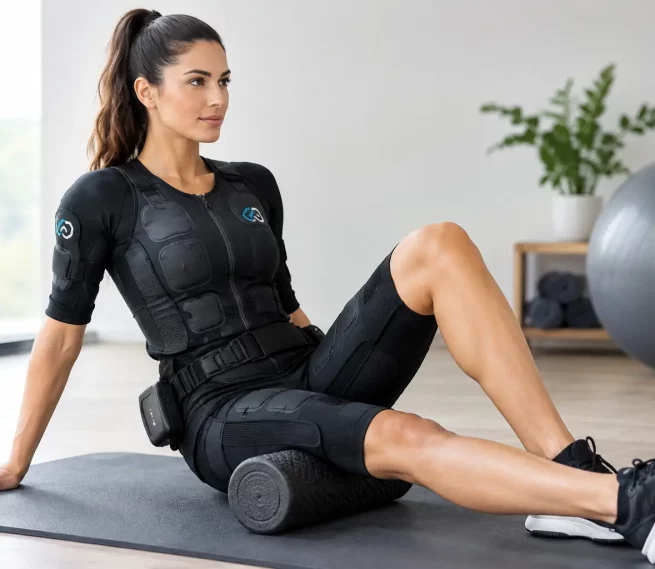
Your diary is already full before the working day begins. There are client calls, school runs, deadlines, travel, dinners to sort and the familiar promise that you will get back to the gym next week. EMS transformation for time-poor professionals is not about squeezing more pressure into your routine. It is about making the training time you do have count.
For many people, the problem is not a lack of ambition. It is that conventional training asks for more hours than real life can consistently give. A 60-minute gym session can easily become 90 minutes once you include travelling, changing, waiting for equipment and deciding what to do. Miss a few sessions, lose momentum, and fitness becomes another unfinished task.
A coached EMS session takes a different approach. In 30 focused minutes, electrical muscle stimulation works alongside controlled exercise to create a demanding, highly targeted full-body workout. You are not left wandering between machines or guessing whether your form is right. A trainer is with you, adjusting the session to your goal, your ability and how your body is responding that day.
Why time-poor professionals need a different training model
The best programme is not the one with the most complicated plan. It is the one you can repeat, even during the weeks when work becomes intense and family life takes over.
That is why short, appointment-based training can be so effective. Your session has a clear start and finish. You arrive, train with purpose and leave knowing you have done meaningful work for your strength, fitness and wellbeing. For a business owner heading into back-to-back meetings or a parent training between commitments, that certainty matters.
EMS also gives the trainer a useful way to challenge major muscle groups without needing a long list of exercises. Squats, lunges, presses, pulls and core work become more purposeful when the stimulation is tailored to the movement. The goal is not to make every session feel punishing. The goal is to deliver enough quality stimulus, consistently, to move you forward.
For some clients, that means improving muscle tone and body composition. For others, it is feeling stronger when carrying children, sitting more comfortably through a long drive, moving better on the golf course or rebuilding confidence after an injury setback. The programme should reflect the person in front of the trainer, not a generic fitness template.
What an EMS transformation can realistically look like
Transformation is often sold as a dramatic before-and-after photograph. Real progress is usually more useful than that. It is your trousers fitting differently. It is climbing stairs without feeling winded. It is your back feeling less stiff after a desk-heavy day. It is seeing measurable changes in body composition, strength, posture or mobility over time.
At E-Pulse Studio, progress can be tracked with 3D body scanning alongside regular coaching conversations. This gives you more than a number on the scales. Weight can fluctuate for reasons that have little to do with fat loss or fitness progress, including hydration, stress and sleep. Looking at shape, measurements, performance and how you feel creates a clearer picture.
A realistic early win may be simply establishing consistency. Clients who previously trained once every few weeks can often maintain a regular routine because the session is short and booked in. From there, the results compound. Better strength can support more confident movement. Improved fitness can make active weekends easier. Feeling stronger can make it more likely that you choose the walk, the class or the home-cooked meal rather than writing the day off.
Results still depend on the wider picture. Two 30-minute EMS sessions will not cancel out chronic sleep deprivation, a diet that does not support your goal or a workload that leaves no room for recovery. But they can form a powerful foundation, especially when the alternative is doing nothing because the ideal gym plan is impossible to maintain.
The advantage is coaching, not just the suit
EMS technology is only as valuable as the person guiding the session. Stimulation levels need to be appropriate for your experience, movement quality and goal. Higher is not always better. A trainer should help you find a challenging level that still allows you to move with control and good technique.
This matters particularly for beginners and people returning after a long break. Starting with too much volume, too many exercises or too much intensity is a fast route to soreness and inconsistency. A well-coached plan builds capacity progressively. You should leave feeling worked, not wrecked.
It also matters for experienced trainees. If you already run, lift weights, play sport or train for an event, EMS can complement your existing routine rather than replace everything you enjoy. It may support strength, conditioning, recovery-focused movement or targeted work around a busy competition schedule. The right balance depends on your current training load and performance objective.
Building an EMS routine around a demanding week
The strongest plan is usually the simplest one. Choose sessions you can protect in your calendar, rather than hoping to find spare time after work. For many professionals, that is an early morning appointment, a lunch break slot or a fixed evening each week.
Aim for consistency before intensity. One weekly session is a starting point for someone who has been inactive, while two sessions can suit people pursuing more focused body composition or performance goals. Your trainer can advise on frequency based on your recovery, training history and lifestyle. More is not automatically better if your sleep is poor, you are under unusual stress or you are adding several other demanding workouts.
Outside the studio, keep the supporting habits realistic. A daily walk, enough protein in your meals, regular hydration and a sensible bedtime will often do more for your results than an elaborate plan you abandon after four days. If body fat reduction is a priority, nutrition has to be part of the conversation. If mobility or pain reduction is the goal, the right movement work and recovery habits need equal attention.
The people who progress best are rarely perfect. They are the people who reset quickly after a hectic week. They do not treat one missed session, a business trip or a family event as proof that the plan has failed. They book the next session and continue.
Is EMS right for everyone?
EMS training is adaptable, but it is not a one-size-fits-all solution. A proper consultation should come before your first session, particularly if you have an injury, persistent pain, a medical condition, are pregnant, or have implanted electrical devices such as a pacemaker. Your trainer may need to adapt the programme, ask for medical clearance or recommend a different route first.
There is also a trade-off to understand. EMS is exceptionally efficient, but it does not replace the value of everyday movement, sport-specific practice or outdoor cardiovascular activity if those are part of your goals. If you are training for a marathon, you still need to run. If you want to improve your tennis, you still need time on court. What EMS can do is make strength work more practical, focused and easier to sustain around those commitments.
For the busy professional who has spent months saying, “I just do not have time,” that can be the turning point. You do not need endless hours. You need a plan that respects your schedule, challenges your body and gives you evidence that your effort is paying off.
Book the time, let a coach take the guesswork away, and give yourself 30 minutes that belongs to your health. A demanding calendar does not have to decide how strong, capable and confident you feel in your body.
 7min
7min