A stiff lower back after a long day at your desk. A knee that complains halfway through a run. A shoulder that makes reaching for the top cupboard feel like a warning. These are the moments when exercise pain management becomes more than a fitness topic – it becomes the difference between moving forward with confidence and stopping altogether.
The answer is rarely to push through everything, and it is not always to rest completely either. Most people need a smarter middle ground: the right movement, at the right intensity, with enough consistency to build strength without repeatedly irritating the problem. That is where coached, personalised training earns its place.
Exercise pain management starts with the right question
Before deciding whether to train, ask what the pain is doing. Is it a familiar stiffness that eases once you warm up? Is it a mild muscular ache after a new session? Or is it sharp, sudden, worsening, or linked with swelling, instability, numbness or tingling?
Those distinctions matter. Delayed onset muscle soreness can be a normal response to training, particularly when you have returned after time away or increased the challenge. It usually feels tender, tight or heavy and improves over several days. Joint pain, nerve symptoms or pain that changes how you walk, grip or move should not be treated as a badge of honour.
A useful rule is that exercise should leave you feeling no worse later that day or the following morning. Mild discomfort that settles and does not alter your movement may be manageable. Pain that steadily climbs during a session, causes you to compensate, or remains aggravated for more than 24 hours means the programme needs adjusting.
Seek prompt medical assessment for severe pain after an injury, visible deformity, sudden weakness, unexplained swelling, loss of bladder or bowel control, chest pain, or numbness around the saddle area. Training support is valuable, but it does not replace diagnosis when red flags are present.
Why complete rest often prolongs the problem
When something hurts, avoiding all movement can feel sensible. Sometimes short-term protection is needed. But lengthy rest can reduce strength, mobility and confidence, making everyday tasks feel harder when you return. The body generally adapts well to gradual, appropriate loading.
Think of capacity as your current tolerance for walking, squatting, lifting, climbing stairs or playing sport. If your daily demands regularly exceed that capacity, symptoms often flare. The goal is not to force your way through pain. It is to build capacity until the activity that once caused trouble becomes more manageable.
For someone with recurrent back discomfort, that may mean practising controlled hinges, supported squats and trunk stability work before loading a heavy barbell. For a runner with a sensitive knee, it may mean reducing mileage briefly while improving calf, glute and thigh strength. For a busy parent whose shoulders ache from lifting children, it may mean better upper-back strength, shoulder control and smarter lifting positions.
Progress is rarely perfectly linear. A demanding work week, poor sleep, stress, a long car journey or a sudden jump in activity can all affect symptoms. That does not mean you have failed. It means the plan should respond to real life.
Use a traffic-light approach during training
A simple traffic-light system can remove the guesswork from exercise pain management.
Green: carry on with good form
Green usually means no pain, or mild and familiar discomfort that stays low, does not alter technique and settles soon after training. You can continue, while still paying attention to range of motion, pace and breathing.
Amber: adapt the session
Amber is discomfort that is noticeable but manageable, perhaps around 3 or 4 out of 10, with no sharp quality or loss of control. This is your cue to make a change rather than abandon movement. Reduce the load, slow the tempo, shorten the range, use extra support or switch to an alternative exercise.
A squat to a box may be more comfortable than a deep squat. An incline press may be better tolerated than a press-up from the floor. A shorter walk broken into two sessions may beat one long walk that provokes a flare-up. Adaptation is intelligent training, not taking the easy option.
Red: stop and get guidance
Red is sharp, catching, burning or escalating pain; pain that makes you limp or hold your breath; a feeling of instability; or symptoms that travel down an arm or leg. Stop that movement. If the symptom does not settle, or if it is recurrent, speak with an appropriate healthcare professional before progressing.
Build strength without chasing exhaustion
Pain management training is not about leaving every session shattered. It is about accumulating high-quality work that your body can recover from. This is particularly relevant for professionals and parents who may only have a narrow window to train and cannot afford to lose the next two days to a flare-up.
Start with movements you can perform well and repeat them consistently. A trainer may use a controlled sit-to-stand, hip hinge, row, supported split squat, carry or gentle trunk exercise as a foundation. Over time, resistance, range, repetitions or complexity can increase – but usually one variable at a time.
The right dose depends on the person. Someone returning after a back-pain episode may benefit from shorter, more frequent sessions. Someone who is already active but has a stubborn shoulder may need to maintain lower-body training while changing upper-body volume. A former athlete may have the strength to do more, but still need to rebuild tolerance patiently after an injury.
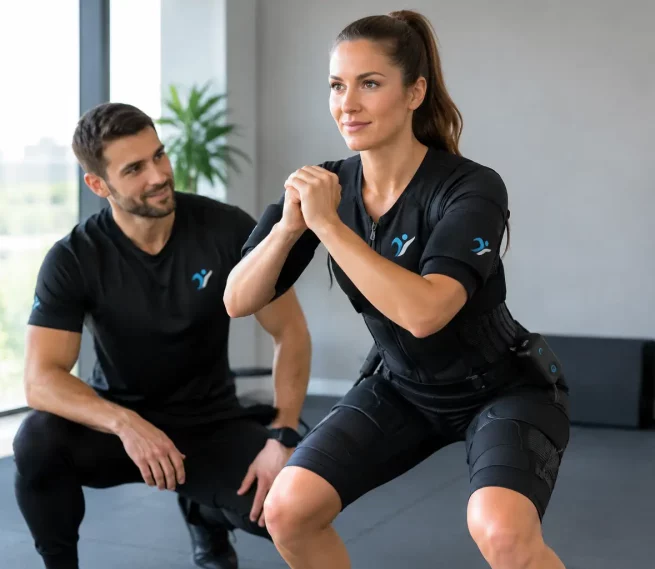
At E-Pulse Studio, a coach-led approach allows training to be adapted in real time. EMS can be useful for people who need an efficient, closely supervised strength session, as it can help create muscular challenge with carefully managed external loading. It is not a shortcut around an injury, and it is not suitable for every condition. The value is in the assessment, coaching and progression behind the session.
Mobility helps when it supports a stronger movement
Mobility work can feel good, and for some people it helps reduce the sense of stiffness before training. But endless stretching alone is not always the solution to recurring pain. A joint often needs control and strength through the range it has, not simply more range.
For example, a tight-feeling hip may respond well to a combination of gentle mobility, glute strength and a gradual return to squatting or walking uphill. A stiff upper back may improve when regular movement breaks are paired with rowing patterns, posture-focused strength work and a better desk set-up. The effective combination depends on what your body can tolerate and what your daily life asks of it.
Use mobility as preparation, not punishment. A few targeted movements performed regularly are more useful than an occasional 45-minute stretch session done only when pain becomes impossible to ignore.
Track the signals that influence pain
Training load is only one part of the picture. Sleep, stress, hydration, nutrition and recovery can all change how sensitive pain feels and how well you tolerate exercise. This does not mean pain is imagined. It means the nervous system responds to the whole context, not just one muscle or joint.
Keep a simple record for two or three weeks: what exercise you did, how symptoms felt during it, how you felt the next morning, and anything unusual such as poor sleep or a long day sitting. Patterns become easier to spot. You may find that your knee tolerates strength work well but reacts to sudden increases in running, or that your back is more sensitive after several sedentary days than after a carefully coached session.
This information gives your coach or clinician something practical to work with. It also replaces vague fear with evidence. You are not guessing whether you can do more – you are making a measured decision.
Know when to bring in extra support
Persistent pain deserves attention, especially when it has lasted several weeks, repeatedly returns, affects sleep, or stops you doing normal work, family or sport activities. A physiotherapist, GP or relevant clinician can help rule out issues that need medical care and provide a clear rehabilitation pathway.
The best outcomes often come from joined-up support. Clinical advice can establish what needs protecting or treating, while structured coaching rebuilds the strength, confidence and routine that help you return to normal life. Be honest about your symptoms, your goals and what you are currently doing. The right plan should feel challenging enough to create progress, but controlled enough that you trust it.
Pain can make your world smaller if you let every movement become a threat. Start with one movement you can do well, repeat it with care, and let steady evidence rebuild your confidence.
 8min