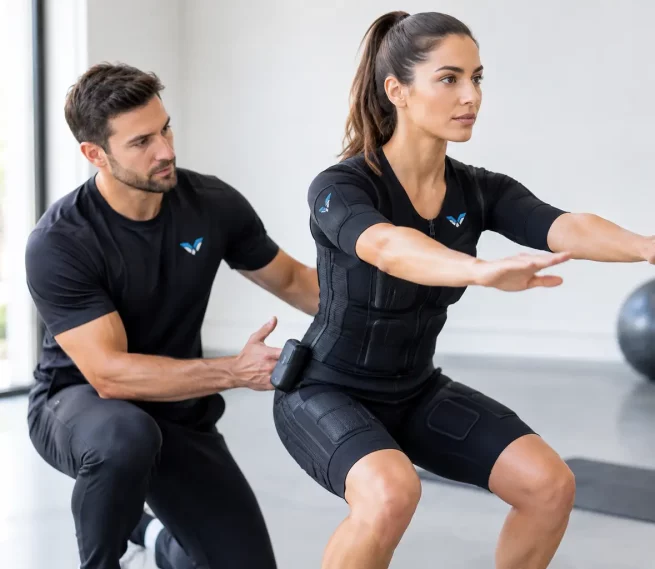
That familiar ache after a day at your desk, a stiff lower back when you get out of the car, or a knee that makes you think twice about training can quickly shrink your routine. EMS pain relief is not about masking every symptom and pushing through. Used properly, it can be a powerful way to activate underperforming muscles, improve movement quality and help you rebuild confidence in your body.
For busy professionals, parents and anyone whose training has been interrupted by discomfort, the appeal is clear: a focused, coach-led session that works with your current ability rather than demanding an hour of high-impact exercise. The key is understanding where EMS can help, where it cannot, and why individual guidance matters.
How EMS pain relief works
Electro Muscle Stimulation uses controlled electrical impulses delivered through a specialist suit or pads. These impulses encourage your muscles to contract while you perform simple, purposeful movements under the guidance of a trainer. It is not the same as lying down with a massager, and it is not a shortcut around good coaching. EMS makes muscle activation more intense and more targeted during exercise.
When pain, inactivity or poor movement habits have caused certain muscles to become weak or reluctant to switch on, the body often compensates. Your lower back may take on work your glutes should be doing. Your neck and shoulders may tighten because your upper back lacks strength and control. One side of your body may carry more load than the other after an old injury.
A well-planned EMS session can help train those muscles in a controlled way. By strengthening the areas that support your posture, joints and movement patterns, many people find everyday activities become more comfortable. That might mean climbing stairs without bracing yourself, walking further, returning to golf, or simply sitting through a workday with less stiffness.
The relief is rarely about one magical session. It is usually the result of better muscle recruitment, gradually improved strength, mobility work and more consistent movement over time.
Where EMS may be most useful
EMS can be particularly helpful when conventional training feels difficult to start or difficult to maintain. Because sessions are only 30 minutes and exercises can be adapted, it gives many people a realistic route back into regular activity.
Lower back discomfort and posture
Non-specific lower back discomfort is often linked to long periods of sitting, reduced core endurance, weak glutes and limited hip mobility. That does not mean every back problem has the same cause, but it does mean a general strengthening programme can be valuable for many people.
With EMS, a trainer can use low-impact movements to build strength through the glutes, legs, core and upper back. The goal is not to exhaust you with endless repetitions. It is to teach your body to share load more effectively. As strength and control improve, the lower back may no longer have to do all the work.
Muscle stiffness and recovery support
Hard training, poor sleep, travel, stress and long hours at a screen can all leave muscles feeling tight and heavy. A lighter EMS session, combined with mobility work and sensible recovery habits, may support circulation and gentle muscle activation without the impact of a demanding gym workout.
This is especially useful for people who want to keep moving between tougher training sessions but know that another run, heavy lift or high-intensity class is not the right answer that day. Recovery should leave you feeling better equipped for life and training, not flattened by it.
Joint confidence after time away from exercise
When a joint has been sore, people often stop using the surrounding muscles properly. That can create a frustrating cycle: less movement leads to less strength, and less strength makes the joint feel even less secure.
A coach can modify range of motion, resistance and exercise selection so you can train around limitations while gradually strengthening the muscles that support the area. For some clients, that means starting with controlled squats to a box, supported lunges or standing core work rather than jumping straight into high-impact training.
It depends on the diagnosis, the stage of recovery and your symptoms. EMS is a training tool, not a replacement for medical assessment or rehabilitation prescribed by a qualified clinician.
What a coached EMS session should feel like
The right session is challenging, but it should not feel reckless. At E-Pulse Studio, the starting point is your body, your goal and the movements you can perform comfortably today. A new client dealing with back stiffness needs a different programme from a runner rebuilding strength after a lay-off or a desk-based professional who wants to improve posture.
Your trainer adjusts the stimulation intensity across different muscle groups and coaches every movement. You remain in control throughout. The sensation is unusual at first – a strong pulsing contraction – but it should be tolerable and clearly explained. Intensity is built progressively, not treated as a competition.
Expect simple exercises done with precision: squats, hinges, rows, presses, lunges, core bracing and mobility-led movements. The suit increases the demand on the muscles, so technique matters even more. Thirty minutes can be plenty when every minute has a purpose.
Progress should also be measurable. Alongside how you feel day to day, tracking strength, posture, mobility and body composition can show whether the programme is moving you forwards. Pain reduction matters, but so does gaining the capacity to stay active once you feel better.
What EMS cannot do
Honesty matters when pain is involved. EMS pain relief is not a diagnosis, a cure for every condition or permission to ignore warning signs. If you have severe, sudden or worsening pain, pain after a significant injury, unexplained numbness or weakness, changes to bladder or bowel control, chest pain, fever, or pain that wakes you persistently at night, seek urgent medical advice.
You should also speak to a healthcare professional before EMS if you are pregnant, have a pacemaker or other implanted electrical device, have epilepsy, have certain cardiovascular conditions, or are recovering from surgery or an acute injury. A good studio will screen you carefully and refer you on when training is not the appropriate next step.
Even with clearance to exercise, more intensity is not always better. If a movement causes sharp pain, the programme needs adjusting. There is a difference between the normal effort of working a muscle and the warning signal of pain. Listening to that difference protects your progress.
Getting better results from EMS for pain relief
The best results come from treating EMS as part of a wider plan, not a once-a-month rescue appointment. Consistency gives your muscles time to adapt. For many clients, one or two sessions each week, combined with regular walking and a few minutes of mobility on most days, is more effective than sporadic hard workouts.
Your daily habits matter too. If your back tightens after eight hours at a laptop, a stronger core will help, but so will changing position regularly, taking short walks and setting up your workstation sensibly. If your knees feel stiff after inactivity, gradual loading and regular movement usually beat avoiding activity altogether.
Nutrition, hydration and sleep have a role as well. Muscles recover and adapt outside the studio. A trainer can help you build a plan that fits your actual week, including the school run, deadlines, travel and family commitments, rather than handing you an unrealistic routine.
Is EMS right for your discomfort?
If you are tired of starting and stopping exercise because your body feels stiff, weak or unreliable, EMS may offer a practical way to rebuild momentum. It can be particularly effective for people who value expert supervision, low-impact training and a clear plan for measurable progress.
Start with an honest conversation about your symptoms, history and goals. The right coach will not promise to fix everything in one session. They will help you move well, build strength steadily and recognise when further clinical support is needed.
Feeling better often begins with doing the right amount of the right movement, consistently. A personalised EMS session can give you the structure, support and challenge to make that movement part of your life again.

 8min
8min