You arrive with half an hour available, not two hours to spare. That is exactly why many busy professionals, parents and people returning to exercise ask what happens in EMS sessions before they commit. The short answer: you are not left alone in a suit to work it out. You are coached throughout a focused, low-impact workout designed around your body, goals and starting point.
At E-Pulse Studio, every session is built to make your time count. The technology adds electrical muscle stimulation to purposeful movement, but the trainer, the programme and your effort are what turn those 30 minutes into progress.
What happens in EMS sessions from the moment you arrive?
Your first session begins with a conversation, not an all-out workout. Your trainer needs to understand what you want to change and what may affect your training. That could be fat loss, strength, better posture, improved mobility, a return from injury, preparation for a race, or simply creating a routine you can sustain.
You will be asked about your training history, lifestyle, any pain or limitations, and relevant health considerations. EMS is not a one-size-fits-all experience. Someone who spends long days at a desk, for example, needs a different emphasis from a runner chasing stronger legs and better conditioning.
Where appropriate, a 3D body scan can provide a clear starting point. It gives you more than a vague feeling of whether your clothes fit differently. Measurements and body-shape data help establish a baseline so your programme can be reviewed against real changes over time. The number on the scales matters to some people, but it never tells the whole story.
Getting fitted into the EMS suit
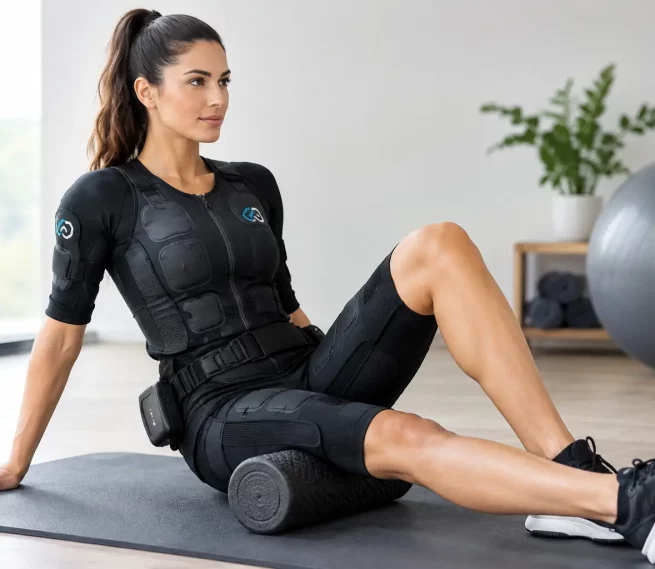
You will change into the EMS training kit, which is designed to sit close to the body. Electrodes are positioned over major muscle groups, commonly including the thighs, glutes, core, back, chest and arms. The kit is dampened so the stimulation can be delivered effectively and comfortably.
Your trainer then connects the suit to the EMS system and begins setting the intensity. This is always gradual. You do not start at maximum power, and there is no prize for tolerating more than you can control with good form.
The sensation is often described as a firm pulsing, tingling or tightening in the muscles. It can feel unfamiliar during the first few minutes, but it should not feel sharp or painful. You remain in control, and the trainer can adjust each area independently. If your thighs feel strong while your shoulders feel too intense, the settings can be changed there and then.
The coached 30-minute workout
Once the settings are right, the active part of the session begins. The stimulation works in intervals while you perform controlled exercises under close supervision. These are not random movements designed to leave you exhausted. They are selected to match your goals, movement quality and current capability.
A typical session may include squats or assisted squats, hip hinges, lunges, presses, rows, core bracing, balance work and mobility-focused movements. For a beginner, the session may be deliberately simple. Learning to brace the core, hinge through the hips and control a squat is valuable work, especially when the muscles are receiving stimulation at the same time.
For an experienced gym-goer or athlete, the programme can become more demanding. Training may include greater range of motion, more complex movement patterns, higher conditioning demands or sport-specific emphasis. A golfer may focus on trunk stability and rotational control. A runner may work on glute activation, single-leg strength and posture under fatigue.
Why it feels harder than it looks
EMS adds an external stimulus to the muscles while you move. You may be performing a bodyweight squat, but the working muscles are being asked to contract more strongly than they would during the movement alone. That is why sessions can look controlled from the outside yet feel surprisingly challenging.
The goal is not to make every rep brutal. It is to create effective muscle activation while preserving technique. Your trainer will cue your breathing, alignment and tempo, adjust the intensity, and make sure you are working at a level that is productive rather than overwhelming.
This coaching element matters. Good EMS training is not about switching on a machine and hoping for results. It is about applying the right dose, in the right movement, for the person standing in front of the trainer.
What you may feel during and after an EMS session
During the stimulation phases, your muscles may feel as though they are being firmly squeezed or switched on from the inside. You will still be able to move, talk and follow instructions. Between intervals, the sensation eases and you reset for the next exercise.
After your first EMS session, it is normal to feel worked without needing to spend an hour dripping with sweat. Some people notice immediate awareness in their core, glutes or upper back because those areas have been properly engaged for the first time in a while. Others feel the familiar delayed muscle soreness 24 to 48 hours later.
How much soreness you experience depends on your previous training, sleep, hydration, programme intensity and how well you recover. More soreness does not automatically mean a better workout. Consistent, well-managed training beats pushing so hard that you cannot train properly again.
You may also feel energised, lighter through the body, or more upright after a session focused on posture and mobility. These responses vary. Lasting change comes from repeated sessions, sensible nutrition, recovery and a programme that progresses as you do.
The checks that keep EMS training personal
A strong EMS programme does not repeat the same 30 minutes forever. Your trainer should ask how you recovered, whether any movement caused discomfort, how your energy has been and what has changed in your routine. That feedback informs the next session.
If you are working towards body recomposition, progress can be tracked through body scans, measurements, photos, strength markers and how you feel in everyday life. If your goal is reduced discomfort or improved movement, the indicators may be different: getting up from a chair more easily, walking further, moving with less stiffness or feeling more confident carrying shopping.
There are trade-offs. EMS is exceptionally time-efficient, but it does not replace every form of exercise. Walking, cardiovascular training, mobility work, good nutrition and adequate sleep still play major roles in health and body composition. Depending on your goals, EMS can be the main strength stimulus in a busy week or a powerful addition to an existing training plan.
It is also not suitable for everyone. Certain medical conditions, implanted electronic devices, pregnancy and other circumstances may mean EMS is unsuitable or requires clinical guidance first. Be open in your consultation and follow the trainer’s screening process. Your safety is more important than forcing a session into the diary.
How often should you train?
For many people, one or two EMS sessions a week is a practical starting point. This gives the body time to recover while allowing enough consistency for strength, fitness and body-composition goals to move forward. Your exact frequency should reflect your experience, overall activity, stress levels and recovery capacity.
A busy parent who has barely trained for a year may make excellent progress with one carefully coached session each week plus regular walking. Someone already active and preparing for an event may use EMS alongside their sport, with a programme designed to support rather than compromise performance.
The advantage is not that EMS makes effort disappear. It is that you can make a meaningful training effort in a short, structured window. No wandering around the gym, no guessing which machine to use next, and no feeling that you need a free evening to look after your fitness.
Your first session is simply the starting point. Arrive ready to move, tell your trainer what you want to achieve, and allow the programme to meet you where you are. Thirty focused minutes, repeated with commitment, can become the part of your week that proves you still have time to get stronger.
 7min
7min