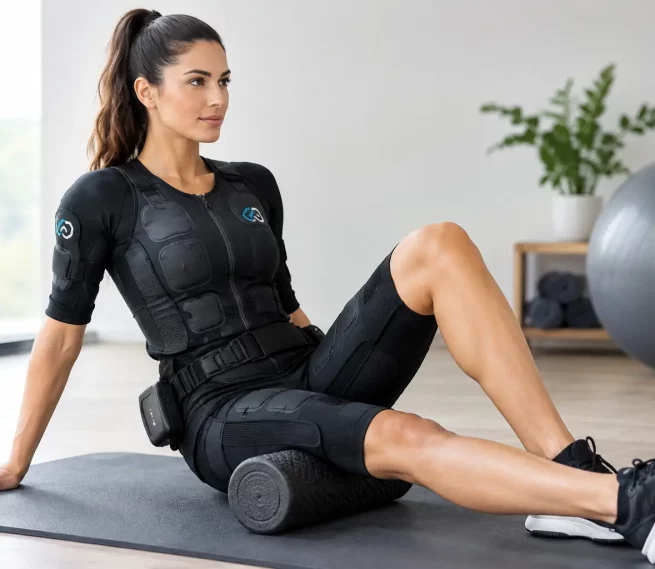
Thirty minutes can be enough to move the needle when every contraction has a purpose. Electric muscle stimulation suit training combines active exercise with precisely controlled electrical impulses, helping you recruit major muscle groups while a coach keeps your technique, intensity and goals on track. For busy professionals, parents and anyone tired of inconsistent gym routines, it offers a more focused way to train.
This is not a shortcut that asks you to lie down and hope for change. You squat, hinge, press, pull, brace and move. The difference is that the suit adds stimulation to selected muscle groups while you work, creating a demanding full-body session without the need to spend hours lifting weights or moving between machines.
What electric muscle stimulation suit training involves
An EMS session begins with a conversation, not a switch being turned on. Your trainer needs to understand your current fitness, injury history, mobility, lifestyle and target. That could be fat loss, stronger legs for running, better posture at your desk, support after a period away from exercise, or simply feeling capable and energised again.
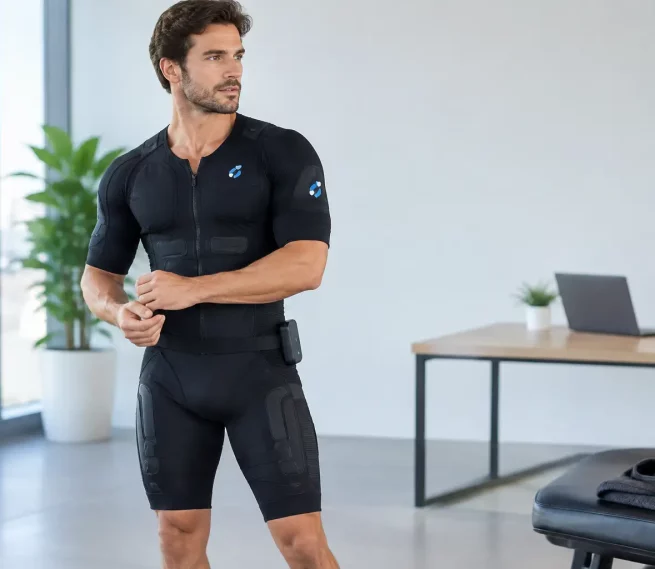
You wear a specialist EMS suit with electrodes positioned over key muscle areas, typically including the legs, glutes, back, abdomen, chest and arms. The suit is fitted correctly, then the trainer introduces the stimulation gradually. Each area can be adjusted independently, because the right setting for your abdominals may feel very different from the right setting for your glutes.
During the session, you perform controlled movements against the stimulation. A coach may guide you through bodyweight squats, split squats, rows, presses, core work and mobility drills. The work is tailored to your starting point. A beginner with limited confidence should not have the same session as an experienced athlete preparing for a race or combat sport.
At E-Pulse Studio, that coaching-led approach is central to the experience. You are not left to guess whether you are working hard enough or moving well. Your trainer can progress the stimulus, correct your position and adapt the session when your body tells you something needs to change.
Why 30 minutes can feel so effective
In conventional training, it takes time to set up equipment, choose loads, rest between sets and make sure every part of the body receives enough work. That training model can be excellent, but it is not always realistic for people whose diary is already full.
EMS training is designed to make the active time count. The suit can stimulate multiple large muscle groups at once while you complete purposeful exercises, creating a high-effort, full-body workout in around 30 minutes. It is especially appealing if a long gym session has repeatedly become the first commitment to disappear when work, family or travel gets busy.
The value is not simply that it is shorter. It is that short sessions can be easier to repeat consistently. Consistency is where body composition, strength, posture and stamina begin to change. One hard session will not transform your body. A structured programme, completed week after week and supported by sensible nutrition, recovery and daily movement, can.
The results people are usually chasing
Clients rarely come in asking for an electrode setting. They want to feel stronger climbing stairs, fit into clothes differently, reduce the nagging stiffness that builds up at a desk, or stop starting and stopping their fitness journey every few months.
Electric muscle stimulation suit training can support several outcomes when it is programmed well:
- Increased muscular strength and tone through progressive, coached contractions.
- Improved movement quality, core control and posture when mobility and technique are prioritised.
- Better fitness capacity when sessions include appropriately challenging conditioning work.
- Support for body recomposition when training is paired with nutrition habits that match the goal.
- A lower-impact route back into regular exercise for suitable clients with mobility limitations or joint sensitivity.
The trade-off is that EMS is not magic, and it is not a replacement for the basics. Walking, sleep, food quality, hydration and stress management still show up in your results. If fat loss is your goal, a 30-minute workout cannot compensate for an eating pattern that consistently exceeds your needs. If your target is sport performance, you may also need sport-specific practice, running, lifting or technical conditioning alongside EMS.
What the sensation is really like
Most first-time clients are understandably curious about the feeling. The stimulation is often described as a strong, rhythmic tightening or pulsing through the muscles. It should feel challenging, but it should never feel alarming or painful.
Your trainer starts conservatively and asks for feedback throughout. As you become familiar with the sensation and your body adapts, the intensity can be progressed. There is no prize for setting every channel to maximum. Productive training is about the right dose, clean movement and a level of effort you can recover from.
Expect to feel as though your muscles have worked, particularly after your first few sessions. Delayed onset muscle soreness can happen, just as it can after any new training programme. Good coaching, sensible session spacing and recovery support help you build momentum without turning every workout into a battle with fatigue.
Who benefits most from EMS training?
The best candidate is not defined by a fitness level. It is someone who values guidance and is willing to be consistent. A busy business owner may use EMS to protect two appointments a week for their health. A new parent may value a concise session that feels achievable. A golfer may focus on rotational control, glute strength and mobility. A runner may use it to strengthen the posterior chain and trunk alongside their mileage.
It can also be a constructive option for people returning to activity after a long break, particularly where conventional gym environments feel intimidating. The private, coach-led setting removes much of the uncertainty. You have a plan, someone watching your technique and tangible checkpoints rather than a vague promise to “get back on it”.
For rehabilitation, pain reduction and mobility support, individual assessment matters even more. EMS can form part of a carefully managed programme, but the right approach depends on the condition, symptoms and advice from relevant healthcare professionals. It should not be used to ignore pain or self-diagnose an injury.
Safety comes before intensity
A quality EMS session is not about strapping someone in and pushing them beyond their limits. It requires screening, professional supervision and an honest discussion about health history. EMS training may not be suitable for everyone, including people with certain implanted electrical devices, pregnancy, particular neurological conditions or unresolved medical concerns.
Tell your trainer about medication, recent surgery, injuries, changes in health and anything that could affect your ability to exercise safely. If you are under medical care or unsure whether training is appropriate, seek medical guidance first. A responsible studio will welcome that conversation and adapt the plan rather than treating every client as identical.
Hydration also matters. Arrive well hydrated, wear the clothing advised by the studio and follow the recovery guidance you are given. More is not always better with high-intensity training. A sensible schedule allows your muscles to adapt, especially early on.
How to make progress measurable
Motivation rises when you can see more than a number on the scales. Weight can fluctuate for many reasons, while strength, posture, measurements, mobility and confidence may be moving in the right direction.
That is why a clear baseline is valuable. A 3D body scan can help track changes in body shape and composition over time, while regular reviews can capture strength improvements, movement quality and how you feel in daily life. Perhaps your back feels less stiff after a day at your laptop. Perhaps you can hold a stronger squat position, run without fading as quickly, or carry the weekly shopping without thinking twice about it. Those wins count.
Set a target that gives the programme direction, then review it honestly. If progress has stalled, the answer may be to adjust training intensity, nutrition, recovery or attendance. The data is not there to judge you. It is there to make the next decision smarter.
Your first session should feel personal
A premium EMS experience should never feel like a production line. Your first appointment is the opportunity to establish where you are now, what you want from training and what could get in the way. The programme should then meet you there, whether that means building confidence with basic movement patterns or adding an extra performance edge to an already active lifestyle.
If you are based in Peterborough or Upminster and your current fitness plan keeps slipping to the bottom of the list, book a session that puts expert coaching and measurable progress back in the diary. The strongest plan is the one you can keep showing up for.
 7min
7min