A stiff lower back when you get out of the car. Hips that complain after a day at your desk. Knees that make stairs feel less straightforward than they used to. These are not small frustrations when they begin to affect how confidently you train, work, play with your children or enjoy a weekend walk. EMS training for mobility support gives you a coached, time-efficient way to rebuild the strength and control that better movement depends on.
At E-Pulse Studio, mobility is not treated as a few stretches at the end of a workout. It is trained through personalised movement, targeted muscle activation and progressive coaching. The goal is simple: help your body move with more freedom, stability and confidence in everyday life.
Why mobility needs strength, not just stretching
Mobility is often confused with flexibility. Flexibility is the range available at a joint or in a muscle. Mobility is your ability to actively control that range. You may be able to touch your toes, for example, but still lack the hip and trunk control needed to squat comfortably, run efficiently or lift a child from the floor without your back taking over.
That distinction matters. If a joint feels restricted, the answer is not always to stretch harder. Sometimes the body is limiting a movement because it does not yet feel stable or strong enough in that position. Building muscular support around the hips, core, upper back and legs can make a meaningful difference to how safely and comfortably you move.
For busy adults, this is particularly relevant. Hours at a desk, long commutes, inconsistent training and old niggles can gradually reduce how much movement you tolerate. You may not need a punishing workout. You may need intelligent resistance training, delivered with enough precision to restore confidence in the movements you have started avoiding.
How EMS training for mobility support works
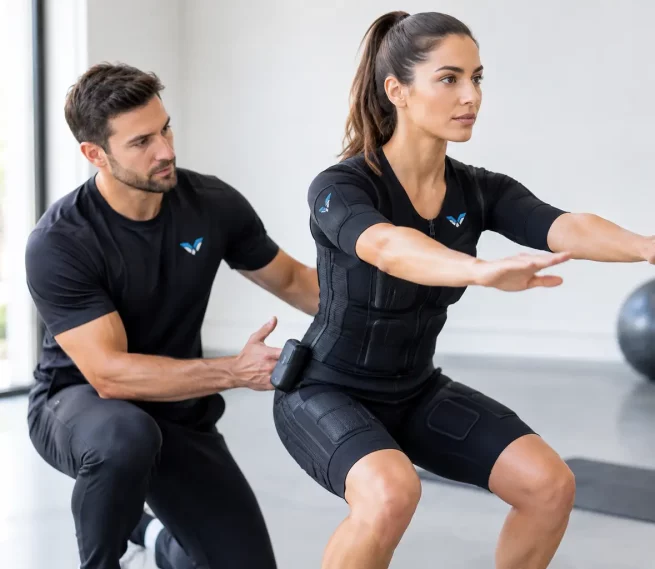
Electrical Muscle Stimulation uses controlled impulses to encourage muscle contraction while you perform guided exercises. During an EMS session, a coach adjusts the intensity to your ability and goals, then leads you through functional movements such as squats, lunges, hip hinges, rows, core bracing and posture-focused work.
The suit does not move for you, and it is not a shortcut around effort. You are still learning to control your body, breathe well and maintain quality positions. What EMS can do is increase the training stimulus across several major muscle groups at once, within a short and closely supervised session.
For mobility support, that can be useful because many movement limitations are linked to underused or poorly coordinated muscles. A sedentary worker may need stronger glutes and trunk control to reduce the load drifting into the lower back. A runner may benefit from improved hip stability and posterior-chain strength. Someone returning to exercise after a long break may need a low-impact route to rebuild capacity before adding more demanding training.
The best programme depends on the person in front of the coach. There is no value in forcing deep ranges before you can own them. At E-Pulse Studio, sessions should meet you where you are, then progress as your strength, balance and confidence improve.
The muscles that often need attention
Mobility work usually becomes more effective when it addresses the whole movement chain rather than one painful area. Tight hip flexors may be part of the picture, but so may weak glutes, an underactive core or a thoracic spine that spends most of the day rounded over a laptop.
EMS coaching can target the muscles that support better posture and everyday movement, including the glutes, abdominals, back, thighs and shoulders. Combined with carefully selected mobility drills, this creates a stronger foundation for sitting, standing, walking, lifting and sport.
That does not mean every ache is caused by weakness, or that one session will resolve a longstanding issue. Pain can be complex. But when poor strength, low activity and reduced control are contributing factors, a progressive training plan can be an extremely positive place to start.
What a mobility-focused EMS session looks like
A good session begins with a conversation, not a generic circuit. Your coach needs to understand what is difficult, what you want to get back to and whether any movement produces pain. That could be getting through a round of golf without a stiff back, returning to regular runs, feeling stronger after pregnancy or simply being able to train without fear of aggravating an old problem.
From there, your coach can assess how you move and select exercises that suit your current level. You might begin with supported squats, controlled hinges, gentle split-stance work, rows and core activation. The pace is deliberate. Position and control come first; intensity follows when your body is ready for it.
As you progress, the programme may introduce greater range, balance challenges, more demanding patterns or sport-specific preparation. For some people, that means moving from a supported squat to a confident bodyweight squat. For others, it means building the leg and trunk strength to run, swing a club or cope better with long shifts on their feet.
The appeal is efficiency. A coached EMS session is short, but it is purposeful. For professionals, parents and business owners who cannot commit to several long gym visits every week, that focused format can make consistency far more realistic.
Who can benefit most?
EMS mobility training can suit beginners who feel deconditioned, experienced gym-goers looking to address gaps in their movement, and people who have fallen out of routine because conventional training feels too time-consuming or intimidating.
It can also be a valuable complement to other activities. Runners may use it to develop strength and control alongside their running plan. Golfers can focus on posture, trunk stability and lower-body strength. Combat athletes may use it as part of a broader conditioning approach. The purpose is not to replace every form of exercise, but to improve the physical capacity that supports the activities you enjoy.
If you are returning after injury, have persistent pain, a medical condition, a pacemaker or are pregnant, get appropriate medical guidance first and tell your coach before training. EMS is not a substitute for diagnosis, physiotherapy or clinical treatment when those are needed. A reputable studio will respect that boundary and adapt or refer where necessary.
Progress you can feel in daily life
The most rewarding mobility improvements are often practical rather than dramatic. You notice that getting off the sofa takes less effort. You can turn to check your blind spot without your neck feeling locked. Your posture holds for longer at your desk. You stop avoiding stairs, carrying shopping or joining in with your children because you trust your body more.
Tracking also matters. Better movement is easier to stick with when you can see how it connects to measurable progress in strength, body composition, posture and performance. Regular coaching gives you accountability, while body analysis can help keep the focus on the outcomes that matter to you rather than relying on guesswork.
Consistency will beat occasional heroic effort every time. Two short, well-coached sessions a week may create more momentum than a gym membership you rarely use. Your trainer can also give you simple movement habits to practise between sessions, because mobility is shaped by what you do across the whole week, not just during training.
Build movement confidence one session at a time
You do not have to accept stiffness, poor posture or reduced confidence as the price of a busy life. With the right coaching, EMS can help you build the strength and control that make movement feel more capable again.
Start at your current level, train with purpose and let progress build from there. The best mobility plan is the one you can follow consistently – and the one that helps you get back to doing more of what makes you feel like yourself.
 8min
8min