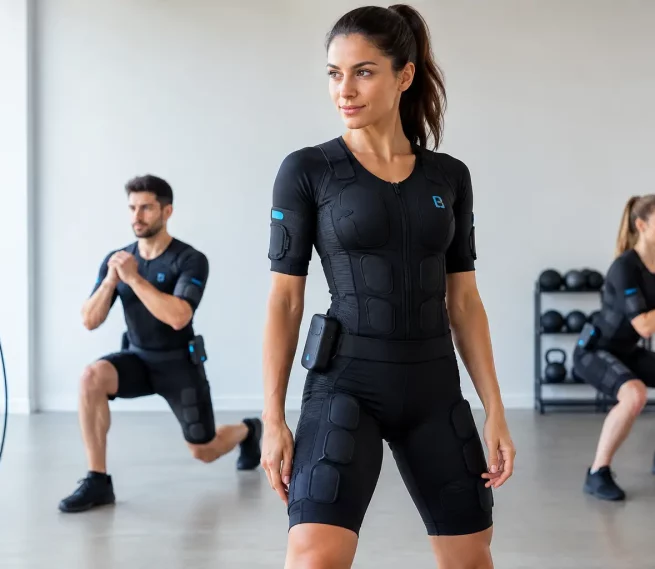
You do not need another fitness plan that looks good on paper and falls apart by week three. What most people need is a method that fits real life, respects injuries or limitations, and still delivers clear progress. That is exactly where personalised EMS personal training stands apart. It is not a generic session with wires attached. Done properly, it is a coached, goal-led training system built around your body, your schedule and your results.
For busy professionals, parents and anyone tired of wasting hours in the gym without much to show for it, that difference matters. A short session can feel far more focused than a long workout because every setting, exercise and progression is chosen with intent. You are not left guessing whether you are working hard enough or doing the right movements. You are guided through it.
What personalised EMS personal training actually means
EMS stands for Electro Muscle Stimulation. During a session, wearable equipment sends controlled electrical impulses to your muscles while you perform guided movements. Those impulses intensify muscle activation, which means more fibres are recruited than in standard low-intensity exercise alone.
That sounds technical, but the real value is simple. The training can be adapted with remarkable precision. A beginner who has not exercised consistently in years should not train like a runner preparing for an event. Someone managing lower back pain needs a different approach from a client chasing body recomposition. Personalisation is what turns EMS from an interesting piece of technology into a genuinely effective coaching method.
A proper programme starts with context. Your coach needs to know your goals, training history, lifestyle, movement quality and any issues around pain, posture or mobility. From there, session intensity, exercise selection and progression can be adjusted in a way that makes the training challenging without being reckless.
Why standard workouts often miss the mark
The problem with many mainstream fitness routines is not effort. It is mismatch. People are handed plans that do not account for their current ability, their recovery capacity or the practical limits of their week. If you are already stretched between work, family and everything else, a five-day gym split is not ambitious. It is unrealistic.
This is where personalised EMS personal training earns its place. It cuts away a lot of the wasted time. Sessions are short, but they are not light touch. You are working with close trainer support and targeted muscle activation, so the training density is high. For many clients, that means they can train consistently without trying to live like a full-time athlete.
There is also a confidence factor that people often underestimate. When a trainer is adjusting the session around how you move and respond, you stop second-guessing yourself. That matters for beginners, but it matters just as much for experienced people who have hit a plateau.
The results people usually care about most
Most clients do not walk into a studio asking for more muscle fibre recruitment. They want to feel stronger, move better, look fitter and get measurable progress. That is why a personalised approach works so well. The training is tied to outcomes people can actually feel in daily life.
For some, the headline result is body shape. Better muscle tone, fat loss and improved body composition are common goals, especially when sessions are paired with smart nutrition and consistent recovery habits. For others, the win is functional. Reduced back discomfort, better posture, stronger core control and improved mobility can have a huge impact on work, sleep and general energy.
Performance-focused clients often notice improvements in stamina, power and movement efficiency. Runners may want support around leg drive and fatigue resistance. Golfers often benefit from better rotational strength and postural control. Clients returning from injury tend to value the ability to rebuild strength in a more supervised, controlled way.
The key point is that the same technology can support very different goals. That is only possible when the programme is personalised from the start.
Coaching makes the difference
A machine on its own does not create transformation. Coaching does.
This is one of the biggest misconceptions around EMS. Some people assume it is a shortcut where the equipment does all the work. In reality, the quality of the session depends heavily on the coach leading it. Intensity needs to be set correctly. Technique still matters. Exercise choices need to reflect your body, not a script.
A strong coach will know when to push and when to pull back. If your movement quality drops, the session should be adjusted. If your confidence grows and your strength improves, the challenge should increase. That is how progress happens safely and consistently.
This is also why premium studio-based EMS training tends to produce a very different experience from a self-directed model. You are not just booking use of equipment. You are getting accountability, expertise and a structured path forwards.
It is efficient, but not magic
The time-saving appeal is real. For many people, that is the first reason they look at EMS in the first place. A shorter, focused session is far easier to fit around a demanding week than spending multiple evenings in a crowded gym.
But it is worth being honest about the trade-off. Efficiency does not mean instant results without commitment. You still need consistency. You still need recovery. You still need enough sleep and a sensible approach to food. If those pieces are ignored, no training format will fully cover for it.
What personalised EMS personal training does very well is make consistency more realistic. When sessions are manageable, coached and tied to visible progress, people are much more likely to stick with them. And sticking with the right plan beats starting and stopping with an ordinary one every time.
Who tends to benefit most
This style of training suits a wide range of people, but it is especially effective for those who need more from less time. Busy adults who struggle to train regularly often thrive because the barrier to entry is lower and the support is higher.
It is also a strong option for people who feel overlooked in traditional gyms. If you have had back pain, poor posture, low confidence or a stop-start relationship with exercise, a personalised setting can feel far more approachable. You are not expected to figure it all out on your own.
At the same time, experienced clients can use EMS to sharpen specific goals. It can complement sports performance work, add intensity without long sessions, and target weaknesses that are holding overall progress back. The method is flexible enough to support both rebuilding and progression.
Measuring progress properly
One of the reasons people lose motivation with fitness is that progress feels vague. If you are relying only on the mirror or the scales, you can miss meaningful changes in strength, posture and body composition.
A better system tracks what matters. That may include body measurements, muscle mass changes, fat reduction, movement quality and session performance over time. When clients can see objective improvement, motivation becomes a lot easier to maintain.
This is where advanced tracking tools can add real value. In a coaching environment like E-Pulse Studio, body analysis helps remove guesswork and keeps the programme focused on outcomes, not assumptions. It is easier to stay committed when the evidence is in front of you.
Is it right for everyone?
Not always, and that is worth saying plainly.
If someone loves long endurance sessions, enjoys solo gym time and is already progressing well with their current programme, they may not need EMS as their main method. Likewise, some health conditions require careful screening before training starts. A responsible studio will always assess suitability rather than pushing everyone into the same offer.
That said, many people who think they are not the type for EMS change their mind once they understand the personalisation behind it. It is not about replacing all other exercise. It is about using a highly targeted method to get better results from the time and energy you actually have.
Why the personalised part matters most
Take away the personalised coaching and EMS becomes far less compelling. The real strength of the method is not just the technology. It is the way technology and coaching work together.
When sessions are built around your needs, you get more than a hard workout. You get structure, accountability and a training plan that makes sense for your life right now. That is why people who have struggled with generic classes or inconsistent gym routines often respond so well to it.
If your goal is to feel stronger, move better and see measurable change without giving up huge chunks of your week, this approach makes a strong case for itself. The best training plan is not the one that sounds the most intense. It is the one you can follow consistently, progress safely and feel proud of month after month.
 7min
7min